
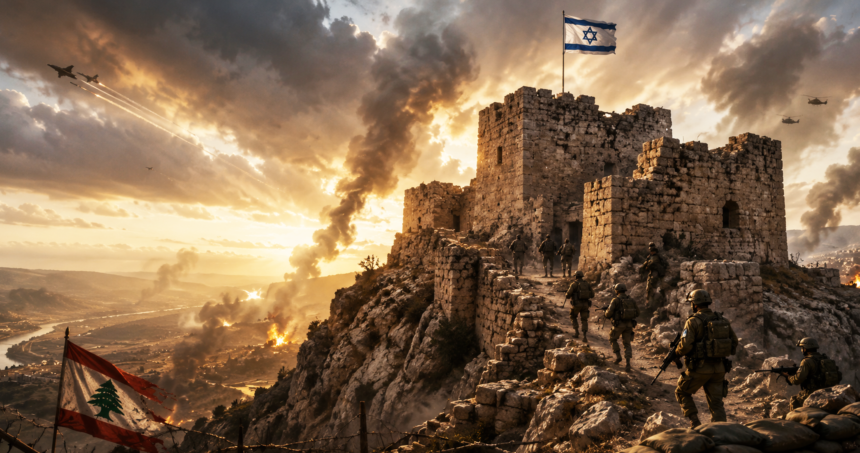
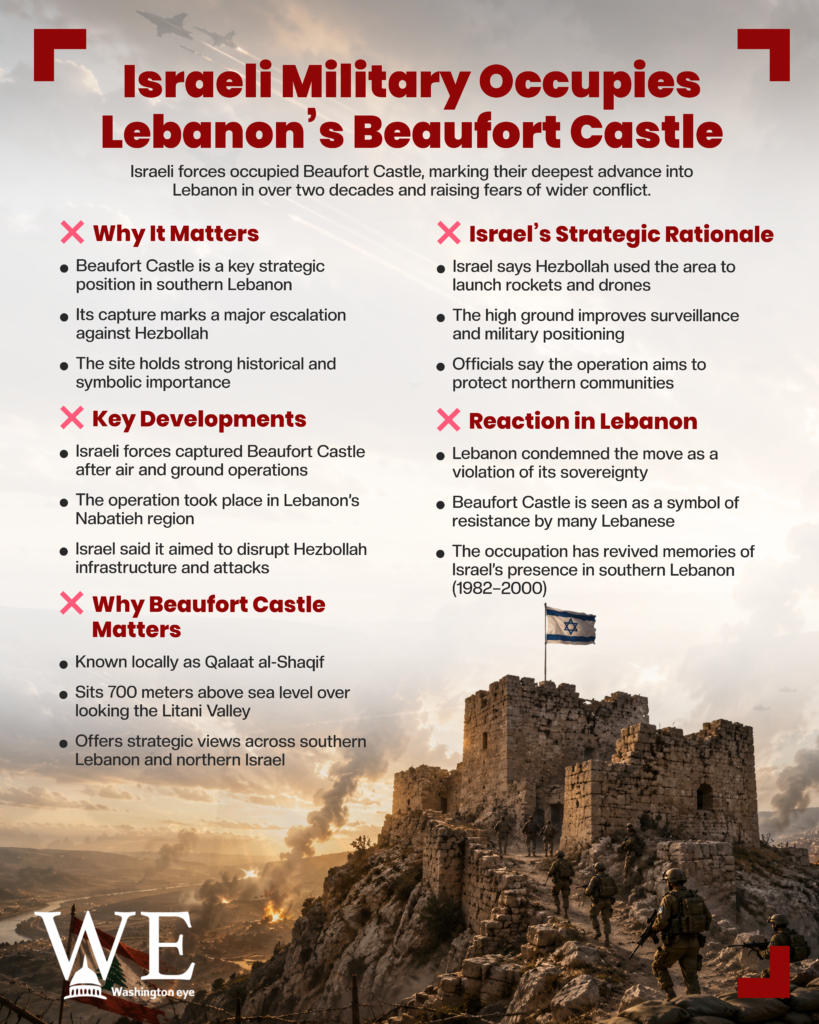
Israeli forces have occupied the historic Beaufort Castle in southern Lebanon, marking one of the deepest Israeli military advances into Lebanese territory in more than two decades and reigniting fears of a broader regional conflict. The capture of the centuries-old fortress has drawn sharp reactions across Lebanon and the Middle East, where the site carries both strategic military importance and powerful symbolic value.
Israeli troops took control of Beaufort Castle, known locally as Qalaat al-Shaqif, after several days of intense military operations, airstrikes and ground advances in the Nabatieh region of southern Lebanon. The operation forms part of Israel’s expanded campaign against Hezbollah, the Iran-backed Lebanese armed group that has been engaged in cross-border hostilities with Israel for months.
Perched atop a steep hill overlooking the Litani River valley, Beaufort Castle provides commanding views of large parts of southern Lebanon and northern Israel. Military analysts have long regarded the fortress as one of the most strategically valuable positions in the region because it allows surveillance of major transportation routes and surrounding terrain. Israeli officials say the operation was intended to dismantle Hezbollah infrastructure and prevent attacks against Israeli communities near the border.

Israeli Prime Minister Benjamin Netanyahu described the seizure of the fortress as a significant military achievement and part of a broader effort to expand operations against Hezbollah. Israeli military leaders argue that Hezbollah has used surrounding ridges and valleys to launch rockets, drones and other attacks into northern Israel. According to Israeli statements, occupying the high ground is necessary to secure border areas and weaken Hezbollah’s military capabilities.
However, the occupation has been widely condemned in Lebanon, where Beaufort Castle is viewed as a symbol of resistance against foreign occupation. The fortress was previously occupied by Israeli forces during Israel’s presence in southern Lebanon from 1982 until its withdrawal in 2000. Images of Israeli soldiers raising their flag over the castle have revived painful memories among many Lebanese who lived through years of conflict and occupation.
Residents of nearby villages have reported renewed displacement as military activity intensified across the region. Many families have fled their homes amid fears of further bombardment and clashes. Humanitarian organizations have expressed concern about civilian casualties, damage to infrastructure and the growing number of displaced people across southern Lebanon. Several towns and villages in the south have experienced repeated airstrikes in recent weeks, adding to an already fragile humanitarian situation.
The latest escalation comes despite previous ceasefire efforts aimed at reducing tensions along the Israel-Lebanon border. Lebanese officials have accused Israel of expanding its military footprint inside the country and violating Lebanese sovereignty. Hezbollah, while acknowledging the significance of the castle’s occupation, has vowed continued resistance and warned that military advances will not alter the broader balance of the conflict.

International concern has also intensified. France and other diplomatic actors have called for urgent efforts to prevent further escalation, while humanitarian agencies continue to warn about the impact on civilians. Analysts note that the occupation of Beaufort Castle is not only a military development but also a symbolic one, given the fortress’s long history as a contested stronghold. Over the centuries, it has been controlled by Crusaders, Muslim rulers, Palestinian fighters, Israeli forces and Hezbollah, making it one of the most politically charged landmarks in the Levant.
The fortress itself dates back to the medieval era and stands approximately 700 meters above sea level. Its commanding location has repeatedly turned it into a battleground during regional wars. During the 1982 Lebanon War, Israeli forces captured the castle from Palestinian fighters, and it later became a major military outpost until Israel’s withdrawal in 2000. Today, its recapture once again places the fortress at the center of Middle Eastern geopolitics.
As fighting continues across southern Lebanon, the future of Beaufort Castle remains uncertain. Whether the occupation proves to be a temporary tactical gain or a longer-term military presence may depend on the course of the conflict in the weeks ahead. For many Lebanese, however, the sight of foreign troops occupying one of the country’s most iconic landmarks has already become a powerful reminder of a turbulent past that continues to shape the present.