A public dispute between United States President Donald Trump and Italian Prime Minister Giorgia Meloni over photographs taken at the Group of Seven summit has developed into a wider diplomatic confrontation, exposing growing disagreements between two leaders once presented as natural political allies.
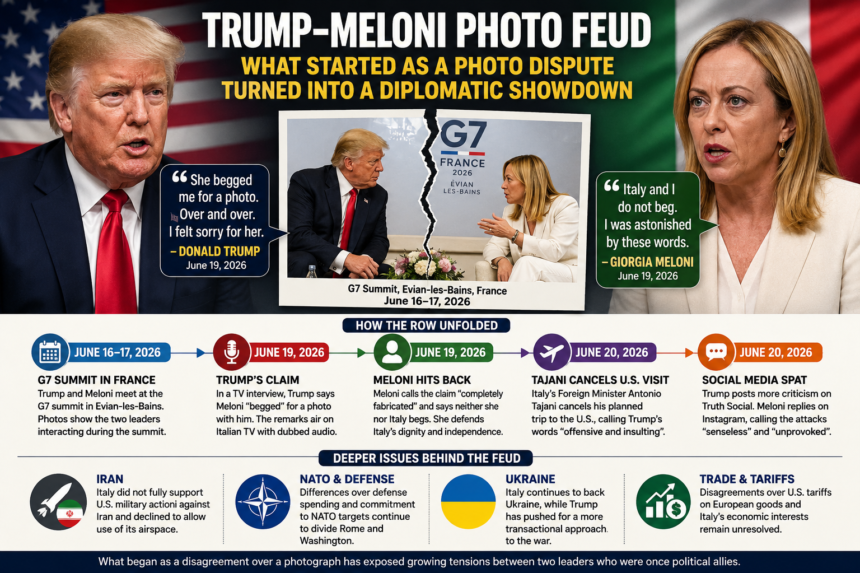
The row centres on meetings held during the G7 summit in Evian-les-Bains, France, on June 16 and 17, 2026. Trump and Meloni were photographed speaking during a working lunch, after the summit’s group photograph and while seated together on a small sofa. The images initially appeared to show contact between allied leaders attending discussions on Ukraine, European security and the Middle East.
The controversy erupted on June 19 after an interview with Italian broadcaster La7 aired in which Trump claimed Meloni had strongly wanted a photograph with him. He said she had “begged” for the picture and suggested he agreed because he felt sorry for her. According to the Associated Press, La7 published a dubbed version of the exchange rather than the original English audio, but the remarks quickly circulated through Italian and international media.
Meloni responded with an unusually direct video statement, calling Trump’s account “completely fabricated” and saying she was stunned that the American president would speak that way about an ally. She declared that neither she nor Italy begged and criticised Trump for appearing tougher with Western partners than with leaders considered adversaries of the United States and Europe.
Instead of allowing the issue to fade, Trump intensified the argument on June 20 through his Truth Social platform. He claimed Meloni had asked “over and over” for a photograph and alleged that she wanted to repair relations with Washington to improve her domestic popularity. Trump linked the photo dispute to Italy’s refusal to fully support United States military action against Iran and complained that Rome had not allowed American forces to use Italian runways as requested.
Meloni replied in English on Instagram, describing the attacks as unprovoked and senseless. She said her popularity depended on defending Italy’s national interest, not on her relationship with Trump, and added that being considered his friend had not helped her politically. In one of her sharpest remarks, she told Trump that her popularity was none of his concern and suggested that he focus on his own.
The disagreement produced immediate diplomatic consequences. Italian Foreign Minister and Deputy Prime Minister Antonio Tajani cancelled a planned visit to the United States, saying Trump’s words were serious, offensive and insulting to the whole country. A business and scientific forum in Miami that Tajani was expected to attend was also cancelled. Ministers from Meloni’s coalition rallied around her, while several opposition politicians said that political differences at home did not justify a foreign leader humiliating Italy.

The feud is significant because Meloni had spent considerable effort positioning herself as a bridge between the Trump administration and the European Union. She met Trump at Mar-a-Lago before his 2025 inauguration and was the only European Union leader to attend the ceremony. Trump previously praised her as a strong leader and close friend, while their parties shared conservative positions on migration, national sovereignty and traditional values.
However, their relationship had already weakened before the photograph dispute. Italy has continued supporting Ukraine, opposed threats against Greenland and disagreed with Washington over tariffs, Gaza and the war involving Iran. Meloni also defended Pope Leo XIV after Trump criticised the pontiff’s antiwar views. These disagreements challenged the idea that ideological similarity would automatically produce a stable partnership.
The reports reviewed do not independently establish who requested a specific photograph at the summit. Available press images show Trump and Meloni interacting in several settings, but they do not prove either leader’s version of the private exchange. The dispute therefore rests largely on conflicting personal accounts, amplified through television interviews and social media posts.
What might normally have remained a minor argument over diplomatic protocol has consequently become a test of national dignity and alliance management. The episode shows how personal claims can rapidly affect official relations when leaders conduct diplomacy publicly and online. It also raises questions about whether the Trump-Meloni partnership can recover while deeper disagreements over war, security, trade and Europe’s relationship with Washington remain unresolved.