For nearly two decades, Cristiano Ronaldo and Lionel Messi have dominated football, broken records and inspired one of the fiercest debates in sporting history. From classrooms and cafés to stadiums and social media, supporters continue to argue over one seemingly impossible question: Who is the greatest of all time? Although both superstars are approaching the end of their playing careers, the Ronaldo-versus-Messi craze remains a global cultural phenomenon.
The rivalry began taking shape in the mid-2000s, when Messi emerged from Barcelona’s famous La Masia academy and Ronaldo became a star at Manchester United. However, it reached another level in 2009, when Ronaldo moved from United to Real Madrid for a then-world-record transfer fee of £80 million. With Messi leading Barcelona and Ronaldo representing their greatest rivals, almost every El Clásico became a worldwide spectacle.
Between 2009 and 2018, the two regularly competed for Spain’s La Liga title, the UEFA Champions League, the European Golden Shoe and the Ballon d’Or. Their contrasting styles strengthened the rivalry. Messi, the left-footed Argentine playmaker, became famous for close control, dribbling, passing and the ability to create goals from apparently impossible positions. Ronaldo, the powerful Portuguese forward, built his reputation through speed, aerial ability, athleticism, finishing and extraordinary discipline.
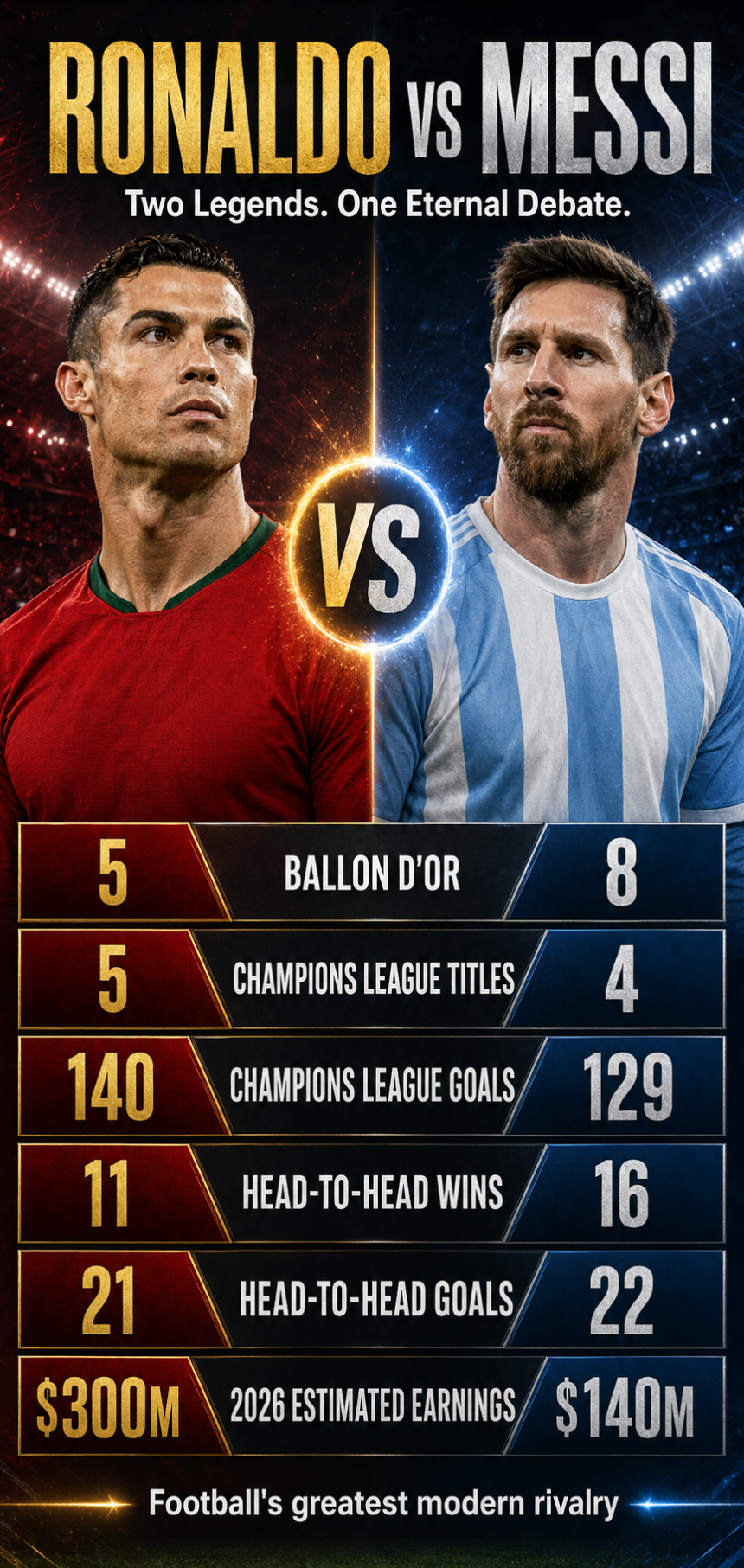
Their individual contest produced remarkable numbers. Ronaldo remains the UEFA Champions League’s record scorer with 140 goals, ahead of Messi’s 129. He has won the Champions League five times, while Messi has lifted the trophy four times. Messi, however, leads the Ballon d’Or race with a record eight awards, compared with Ronaldo’s five. The pair dominated the honour so completely that only Luka Modrić interrupted their joint winning run between 2008 and 2017. UEFA’s official records reflect the extraordinary length of their supremacy.

The stars have faced each other 36 times for their clubs and national teams. According to UEFA’s recorded comparison, Messi’s teams won 16 of those matches, Ronaldo’s won 11 and the remaining nine ended in draws. Messi scored 22 goals in those encounters, narrowly ahead of Ronaldo’s 21. One of their most memorable meetings was the 2009 Champions League final in Rome, where Messi scored as Barcelona defeated Ronaldo’s Manchester United 2–0. UEFA’s head-to-head account also recalls their dramatic Champions League clashes involving Barcelona, Real Madrid and Juventus.
Their international careers added another dimension. Ronaldo helped Portugal win Euro 2016 and two UEFA Nations League titles, while becoming the leading scorer in men’s international football. Messi’s long wait for a senior international trophy ended with the 2021 Copa América, followed by Argentina’s celebrated 2022 FIFA World Cup victory and another Copa América triumph in 2024. For many Messi supporters, the World Cup settled the debate; Ronaldo’s admirers respond by highlighting his goal record, longevity and success in England, Spain and Italy.
The rivalry has also become a commercial empire. Ronaldo’s CR7 brand, endorsements and enormous social-media following have made him one of the world’s most marketable individuals. Messi has similarly secured major partnerships and transformed interest in Major League Soccer after joining Inter Miami. Forbes estimated Ronaldo’s earnings at $300 million and Messi’s at $140 million in its 2026 ranking of the world’s highest-paid athletes, demonstrating how their influence extends far beyond football.

Their journeys have taken them across the sporting world. Ronaldo has represented Sporting CP, Manchester United, Real Madrid, Juventus and Al-Nassr, while Messi has played for Barcelona, Paris Saint-Germain and Inter Miami. Their arrivals have increased ticket demand, shirt sales, television audiences and online engagement in every league they entered.
Ultimately, the craze survives because Ronaldo and Messi represent two different versions of footballing greatness: one shaped by relentless physical development and ambition, the other associated with natural creativity and artistic brilliance. The argument may never produce a universally accepted winner, and that is precisely why it remains so powerful. Rather than diminishing either player, the rivalry pushed both towards unprecedented heights and gave football supporters an era they may never witness again.