

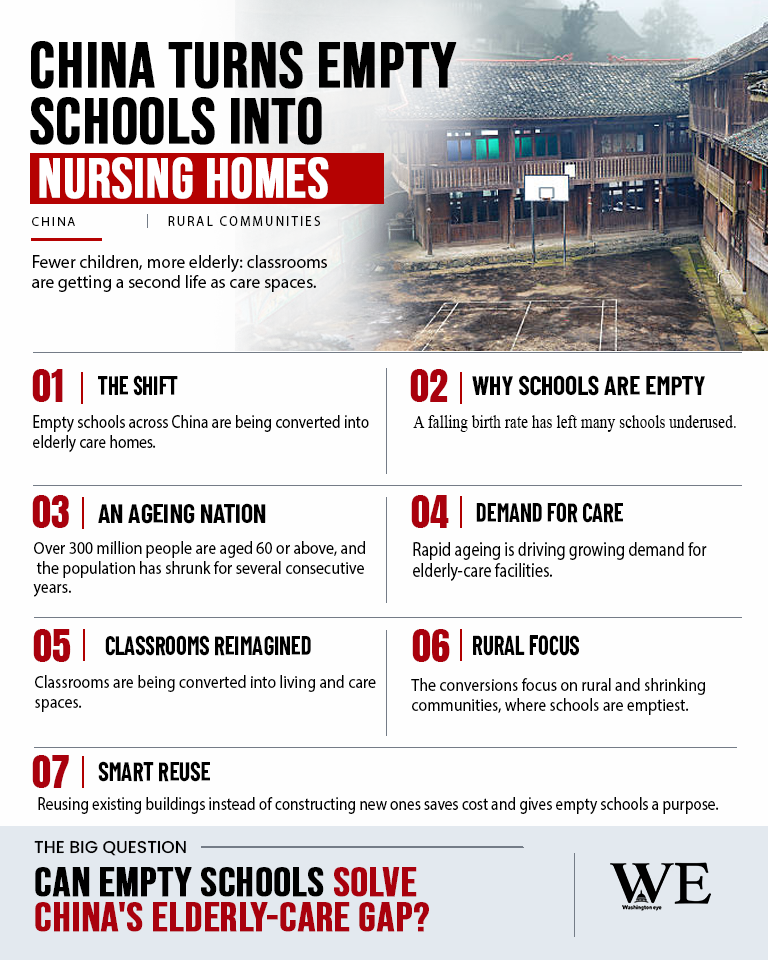
China is transforming abandoned schools and kindergartens into nursing homes, elderly care centres and community dining facilities as the world’s second-most populous country confronts a rapidly ageing society and a prolonged decline in birth rates. The initiative, gaining attention across several Chinese provinces in 2026, reflects a significant demographic transformation, with classrooms once occupied by children increasingly being repurposed to accommodate elderly residents. The development highlights China’s growing challenge of balancing shrinking demand for educational facilities with increasing pressure on healthcare, pensions and long-term elderly care services.
According to figures released by China’s Ministry of Education, primary school admissions and preschool enrolments each declined by approximately 10% in 2025. The total number of educational institutions fell by more than 6% to approximately 440,700 nationwide. Meanwhile, the number of primary schools dropped from around 158,000 in 2020 to 128,300 in 2025, representing a reduction of nearly 29,700 schools over five years. These closures, combined with rural-to-urban migration and falling fertility rates, have left numerous educational buildings vacant, prompting local authorities to explore alternative uses.
From Classrooms to Elderly Care Facilities

The transformation is taking place across different regions, particularly in rural communities where declining school enrolment has forced smaller institutions to close or merge. Reports have identified projects in Shaanxi and Fujian provinces, where unused school premises are being adapted into nursing homes, senior activity centres and communal dining facilities. Rather than allowing public buildings to deteriorate, local administrations are seeking to utilise existing infrastructure to provide essential services for older residents.
In Qingdao, Shandong province, authorities have advanced a project to convert a former kindergarten into an integrated medical and elderly care institution with a planned capacity of 153 beds. Such developments illustrate how China’s demographic changes are influencing public infrastructure, local investment and community planning. Former classrooms can accommodate recreational activities, communal meals and care services, although residential nursing facilities require substantial modifications to meet medical and accessibility standards.

The shift comes as China’s elderly population continues to expand. By the end of 2025, approximately 323 million people were aged 60 or above, accounting for roughly 23% of the country’s population. Government estimates also indicate that around 35 million elderly people require long-term care because of disabilities or reduced independence. These figures demonstrate the growing demand for affordable and accessible services, particularly in rural areas where younger generations have migrated to cities for employment.
China’s demographic difficulties have developed over several decades. The country’s former one-child policy, introduced nationally around 1980 and replaced with a two-child policy in 2016, contributed to smaller family sizes. Authorities subsequently permitted three children per family in 2021 and introduced measures intended to encourage childbirth. However, rising living costs, expensive housing, childcare pressures, changing social expectations and delayed marriages have continued to influence family planning decisions.
Official figures further reveal that China recorded just 7.92 million births in 2025, compared with 11.31 million deaths, resulting in a population decline of approximately 3.39 million. The country has now experienced four consecutive years of population contraction, raising concerns about future labour shortages, slower economic growth and increasing pressure on its pension system.

Government Response, Economic Impact and Future Challenges
The Chinese government has recognised elderly care as an increasingly important national priority. Under its 15th Five-Year Plan covering 2026–2030, Beijing intends to expand community-based care, improve nursing facilities and strengthen support for elderly citizens living alone or requiring specialised assistance. Authorities aim to ensure that 70% of villages and communities have nearby access to elderly care facilities by 2030, while nursing beds are expected to represent 73% of institutional elderly care capacity.
However, converting schools into nursing homes presents financial, administrative and safety challenges. Research published in June 2026 in the Journal of Architecture and Planning identified obstacles involving building regulations, wheelchair accessibility, elevators, evacuation routes and renovation costs. Researchers emphasised that converting educational buildings into residential care institutions requires appropriate safety standards, financial support and regulatory approval.
The transformation also raises broader questions about China’s economic future. A declining working-age population could reduce tax revenues while increasing demand for healthcare and social protection. At the same time, repurposing unused schools may create employment opportunities in nursing, rehabilitation, community services and elderly care, contributing to China’s expanding silver economy.
Nevertheless, the conversions represent only one response to a much larger demographic challenge. China must simultaneously improve elderly care, support families considering parenthood and address regional inequalities in public services. The sight of former classrooms becoming nursing homes illustrates how profoundly the country’s population structure is changing, with infrastructure originally built for younger generations increasingly serving an ageing society.