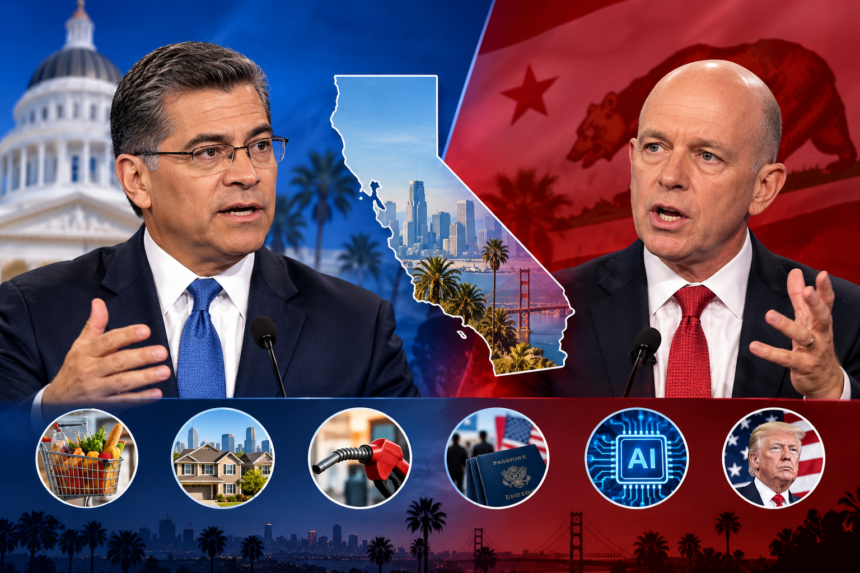
Democrat Xavier Becerra and Republican Steve Hilton traded sharp attacks over California’s cost of living, immigration, taxes, homelessness and President Donald Trump on Wednesday night, as the two candidates met in what is expected to be their only televised debate before the November 3 gubernatorial election.
The hour-long CNN California Governor Debate, held on September 30 at CNN’s studio in Burbank, was moderated by Jake Tapper and Dana Bash. Becerra and Hilton are competing to succeed Democratic Governor Gavin Newsom, who cannot seek another term because of California’s term limits.
The encounter came at a critical point in the campaign, just before mail ballots begin reaching California voters. It also offered a rare direct confrontation between Becerra, who has maintained a comparatively low-profile campaign since winning the June primary, and Hilton, who has travelled extensively across the state presenting himself as an outsider challenging years of Democratic control.

Affordability, Taxes and California’s Direction
The high cost of living dominated much of the debate. Hilton argued that years of Democratic control in Sacramento had contributed to expensive housing, high taxes, energy costs and homelessness. He promoted his “Califordable” economic plan, including eliminating state income tax on the first $150,000 of earnings and reducing regulations that he says increase the cost of housing and business.

Becerra challenged the financial viability of Hilton’s proposal, arguing that large reductions in state revenue could eventually affect funding for schools, healthcare and other public services. He instead called for cutting regulatory barriers to housing while arguing that federal policies, including tariffs and the conflict involving Iran, had contributed to rising prices.
The two candidates also presented contrasting approaches to housing. Hilton argued that California needs dramatic deregulation to increase construction and floated the development of 10 new cities, while Becerra advocated speeding housing construction by reducing bureaucratic obstacles without embracing Hilton’s broader tax-cutting approach.
President Trump became one of the debate’s most persistent themes. Becerra repeatedly connected Hilton to Trump, whose endorsement Hilton received during the primary. He argued that Hilton’s approaches to taxation, immigration, energy and other issues reflected Trump administration policies.

Hilton pushed back, accusing Becerra of focusing excessively on national politics rather than California’s longstanding problems. He instead sought to connect Becerra with Newsom and the Democratic-controlled state government, arguing that voters should judge Democrats on the state’s affordability, homelessness and regulatory record.
Immigration, AI and Homelessness Fuel Heated Exchanges
Immigration produced some of the evening’s most personal exchanges. Hilton attacked Becerra’s record as U.S. Health and Human Services secretary under President Joe Biden, focusing on the federal government’s handling of unaccompanied migrant children. Previous investigations have documented cases in which migrant children released to sponsors subsequently ended up working illegally in dangerous jobs. Becerra defended his department’s actions and said officials had worked to vet sponsors amid limited resources and significant migration pressures.
Becerra, whose parents immigrated from Mexico, then accused Hilton of supporting an immigration approach that treated immigrants differently depending on their backgrounds. Hilton rejected the accusation as disgraceful and said immigration enforcement should prioritise dangerous criminals. Artificial intelligence also emerged as an important California-specific issue because the state is home to many of the world’s largest technology and AI companies.
Both candidates expressed support for some regulation, but differed over its form. Becerra called for enforceable protections around AI and data centres, including consideration of their effects on jobs, electricity and water. Hilton said California should lead on AI while avoiding regulations that could drive companies and investment to states such as Texas or Arizona.
The candidates found occasional common ground. Both oppose Proposition 40, a proposed one-time 5% tax on billionaire wealth. They differed on Proposition 39, a voter-identification measure: Hilton supports it, while Becerra opposes it.
Polls, Impact and the Critical View
Becerra entered the debate with a substantial advantage in one major statewide survey. A UC Berkeley Institute of Governmental Studies poll, conducted September 15–20 among California likely voters and co-sponsored by the Los Angeles Times, showed Becerra at 58% and Hilton at 33%. The poll also found the high cost of living was voters’ leading concern.
Those figures describe voter preferences at the time of the survey rather than predict the election result. The debate therefore carried different strategic stakes for each campaign: Hilton had an opportunity to introduce his argument for political change to a statewide television audience, while Becerra faced scrutiny over his record and comparatively limited public campaigning.
The debate also revealed a broader tension in California politics. Hilton framed the election primarily as a referendum on Democratic governance of the state, while Becerra repeatedly framed it through California’s relationship with the Trump administration. That left voters with two competing explanations for California’s problems, one centred on Sacramento and another that placed greater emphasis on federal policy.
Some post-debate coverage noted that the confrontation produced plenty of attacks but fewer detailed answers about how either candidate would overcome the financial and political obstacles facing their proposals. The Associated Press described the candidates as offering sharply different approaches, while CalMatters highlighted how heavily Trump dominated the discussion.
With no additional debate currently scheduled, Wednesday’s encounter may be the only extended side-by-side comparison Californians receive before Election Day. The central choice presented during the debate was clear even if many implementation details remained unresolved: Becerra argued for experienced Democratic leadership capable of resisting federal policies he says hurt California, while Hilton presented himself as an agent of structural change after years of Democratic dominance. Whether the contentious hour changes voter preferences will become clearer in post-debate polling. For now, the November 3 election remains the final test of which argument California voters find more persuasive.