Saudi Arabia’s air-defence network is facing one of its toughest tests as Yemen’s Houthi movement expands its missile and drone campaign against the kingdom. The repeated strikes on airports have exposed the risks facing civilian infrastructure when regional conflicts spill across borders.
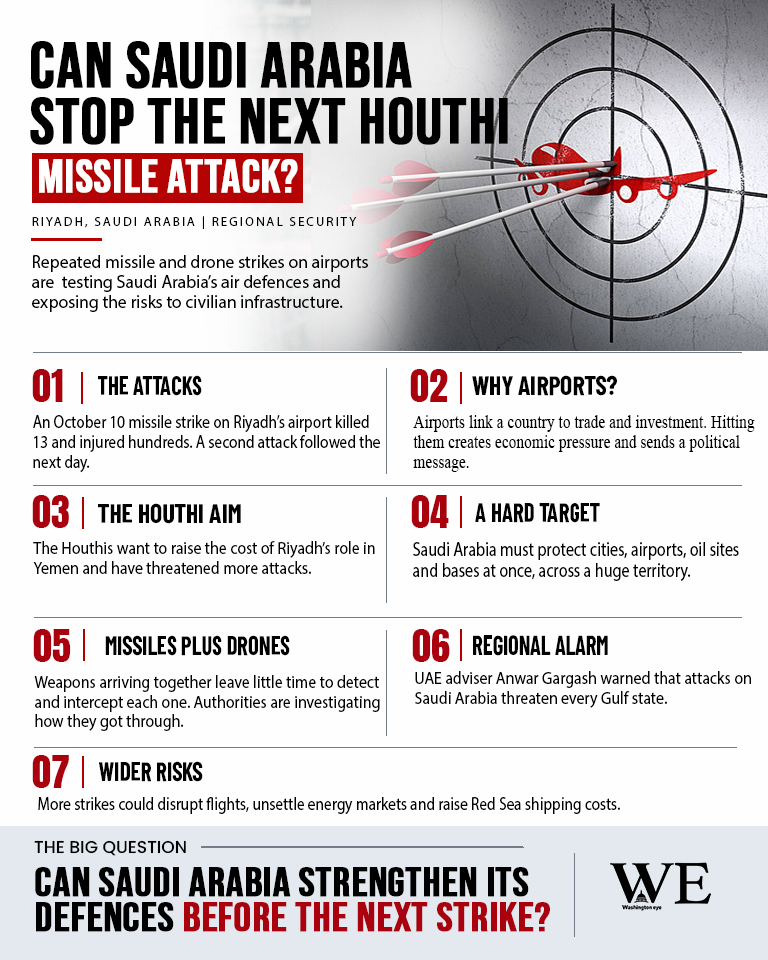
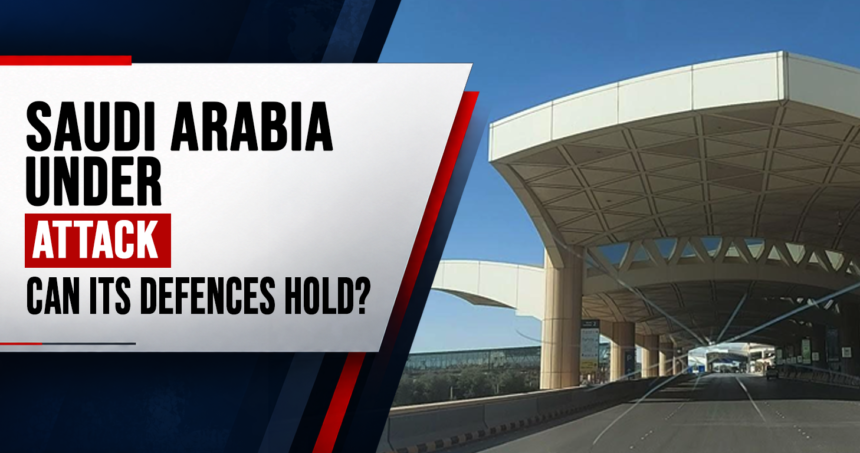
The latest escalation has centred on King Khalid International Airport in Riyadh. A missile strike on Saturday, October 10, killed 13 people and injured hundreds, according to Saudi authorities. Another attack the following day killed one person and injured 11. The strikes forced airport operations to halt and disrupted flights, leaving passengers and airlines facing fresh uncertainty.
Why are airports being targeted?
Airports carry significance beyond passenger travel. They connect a country to international business, tourism and investment. Disrupting them creates immediate economic pressure and sends a powerful political message.
The Houthis have also targeted Saudi oil facilities and other strategic locations. The campaign comes as Saudi-backed Yemeni government forces attempt to reverse Houthi territorial gains, including around the Bab al-Mandab Strait, a critical gateway between the Red Sea and the Gulf of Aden.
For the Houthis, striking Saudi territory raises the cost of Riyadh’s involvement in Yemen. The group has threatened further attacks unless Saudi Arabia ends its military campaign and interference in the country.
Why are Saudi defences struggling?
Saudi Arabia has invested heavily in advanced military equipment, but even sophisticated air-defence systems have limits. Defending a large territory means monitoring multiple approaches while protecting cities, airports, oil installations and military bases simultaneously.
Missiles and drones also present different challenges. Some fly at high speeds, while others can approach at lower altitudes. When several weapons arrive close together, defenders may have little time to detect, classify and intercept every threat.
More Read

The latest attacks have prompted Saudi Arabia to investigate how projectiles reached the airport. Reports indicate that drones may have accompanied the missile assault, although the precise sequence and the reasons for the defensive failure remain under investigation. Cite refs={[“turn483460news14″,”turn483460news6”]}/>
A crisis beyond Saudi Arabia
The consequences could extend across the Gulf. On Monday, UAE presidential adviser Anwar Gargash called for stronger regional defence cooperation, warning that attacks on Saudi Arabia threaten the security of all Gulf states. Cite ref=”turn483460news1″/>
The economic risks are equally serious. Further attacks could disrupt aviation, unsettle energy markets and raise shipping costs if insecurity spreads towards Red Sea trade routes.
What comes next?
Saudi Arabia is likely to strengthen surveillance, improve early-warning systems and continue targeting Houthi military infrastructure. The Houthis, meanwhile, have shown no clear sign of abandoning their campaign.
The danger is that each new strike could trigger a stronger response, widening a conflict already tied to tensions involving Iran and the United States.
The central challenge for Riyadh is no longer simply intercepting individual missiles. It is preventing a sustained campaign from turning airports, energy facilities and vital trade routes into recurring targets.