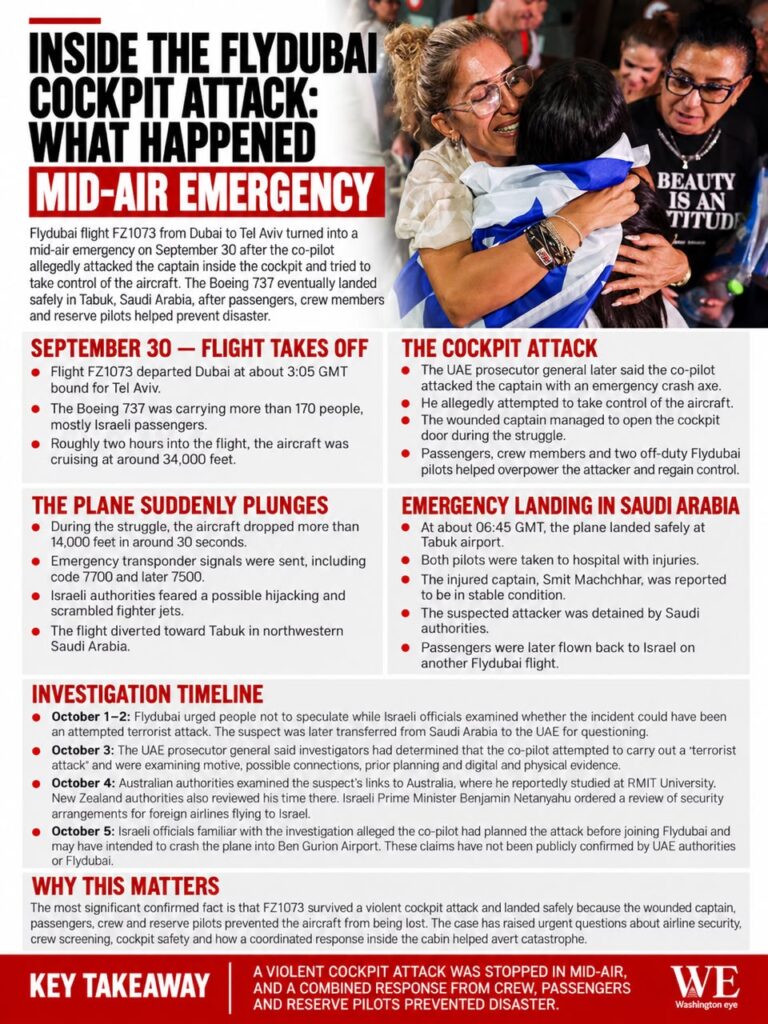

A routine Flydubai flight from Dubai to Tel Aviv turned into a terrifying mid-air emergency on September 30, after the co-pilot allegedly attacked the captain inside the cockpit and tried to take control of the aircraft.
Flight FZ1073 was carrying more than 170 people when the incident began. The aircraft eventually made an emergency landing in Tabuk, Saudi Arabia, after passengers, crew members and reserve pilots helped regain control.
Here is the timeline of what happened and how the investigation has developed.
September 30 – Flight Takes Off
Flydubai flight FZ1073 departed Dubai at about 3:05 GMT, bound for Tel Aviv. The Boeing 737 was carrying mostly Israeli passengers.
The Cockpit Attack
About two hours into the flight, the aircraft was cruising at roughly 34,000 feet when a violent struggle reportedly broke out in the cockpit.

According to later statements from the UAE prosecutor general, the co-pilot attacked the captain with an emergency crash axe and attempted to take control of the aircraft.
The wounded captain nevertheless managed to open the cockpit door. Passengers and crew members rushed forward and helped overpower the attacker. Two off-duty Flydubai pilots who were travelling on the aircraft then helped take control of the plane.
The Plane Suddenly Plunges
During the struggle, the aircraft dropped more than 14,000 feet in around 30 seconds, creating panic among passengers. Emergency signals were transmitted, including the 7700 general emergency code and later 7500, which indicates unlawful interference.
Israeli authorities feared a possible hijacking and scrambled fighter jets as the aircraft diverted toward Saudi Arabia.
Emergency Landing in Saudi Arabia
At about 06:45 GMT, the plane landed safely at Tabuk airport in northwestern Saudi Arabia. Both pilots were taken to hospital with injuries. The injured captain was later identified as Indian national Smit Machchhar, who was reported to be in stable condition.
The suspected attacker was detained by Saudi authorities.
Passengers were later transported back to Israel on another Flydubai flight.
October 1–2 – Investigation Expands
Initially, Flydubai urged people not to speculate about the motive, saying the circumstances were still being investigated. Israeli officials, however, began examining whether the incident could have been an attempted terrorist attack.
The suspect was subsequently transferred from Saudi Arabia to the United Arab Emirates for questioning.

October 3 — UAE Calls It a Terrorist Attack
The UAE prosecutor general said investigators had determined that the co-pilot attempted to carry out a “terrorist attack.” Officials said he used the emergency axe against the captain and tried to take control of the aircraft.
Investigators said they were examining his motive, possible connections, prior planning and digital and physical evidence.
October 4 — International Investigation
The investigation widened beyond the UAE and Israel.
Australian authorities confirmed they were examining the co-pilot’s links to Australia. He had reportedly studied at RMIT University in Melbourne. New Zealand authorities also confirmed they were looking into his time in the country.
Israeli Prime Minister Benjamin Netanyahu also ordered a review of security arrangements for foreign airlines operating flights to Israel.
October 5 — New Allegations Emerge
The latest development has significantly changed the picture.
According to two Israeli officials familiar with the investigation, the co-pilot told UAE interrogators that he had planned the attack before joining Flydubai. Another source said he had allegedly intended to crash the September 30 flight into Ben Gurion Airport.
The same source alleged that he had previously operated a Tel Aviv-bound flight and considered carrying out a similar attack but abandoned the plan. These claims have not been publicly confirmed by UAE authorities or Flydubai.
Reports have also identified the suspect as Omani national Hamam al-Hammami, although UAE authorities and Flydubai have not publicly confirmed his identity.
For now, the most significant confirmed fact is that FZ1073 survived a violent cockpit attack and landed safely because the wounded captain, passengers, crew and reserve pilots managed to prevent the aircraft from being lost. The investigation is continuing across several countries, while authorities work to establish exactly how the attack was planned and whether further security failures were involved.