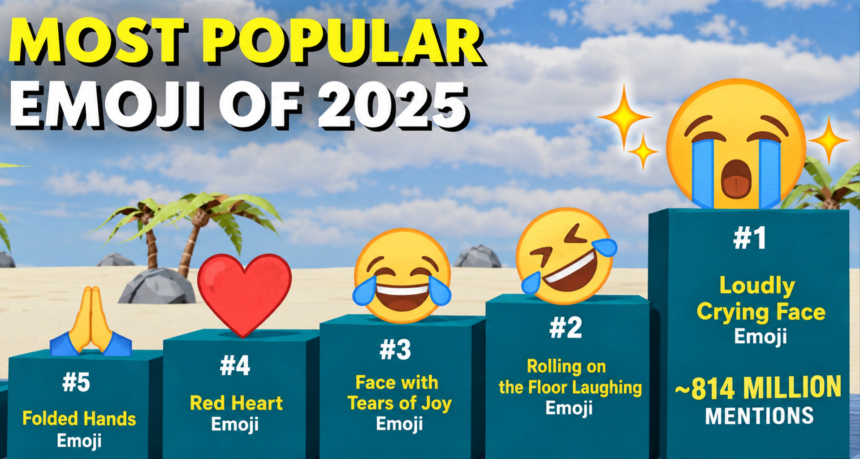
The “Loudly Crying Face” 😭 emerged as the most-used emoji on social media in 2025, reflecting a striking change in the way internet users, particularly younger generations, express laughter, sadness and emotional overload online
According to an analysis published by media and social intelligence company Meltwater, 😭 accumulated approximately 814 million social-media mentions between January 1 and December 15, 2025, putting it ahead of other major emojis across the platforms included in the study. The analysis examined leading emojis across more than a dozen social and digital platforms, including X, Reddit, Instagram, Facebook and Pinterest.
The result may initially seem surprising. Officially called the “Loudly Crying Face,” 😭 was designed to depict intense sadness, with tears streaming from both eyes. But internet culture has dramatically expanded its meaning. Today, someone replying “😭😭😭” may not be upset at all. They could be laughing uncontrollably, reacting to an adorable animal, expressing embarrassment or simply saying that something is emotionally overwhelming. That flexibility appears to be a major reason behind its extraordinary popularity.
From Sadness to Laughter: Why 😭 Became No. 1
The rise of 😭 did not happen overnight. Meltwater reported that it had already overtaken the famous 😂 “Face with Tears of Joy” in 2024 after ranking second in 2023. Its continued dominance in 2025 suggests that a broader change in digital language is taking place. For years, 😂 was virtually synonymous with online laughter. It became so culturally significant that Oxford Dictionaries selected it as its 2015 Word of the Year. But younger internet users increasingly began using 😭 to communicate an even more exaggerated version of laughter, something closer to “I’m crying,” “I can’t handle this” or “this is too funny.”

This change has been heavily associated with Gen Z communication and meme culture. Rather than giving 😭 one fixed definition, users employ it to intensify almost any emotion. The demographic numbers reinforce that generational influence. Meltwater’s analysis found that around 74% of 😭 usage within its age analysis came from users aged 18–24. About 452 million mentions were associated with female-identified users, making the emoji particularly prominent among younger female audiences. Memes have helped accelerate the transformation. A ridiculous video, an awkward celebrity moment, a cute animal or a sarcastic comment can all receive the same 😭 response. The emoji works because the surrounding conversation explains whether those tears mean sadness, laughter, affection or disbelief.
Different Countries and Platforms Have Different Favourites
Although 😭 topped Meltwater’s overall social-media analysis, the findings also demonstrate that there is no single emoji dominating every corner of the internet. On X, 😭 accounted for 25.4% of the share of voice among the emojis examined, narrowly ahead of 🔥 at 22%. On Reddit, 😭 and 😂 were almost level, each accounting for roughly 30%. YouTube users showed a different preference altogether: ❤️ was the leading emoji there, with about 34% share of voice. Meanwhile, 🔥 was particularly strong on Twitch, and ⭐ stood out on Sina Weibo.
Geography produced similar differences. Meltwater found that 😂 remained the most-mentioned of the studied emojis in the United States, United Kingdom, Canada, Nigeria and Ghana. 🔥 led in India, while 😭 was particularly dominant in South Africa, Indonesia and the Philippines. This is an important distinction when calling 😭 the “most popular emoji of 2025”: it was the overall winner in Meltwater’s social-media dataset, rather than necessarily being the most frequently typed emoji in every country, application or private message.

Interestingly, 😭 did not dominate every month either. The 🔥 Fire emoji gained considerable momentum during the second half of the year and temporarily moved into the top position in September and again around the beginning of December. High-profile social-media posts, including posts associated with football star Cristiano Ronaldo, contributed to the visibility of 🔥.
Emojis Are Becoming a Language of Their Own
The 2025 ranking tells a bigger story than simply which yellow face received the most mentions. Emojis increasingly function as a constantly evolving digital language. Their meanings are not determined solely by their official names or original designs. Instead, memes, generations, online communities and cultural trends can completely transform how a symbol is understood. 😭 may be the clearest example. A pictograph originally intended to represent intense crying is now routinely used to communicate hysterical laughter, affection, disbelief and emotional overload.
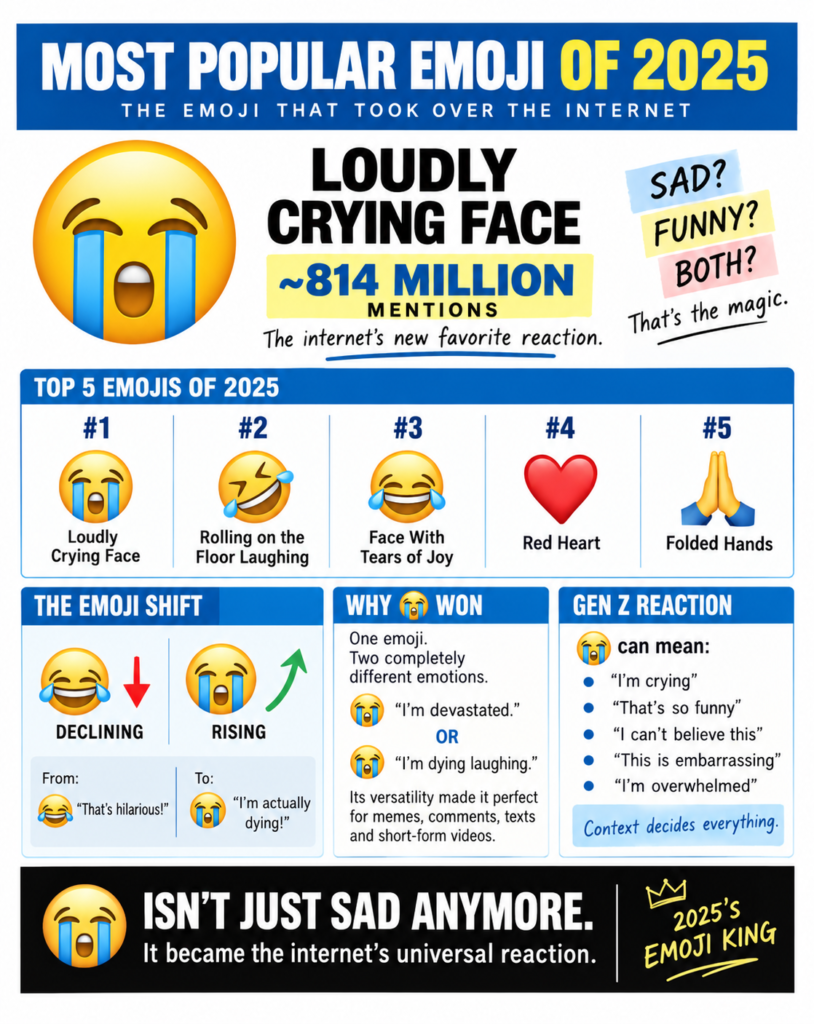
The shift also highlights how difficult it can be for brands, advertisers and even older internet users to interpret younger audiences simply by looking at an emoji’s literal meaning. Meltwater argues that emoji usage varies substantially according to age, platform, gender and location, making context increasingly important in online communication. For now, the internet appears to be crying, but not necessarily because it is sad. With approximately 814 million social-media mentions, 😭 captured the mood of 2025 precisely because it could mean almost anything: “That’s heartbreaking,” “That’s adorable,” “I can’t believe this,” or, perhaps most importantly, “I’m laughing so hard I’m crying.”