

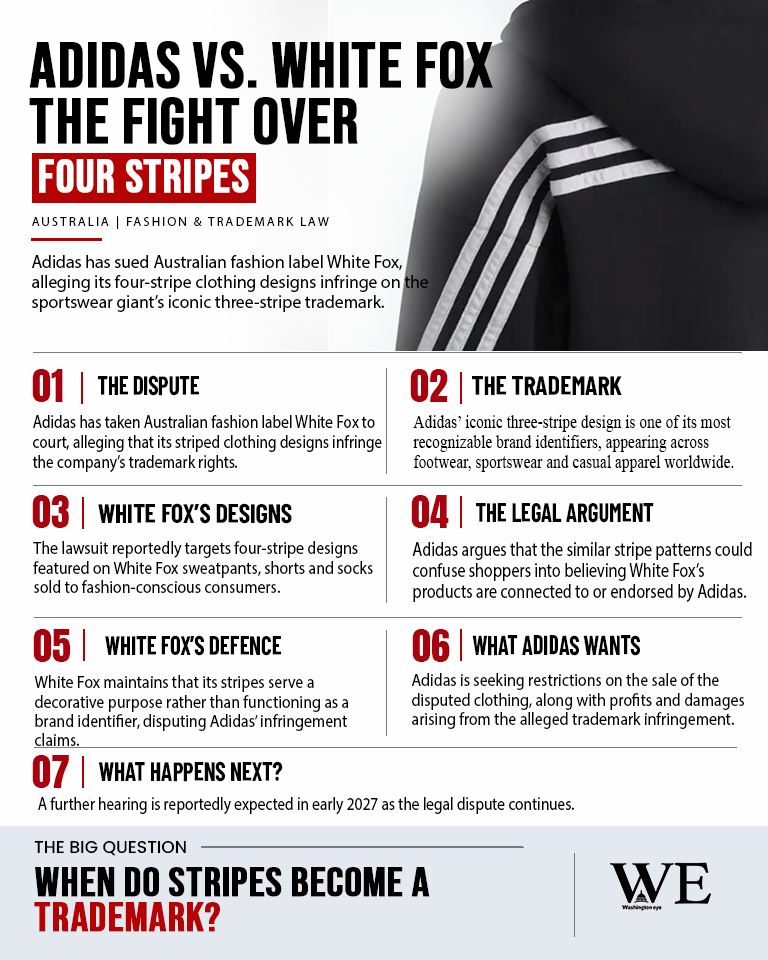
German sportswear giant Adidas has launched legal action against Australian fashion retailer White Fox Boutique, accusing the Sydney-based brand of infringing its iconic three-stripe trademark by selling clothing featuring four parallel stripes. The dispute, filed in the Federal Court of Australia in September 2026, has sparked debate over intellectual property rights, fashion design and the extent to which companies can claim exclusive ownership of distinctive patterns.
Adidas alleges that White Fox’s four-stripe designs, appearing on sweatpants, lounge shorts, socks and other garments, are deceptively similar to its internationally recognised three-stripe branding. The company argues that the resemblance could mislead consumers into believing the products were manufactured, authorised or endorsed by Adidas, potentially benefiting White Fox through an association with the sportswear giant’s established reputation.
The legal proceedings began on September 18, following months of correspondence between the companies. According to court documents, Adidas first contacted White Fox on March 19, requesting that it stop selling and advertising products featuring the disputed design. However, the Australian retailer allegedly rejected repeated requests and continued promoting the garments through its online platforms and advertising campaigns.

To support its claims, Adidas representatives purchased several White Fox products between March and July 2026, including plum-coloured lounge shorts featuring contrasting white stripes. The company also collected photographs of White Fox advertisements displayed on buses and at bus stops across Sydney between April and June. These materials were submitted as evidence to demonstrate the extent of the alleged trademark infringement.

The dispute extends beyond the clothing designs themselves. Adidas has accused White Fox of using promotional photographs featuring models wearing its four-striped garments alongside genuine Adidas footwear. According to the German company, these images could strengthen the impression of a commercial connection between the two brands. Adidas further alleged that certain promotional photographs were digitally altered after legal proceedings began, with stripes gradually removed from the Adidas shoes shown in the images.
During the first court hearing on October 9, Adidas’s barrister, Patrick Flynn SC, argued that White Fox had attempted to benefit from the reputation associated with the three-stripe trademark. He maintained that the retailer’s use of similar designs and promotional imagery could confuse customers and undermine Adidas’s brand identity.
White Fox, however, has disputed the allegations. Its legal representative, Ed Heerey KC, argued that the four stripes were decorative elements rather than trademarks intended to identify the manufacturer. He also highlighted the presence of similar designs among other fashion retailers, including Princess Polly, Glassons and Shein, suggesting that parallel stripes are commonly used throughout the clothing industry. The Australian retailer intends to challenge whether its designs are sufficiently similar to Adidas’s registered trademarks to constitute infringement. Its defence is expected to focus on the distinction between decorative fashion elements and legally protected brand identifiers.

Founded in Sydney in 2013 by Georgia and Daniel Contos, White Fox Boutique has developed into a prominent online fashion retailer, particularly among teenagers and young adults. The company has built much of its commercial success through social media marketing, influencer collaborations and popular casualwear collections. Its advertising campaigns have expanded beyond Australia into international markets, including the United States and the United Kingdom.
Adidas, meanwhile, has used its distinctive three-stripe design for more than seven decades and has repeatedly pursued legal action to protect the trademark. In Australia, the company previously won a 2013 case against Pacific Brands involving certain four-stripe footwear designs sold under the Dunlop and Grosby brands. However, Adidas has also faced legal setbacks internationally, including disputes involving American luxury fashion designer Thom Browne, whose clothing incorporates four-stripe patterns.
The current lawsuit highlights the complexities of trademark protection within the global fashion industry. While registered trademarks provide companies with legal rights over distinctive branding, courts must determine whether a competing design is likely to create consumer confusion. The mere presence of stripes does not automatically establish infringement, making the arrangement, appearance and commercial presentation of the designs important considerations.
Adidas is seeking court orders preventing White Fox from manufacturing, advertising and selling the disputed garments. The company has also requested financial compensation, including profits generated from the products, damages, interest and legal costs. Federal Court Justice Ian Jackman has scheduled the dispute for a hearing in early 2027, with proceedings expected to last approximately three to four days. No final determination has been made regarding the alleged infringement.
As the two fashion brands prepare for their legal confrontation, the case could influence how Australian courts interpret trademark similarities in clothing design. Beyond the immediate dispute, it raises broader questions about the balance between protecting established brands and allowing creative freedom in an increasingly competitive global fashion market.