
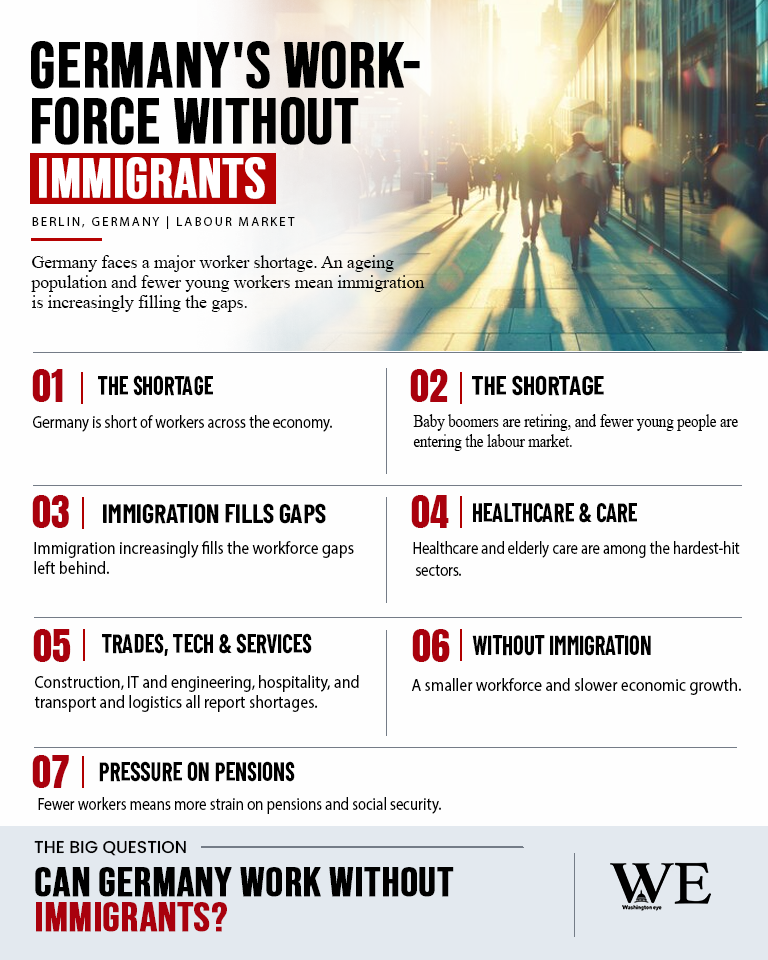
Germany could lose millions of potential workers over the coming decade without continued immigration, according to official demographic projections, raising concerns about the future of Europe’s largest economy. As the country confronts an ageing population, declining birth rates and the retirement of the baby-boomer generation, foreign workers have become increasingly important to maintaining employment levels across healthcare, manufacturing, construction, technology and other essential industries. Recent figures from Germany’s Federal Employment Agency reveal that employment growth since 2024 has been driven exclusively by foreign nationals, highlighting the country’s growing dependence on international labour.
According to Germany’s Federal Statistical Office (Destatis), the country’s potential workforce could decline by approximately 6.2 million people by 2035 in a scenario without net immigration. The agency estimates that Germany would require average annual net immigration of approximately 570,000 people aged between 20 and 66 from 2025 to 2035 to offset demographic losses in that age group. Even with moderate immigration, the working-age population is projected to shrink, demonstrating the scale of the demographic challenge confronting German policymakers.
Foreign Workers Become Essential to Germany’s Economy

Figures published by the Federal Employment Agency on July 14, 2026, reveal a significant transformation in Germany’s labour market. Between 2014 and 2024, the working-age population holding German citizenship declined by approximately 3.9 million, while the corresponding foreign-national population increased by around 3.4 million. The findings suggest that immigration has played a crucial role in preventing a much sharper contraction in the country’s available workforce.
Between June 2014 and June 2025, approximately 43% of employment growth was attributable to workers from non-European Union countries, while another 26% came from European Economic Area countries and Switzerland. German nationals accounted for roughly one-third of the increase. However, since 2024, overall employment growth has been sustained by foreign workers as employment among German nationals has weakened amid demographic ageing.

Vanessa Ahuja, a member of the Federal Employment Agency’s executive board, warned in July that immigration had become essential for meeting companies’ staffing requirements. She emphasised that workers from countries outside the European Union were particularly important as Germany’s domestic and European workforce continued to age.
The situation is especially significant for Germany’s healthcare system, where hospitals, nursing homes and elderly care institutions depend increasingly on internationally recruited professionals. Skilled workers are also required in engineering, information technology, logistics, hospitality and skilled trades. In September 2026, the Federal Employment Agency identified 157 occupational categories experiencing skilled labour shortages, despite slower economic activity and a reduction from 163 shortage categories the previous year.
Research published by the Bertelsmann Foundation in November 2024 further estimated that Germany’s labour force potential could decline from approximately 46.4 million to 41.9 million by 2040 without additional immigration. By 2060, that figure could fall to approximately 35.1 million. The study calculated that around 288,000 international workers would be required annually until 2040 to meet projected labour market needs, using assumptions different from the more recent Destatis population projections.

Immigration Policies, Political Debate and Economic Consequences
Germany has introduced several reforms to attract international professionals, including the Skilled Immigration Act, expanded EU Blue Card provisions and the Opportunity Card, which allows eligible foreign nationals to seek employment. In November 2025, the federal government also approved plans for a Work-and-Stay Agency designed to simplify recruitment procedures, qualification recognition and administrative processes through a central digital platform.
The growing economic need for immigration comes amid continuing political debate over migration controls, integration and public services. While supporters of stricter immigration policies emphasise border management, housing pressures and administrative capacity, employers and labour market researchers warn that restricting skilled migration could intensify workforce shortages. The distinction between asylum migration and employment-based immigration remains particularly important in these discussions.
Meanwhile, the economic slowdown has reduced immediate hiring demand. Germany recorded approximately 1.15 million job vacancies during the first quarter of 2026, around 2% fewer than a year earlier. Nevertheless, economists caution that short-term unemployment and long-term skills shortages can exist simultaneously because available workers do not always possess the qualifications required by employers.
Beyond immigration, Germany faces pressure to increase workforce participation among women, older employees and people currently outside employment. Expanding childcare, improving professional training, accelerating qualification recognition and investing in automation could help address some shortages. However, researchers argue that domestic labour market reforms alone are unlikely to fully compensate for demographic decline.
The consequences of insufficient immigration could extend beyond individual businesses. A shrinking workforce may constrain economic output, reduce tax contributions and place additional pressure on pensions and healthcare funding as the number of retirees increases.
Germany’s challenge is therefore not simply attracting foreign workers, but ensuring their successful integration through language training, fair employment conditions, affordable housing and efficient administrative procedures. As the country approaches the next decade, its ability to balance migration management with economic needs will remain central to its labour market and long-term competitiveness.