

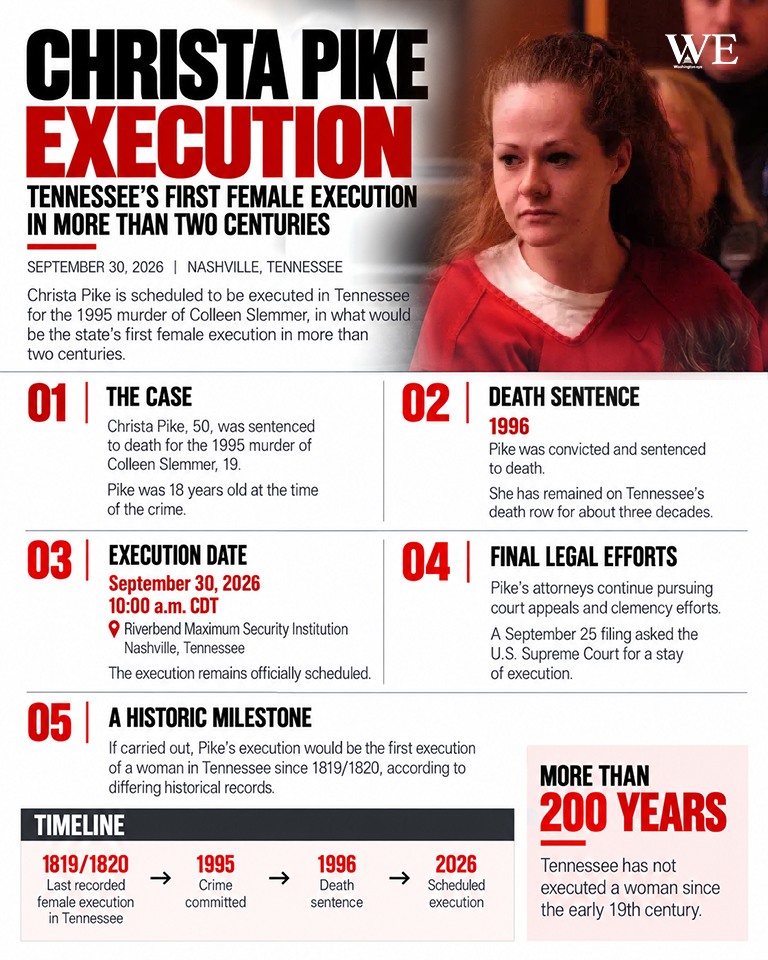
Christa Gail Pike, the only woman currently on Tennessee’s death row, is scheduled to be executed on September 30, 2026, in a case that has renewed debate over capital punishment, crimes committed by young adults, childhood trauma and mental illness. If the execution proceeds, Pike will become the first woman executed by Tennessee in more than 200 years.
Pike, now 50, was sentenced to death in 1996 for the 1995 murder of 19-year-old Colleen Slemmer, whom she knew through the Knoxville Job Corps program. Pike was 18 when the crime was committed. She has spent approximately three decades under a death sentence.
Her execution is scheduled for 10 a.m. Central Time at Riverbend Maximum Security Institution in Nashville, according to the Tennessee Department of Correction. However, with only days remaining, her lawyers continue efforts to stop the execution, including a clemency request to Tennessee Governor Bill Lee and an application for a stay filed with the U.S. Supreme Court on September 25.

The 1995 Murder of Colleen Slemmer
The case dates back to January 12, 1995, when Pike, Slemmer and other young people were enrolled at the Job Corps program in Knoxville. Prosecutors said Pike, her then-boyfriend Tadaryl Shipp, who was 17, and another teenager, Shadolla Peterson, took Slemmer to an isolated area near the University of Tennessee agricultural campus. Slemmer was assaulted and killed. The prosecution presented the killing as premeditated and argued that Pike played a central role.

A Tennessee jury convicted Pike in 1996 of premeditated first-degree murder and conspiracy to commit first-degree murder. She received a death sentence for the murder and an additional prison term for conspiracy. Jurors found that aggravating circumstances surrounding the killing outweighed the mitigating circumstances presented by her defense.
The sentences imposed on the other participants have subsequently become an important part of Pike’s lawyers’ arguments. Shipp could not receive the death penalty because he was 17 at the time of the crime and received a life sentence. Peterson testified against Pike and Shipp and received probation. Pike’s attorneys have cited those differences while arguing that her death sentence should be commuted.
Childhood Trauma, Mental Health and Fight for Clemency

Much of the current controversy concerns circumstances from Pike’s childhood and adolescence that her present legal team says were not adequately presented to the original sentencing jury. Her attorneys have documented a childhood marked by severe neglect and repeated sexual abuse and say Pike was later diagnosed with bipolar disorder and post-traumatic stress disorder. Her lawyers have also raised evidence concerning neurological impairment and argue that her youth, trauma and mental-health history should be considered in determining whether she should be executed.
Earlier this month, her lawyers submitted a 226-page clemency petition to Governor Bill Lee asking him to commute her death sentence to life imprisonment without the possibility of parole. They argue that Pike accepts responsibility for Slemmer’s murder but that her age, traumatic upbringing, mental-health history and changes during three decades in prison justify sparing her life.
Those arguments do not overturn the underlying conviction. Tennessee courts have repeatedly upheld Pike’s death sentence through years of litigation, and the state has continued preparations for the September 30 execution. The Tennessee Supreme Court on September 23 denied a request to stay Pike’s execution. Two days later, her attorneys filed an application with the U.S. Supreme Court seeking another stay. As of September 28, the Supreme Court docket records the application but does not show an order granting a stay.
Why the Execution Is Historically Significant
Women constitute only a small fraction of people sentenced to death or executed in the United States. According to the Death Penalty Information Center, only 18 women were executed nationwide between the resumption of executions in the modern death-penalty era and the publication of its analysis, compared with more than 1,600 executions overall.
Tennessee’s historical gap is even more striking. The last woman executed by the state was put to death in 1820, meaning Pike would be Tennessee’s first execution of a woman in roughly 206 years. She is currently the only woman serving a death sentence in the state.
Her age when the crime occurred has also become central to the case. The U.S. Supreme Court ruled in 2005 that offenders who were under 18 when they committed their crimes cannot be executed. Pike, however, had already turned 18, placing her on the other side of the constitutional line. Her attorneys and supporters argue that modern research into adolescent and young-adult brain development should influence how her culpability is assessed, while existing U.S. Supreme Court precedent does not categorically prohibit the death penalty for crimes committed at age 18.
The case has consequently become part of a wider debate about whether chronological age 18 should remain the decisive boundary in capital cases. Pike has also faced legal consequences for conduct while imprisoned. Tennessee records show that she was convicted in 2001 of attempted first-degree murder following an assault on another inmate.
Final Appeals as September 30 Approaches
Public pressure has intensified as the execution date approaches. Opponents of Pike’s execution have held demonstrations and urged Governor Lee to grant clemency, focusing particularly on her childhood abuse, mental-health history and age at the time of Slemmer’s murder.
At the same time, the case continues to centre on the killing of Colleen Slemmer, who was 19 years old. The conviction and death sentence have survived decades of judicial review, and Tennessee is continuing preparations to carry out the sentence unless a court or the governor intervenes.
The state has already selected media witnesses and issued detailed procedures for reporters covering the execution at Riverbend Maximum Security Institution. The final outcome could therefore still change before September 30. Governor Lee has the power to grant clemency, while Pike’s lawyers are pursuing relief through the courts.
If neither effort succeeds and the execution proceeds, Pike will enter Tennessee history as the first woman put to death by the state since 1820, more than two centuries after Tennessee last executed a female prisoner. Her case will also remain part of the broader American debate over capital punishment, youth, trauma, mental illness and how the justice system weighs those factors against responsibility for serious crimes.