Tesla CEO Elon Musk has unveiled a revolutionary new version of the company’s long-awaited Roadster electric sports car, demonstrating its ability to lift off the ground, perform aerial manoeuvres and land using advanced propulsion technology developed in collaboration with SpaceX. The dramatic unveiling, held on October 15 at SpaceX’s testing facility in McGregor, Texas, has attracted worldwide attention, bringing the idea of a flying car closer to reality while raising questions about safety, affordability and regulatory approval.
The futuristic two-seater vehicle, known as the second-generation Tesla Roadster, stunned spectators during a livestreamed demonstration when it drove up a towering curved ramp, travelled upside down and launched into the air. Using powerful compressed-air thrusters, the car completed a midair rotation before landing safely on its wheels. The demonstration was conducted without a driver to minimise safety risks, with Musk acknowledging the experimental nature of the technology.
The event marked a significant milestone for Tesla, which first announced the second-generation Roadster in November 2017. Originally expected to enter production in 2020, the vehicle has faced repeated delays as the company prioritised mass-market electric cars, autonomous driving technology and robotics. Nearly nine years later, the redesigned Roadster has emerged as a high-performance electric sports car incorporating aerospace-inspired engineering.

During the unveiling, Musk declared that flying cars were becoming a reality, explaining that the vehicle uses altitude-control thrusters and rear-mounted propulsion systems to perform movements normally associated with aircraft. He described the project as a collaboration between Tesla’s automotive engineers and SpaceX’s rocket specialists, combining electric vehicle technology with advanced propulsion systems.
According to Tesla, the Roadster uses a specialised suction system beneath its body to generate enough downward force to remain attached to surfaces even while travelling upside down. Once airborne, compressed-air thrusters control its movement, allowing the vehicle to rotate, stabilise and land. The technology represents an unusual approach to vehicle mobility, although the demonstration did not establish that the Roadster could undertake sustained or long-distance flight.
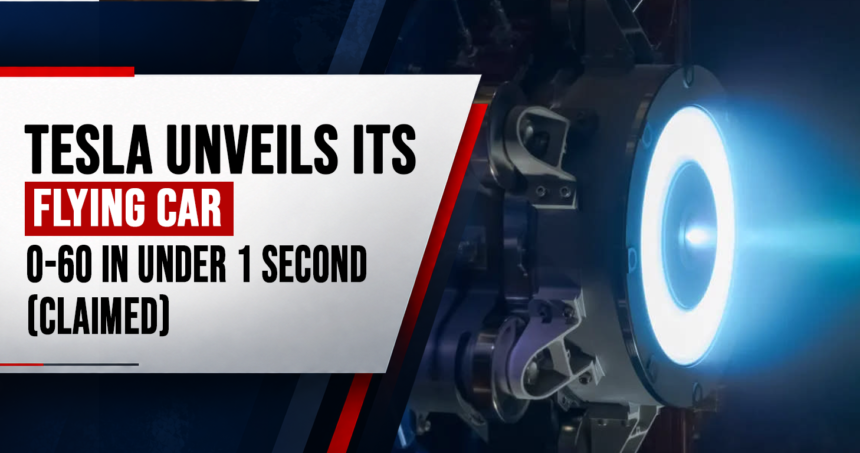
The company also demonstrated the vehicle jumping over a row of Tesla cars, including a Cybertruck and other electric models. In another display, the Roadster accelerated from zero to 60 miles per hour in less than one second, a performance claim that would place it among the fastest-accelerating vehicles ever demonstrated.
Tesla says the new Roadster could achieve a top speed exceeding 230 miles per hour, approximately 370 kilometres per hour, while offering a driving range of more than 300 miles on a single charge. However, these figures remain manufacturer claims, and independent testing of the production vehicle has not yet been completed.

The redesigned sports car features a striking angular exterior inspired by high-performance aircraft, including the SR-71 Blackbird and F-35 fighter jet. Its aerodynamic body, advanced propulsion technology and compact two-seat interior distinguish it from Tesla’s conventional electric vehicles. The company has outlined three versions of the Roadster: Performance, Thrust and Rocket. The Performance model is intended for conventional road use, while the Thrust version incorporates additional propulsion technology to enhance acceleration. The exclusive Rocket version is designed with a more extensive flight system and will reportedly be available only to selected customers through invitation.
Reservations have opened for some versions, with deposits reaching $50,000 for the Performance model and $250,000 for the Thrust variant. Tesla has not confirmed final selling prices, although the Roadster is expected to occupy the luxury sports car market. Production is currently scheduled to begin in 2028, subject to further development and testing.
Despite the excitement, significant challenges remain before such vehicles could become widely available. The Roadster’s aerial capabilities raise questions about passenger safety, airspace regulation, insurance and the suitability of existing roads for vehicles capable of leaving the ground. The US Federal Aviation Administration has reportedly indicated that the Roadster does not meet its current definition of an aircraft, creating uncertainty about which regulatory framework would govern its unusual capabilities. Tesla has also stated that the flying configuration is not approved for public road use.
Industry analysts have cautioned that the Roadster is unlikely to contribute substantially to Tesla’s overall vehicle sales because of its anticipated high price and limited production. Instead, the project may serve as a demonstration of the company’s engineering capabilities and its collaboration with SpaceX. The unveiling comes as Tesla continues expanding beyond conventional electric vehicles into artificial intelligence, autonomous transport and robotics. Musk has increasingly positioned the company as a technology business rather than solely an automobile manufacturer.
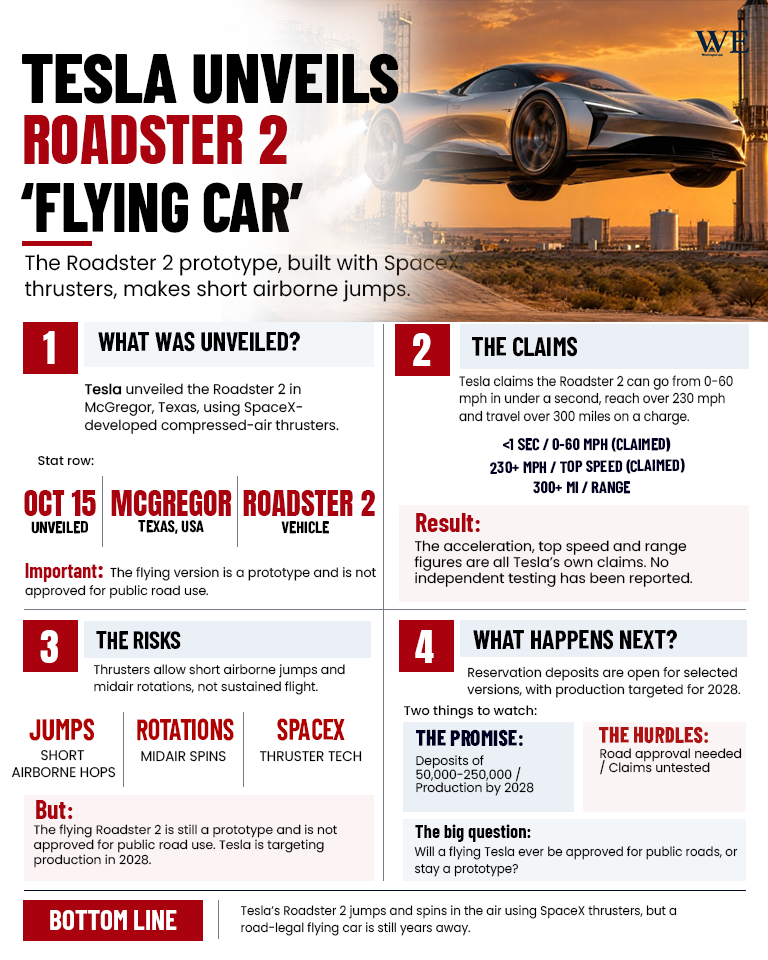
Although the Roadster’s brief airborne demonstrations do not yet represent practical everyday flight, they demonstrate a new application of propulsion technology in road vehicles. Whether Tesla can transform the prototype into a commercially viable product remains uncertain. With production planned for 2028, the coming years will determine whether Musk’s ambitious flying Roadster becomes a new category of high-performance vehicle or remains an experimental showcase of futuristic engineering.