
Archaeologists have discovered what could be the world’s oldest known shipwreck off the Mediterranean coast of Turkey, uncovering remarkably preserved cargo dating back approximately 4,400 to 4,700 years. The extraordinary find, located near Kekova Island in southern Turkey’s Antalya province, offers new evidence of ancient maritime trade networks that existed during the Early Bronze Age, around the time Egypt’s Great Pyramid of Giza was being constructed.
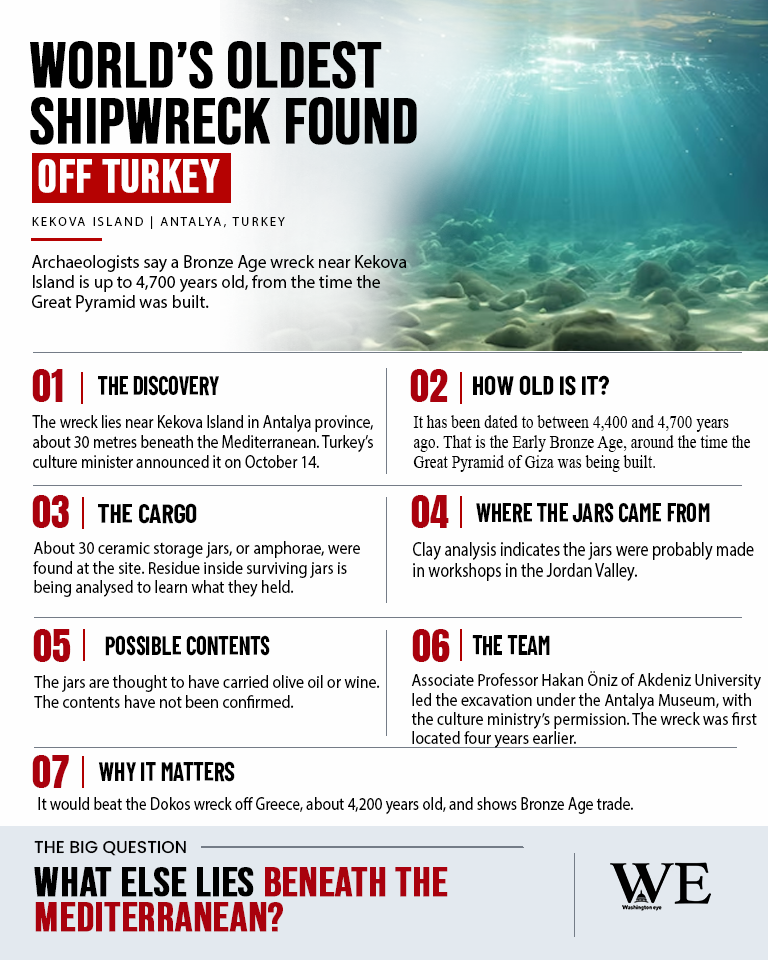
The discovery was publicly announced on October 14 by Turkish Minister of Culture and Tourism Mehmet Nuri Ersoy, following underwater excavations conducted by archaeologists from Akdeniz University and the Mediterranean Archaeology Association. Although the ship’s wooden structure has completely disintegrated over thousands of years, researchers recovered ceramic storage jars, stone anchors and other artefacts that provide valuable clues about its origins, cargo and final voyage.
The excavation was led by Professor Hakan Öniz of Akdeniz University, who has spent decades investigating ancient shipwrecks along Turkey’s coastline. The site was initially identified in 2024 following information provided by local seafarers, while detailed archaeological excavations began in 2026. The findings were subsequently examined by international specialists to establish the ship’s approximate age and historical significance.

Researchers believe the vessel sank sometime between 2700 and 2400 BC, making it potentially several centuries older than the previously recognised oldest shipwreck near Dokos Island in Greece, which dates back approximately 4,200 years. However, scientists have emphasised that the dating remains provisional and further research is necessary before the discovery’s status can be conclusively established.

The wreck was discovered approximately 25 to 40 metres beneath the Mediterranean Sea, where more than 30 ceramic storage vessels were found scattered across a rocky underwater slope. The jars, commonly described as amphorae, were used by ancient merchants to transport valuable commodities, potentially including olive oil, wine, resins and other agricultural products.
Remarkably, several containers still preserve traces of their original contents, despite spending nearly five millennia underwater. Scientists are now analysing these residues to determine what the vessel was transporting when it sank. The findings could provide important insights into ancient food production, commercial exchanges and the everyday lives of Mediterranean sailors.
One particularly unusual container features nine distinct markings and two holes in its body. Preliminary examinations suggest that it may have been used to produce cheese or butter, raising the possibility that sailors processed dairy products during long voyages. However, researchers have stressed that this interpretation remains tentative until further scientific investigations are completed.

The pottery itself has provided some of the strongest evidence for dating the shipwreck. Australian archaeologist Karin Sowada of Macquarie University, who specialises in ancient Egyptian archaeology and Bronze Age trade, helped analyse the ceramic vessels. Their distinctive shapes, manufacturing techniques and clay composition resemble pottery produced in the Jordan Valley and found at archaeological sites in Egypt, Troy and Crete.
These similarities suggest that the ship may have formed part of an extensive trading network connecting communities across the eastern Mediterranean. Researchers believe it could have departed from a port along the Levantine coast before travelling towards northwestern Anatolia or Crete, although its exact route remains unknown.
The vessel is estimated to have measured approximately 10 metres in length and was probably designed to transport commercial cargo between coastal settlements. Archaeologists also discovered three large stone anchors, suggesting that the ship was equipped for maritime journeys requiring stops at different ports.
The cause of the shipwreck remains uncertain. Researchers suspect that the vessel may have encountered dangerous weather conditions or struck rocks while attempting to navigate the coastline near Kekova Island. Its wooden structure eventually disappeared through natural decomposition, leaving behind the more durable ceramic and stone objects.
The discovery is particularly important because physical evidence of maritime trade from the third millennium BC remains limited. While historical records and archaeological finds have long indicated commercial exchanges between Egypt, the Levant and the Aegean, surviving evidence from ships of this period is exceptionally rare.
The recovered artefacts could therefore help historians reconstruct how goods, technologies and cultural influences travelled between ancient civilisations thousands of years before modern international shipping networks emerged. Nevertheless, researchers caution that the findings have not yet been fully published in a peer-reviewed scientific journal. Additional analysis of the pottery, chemical residues and archaeological context will be required to refine the dating and establish the vessel’s precise historical significance.
For Turkey, whose Mediterranean coastline contains numerous ancient shipwrecks, the discovery represents an important contribution to underwater archaeology and cultural heritage preservation. As investigations continue, the ancient cargo resting beneath the Mediterranean offers a rare glimpse into a world of merchants, sailors and interconnected civilisations nearly 5,000 years ago. The discovery could significantly expand understanding of the origins of long-distance maritime commerce and the development of early Mediterranean trade networks.