The death of 87-year-old María del Carmen Abascal, widely known as Maricarmen, has triggered renewed mass demonstrations across Spain, intensifying public anger over soaring rents, forced evictions and the country’s deepening housing crisis. Abascal died on October 7, 2026, at Madrid’s Gregorio Marañón Hospital, approximately two weeks after being forcibly removed from the apartment where she had lived for more than seven decades.
Her death has transformed an already controversial eviction into a national political issue, with thousands of protesters demanding stronger tenant protections and affordable housing. The demonstrations have also heightened tensions ahead of Spain’s snap general election, scheduled for November 29, as political parties clash over responsibility for the country’s housing emergency.
Who Was Maricarmen Abascal and Why Was She Evicted?

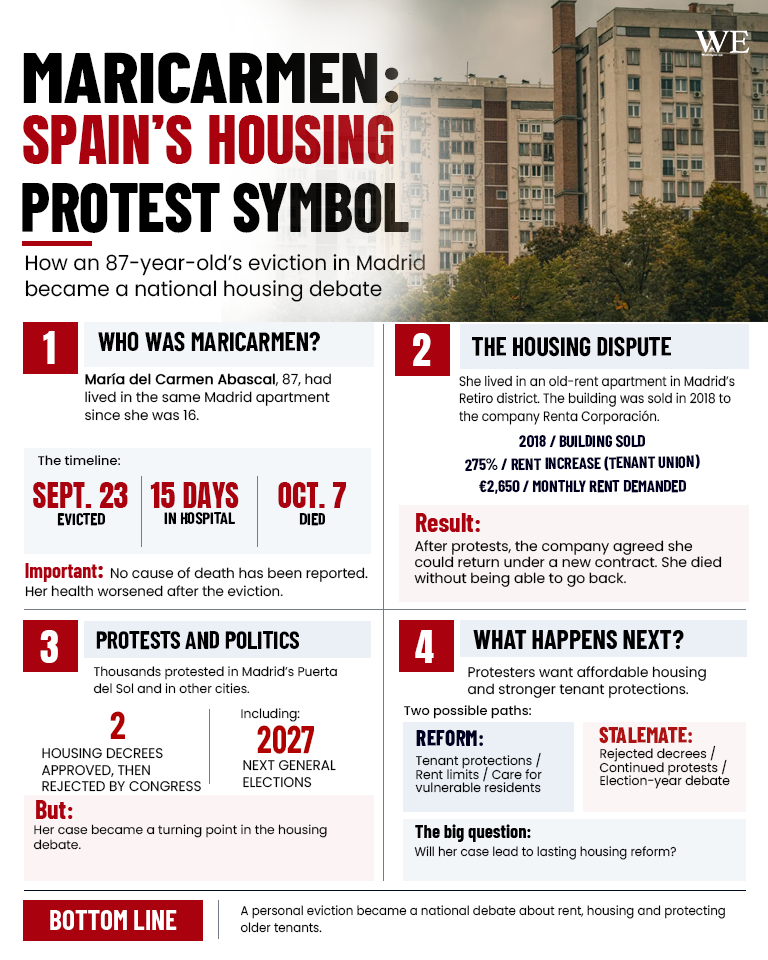
Maricarmen Abascal was an 87-year-old pensioner who had spent approximately 71 years living in a rented apartment near Madrid’s Retiro Park. She first moved into the property with her parents and brother and later worked as a secretary for the board of a pharmaceutical company. Her life changed when an investment firm acquired the apartment and sought to increase her rent by approximately 230%. Unable to accept the proposed increase, Abascal became involved in a prolonged dispute with the property owners.
Over several years, she faced four eviction attempts. Supported by Madrid’s Tenants Union and local housing activists, she fought to remain in the home that had been central to nearly her entire life. On September 23, police carried out the final eviction despite protests outside the building. Abascal, whose health had deteriorated and who was using a wheelchair, was removed from her apartment and transferred onto a stretcher before being taken to hospital.

Images of the elderly woman surrounded by police officers and demonstrators circulated widely across Spanish media, provoking outrage and drawing attention to the struggles faced by vulnerable tenants. The incident quickly became a symbol of the wider housing crisis, with demonstrators arguing that elderly residents and low-income families were increasingly being displaced by rising rents and property speculation.
Death in Hospital Sparks Nationwide Demonstrations
Abascal remained hospitalised following her eviction, reportedly suffering from severe anxiety and exhaustion. She died on October 7, just one day before she was expected to sign a new agreement allowing her to return to her apartment. The property company had agreed to an eight-year tenancy at a rent similar to her previous payment following intense public pressure. However, Abascal died before she could return home.

Her lawyer did not announce an official medical cause of death. Although activists have linked her deteriorating condition to the emotional and physical strain of the eviction, that connection has not been medically established. Following news of her death, protesters gathered in Madrid’s Puerta del Sol square, where housing campaigners had maintained a protest encampment since September.
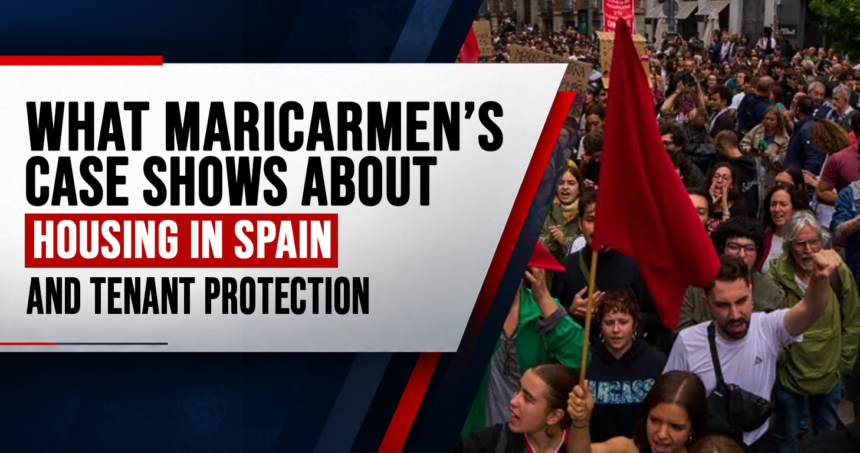
On October 8, approximately 20,000 people marched through central Madrid in her memory, according to reporting by The Guardian. Demonstrators carried placards demanding housing justice, while mourners placed flowers, candles and handwritten messages outside her former apartment. Similar protests and solidarity gatherings took place in Barcelona and other Spanish cities. The Madrid Tenants Union described her death as the tragic outcome of an avoidable situation and pledged to continue campaigning against forced evictions.
Spain’s Housing Crisis Triggers Political Confrontation
The protests have exposed deep divisions over housing policy in Spain, where rental prices have risen sharply over the past decade, particularly in major cities and popular tourist destinations. According to property platform Idealista, average rents across Spain have almost doubled in ten years. Government figures also indicate that 26% of Spanish renters spend at least 40% of their income on rent and utilities, highlighting the financial pressure facing households.
Prime Minister Pedro Sánchez’s Socialist-led government proposed emergency housing measures intended to curb evictions and address property speculation. However, the legislation was rejected in parliament on October 1 after opposition from the conservative Popular Party (PP), far-right Vox and Catalan party Junts. Following the parliamentary defeat and mounting public demonstrations, Sánchez announced an early general election for November 29.
The government’s approach has faced criticism from opposition parties, which argue that rent controls could discourage property investment and worsen housing shortages. Housing activists, meanwhile, insist that stronger regulations are necessary to protect tenants from displacement. Madrid’s mayor, José Luis Martínez-Almeida, accused Sánchez of politicising Abascal’s death, while left-wing politicians observed moments of silence in her memory.
A Symbol of Housing Rights and Spain’s Uncertain Future
Abascal’s death has given new momentum to housing rights organisations, which are demanding restrictions on speculative property practices, greater investment in affordable housing and stronger legal protections for vulnerable tenants. Major Spanish trade unions have announced plans for a general strike on November 11, ahead of the parliamentary election.
Her story has become more than an individual dispute between a tenant and a property company. For many protesters, it represents a broader struggle over whether housing should primarily function as an investment asset or be protected as an essential human need. As Spain approaches its November election, housing affordability is expected to remain a central political issue. Although Abascal never returned to the apartment she called home for seven decades, her case has left a lasting mark on Spain’s national debate about housing, dignity and social justice.