

One of the Himalayas’ most colourful and recognisable birds, the Himalayan monal, is changing the pitch and duration of its calls in response to increasing human activity, according to scientific research that has raised fresh concerns about noise pollution, tourism and environmental degradation in the fragile mountain ecosystem.
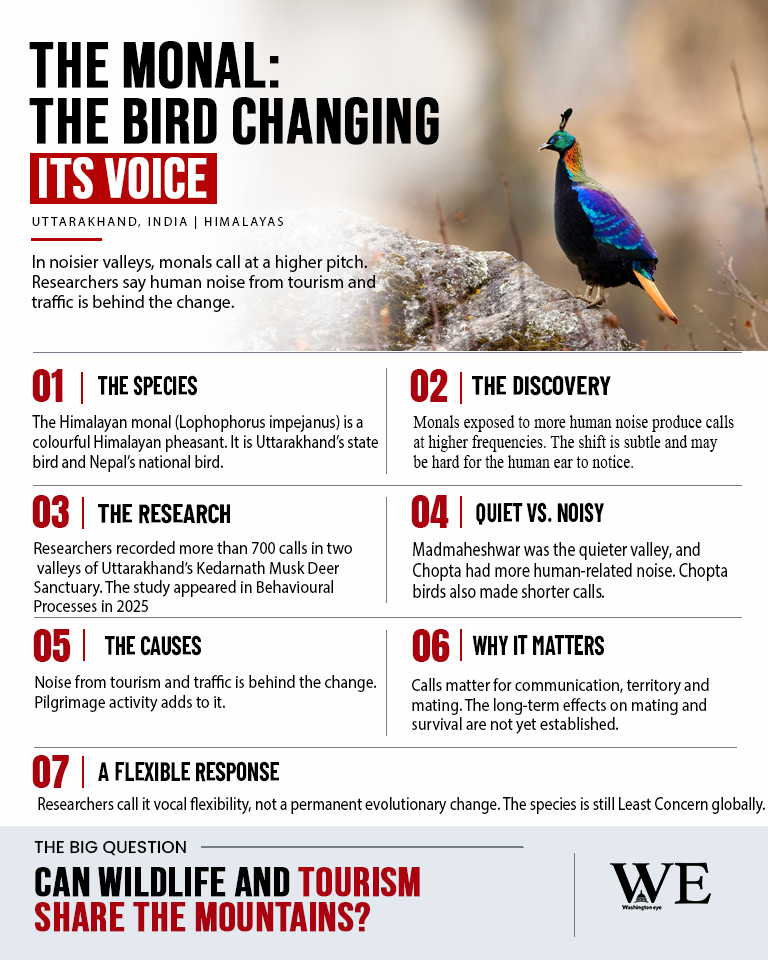
The Himalayan monal (Lophophorus impejanus), celebrated for its brilliant metallic feathers and distinctive vocalisations, is increasingly exposed to traffic, tourist crowds and infrastructure development. Researchers have discovered that birds living in noisier environments produce higher-frequency calls and sometimes extend their vocalisations to communicate above human-generated sounds.
The findings, published in the scientific journal Behavioural Processes in August 2025 and attracting renewed international attention in October 2026, demonstrate how expanding human activity is affecting wildlife behaviour in the Himalayan region.

What Did Researchers Discover and Why Are the Birds Changing Their Voices?
Researchers Rajeev Lochan, Dinesh Kumar Sharma and Anand Kumar from Hemvati Nandan Bahuguna Garhwal University in Uttarakhand conducted a detailed investigation into how human-generated noise influences the Himalayan monal’s vocal communication.
The scientists compared bird calls from two contrasting locations in the Kedarnath Musk Deer Sanctuary region: Madmaheshwar Valley, a relatively undisturbed environment, and Chopta, a popular tourist destination experiencing greater vehicle movement and human activity.
Using specialised recording equipment, researchers analysed approximately 719 bird-call recordings to examine differences in frequency, duration and environmental noise. The results revealed that Himalayan monals in noisier habitats generally produced calls with higher peak frequencies than those living in quieter surroundings. Some calls also became slightly longer, suggesting that the birds were adjusting their communication strategies to remain audible.
These changes are scientifically significant because birds depend on vocal communication for attracting mates, defending territories, identifying potential threats and maintaining social interactions. When vehicle engines, horns and tourist conversations interfere with natural sounds, birds may struggle to communicate effectively. By shifting their calls towards higher frequencies, Himalayan monals appear to reduce interference from lower-frequency background noise. However, scientists caution that such behavioural flexibility does not necessarily mean the birds can overcome every consequence of increasing environmental disturbance.

Who Is the Himalayan Monal and What Threatens Its Survival?
The Himalayan monal is a large, ground-dwelling pheasant belonging to the family Phasianidae. It inhabits Himalayan forests, steep mountain slopes and alpine meadows across countries including India, Nepal, Pakistan and Bhutan. The species is particularly admired for the male’s extraordinary plumage, which displays shimmering shades of green, blue, purple and copper. Females have comparatively subdued brown feathers that provide camouflage in their natural surroundings.
Recognised as Nepal’s national bird and the state bird of Uttarakhand, the Himalayan monal holds considerable ecological and cultural importance. Although the species is currently classified as Least Concern on the International Union for Conservation of Nature’s Red List, its mountain habitats face growing pressure from tourism, expanding road networks, deforestation and climate change.
Separate research examining Himalayan bird habitats has highlighted concerns that changing temperatures and human disturbances could alter the availability of suitable environments, potentially pushing some populations towards higher elevations.
This movement could create additional ecological challenges because suitable mountain habitats become increasingly limited at greater altitudes. Scientists emphasise that the combination of habitat fragmentation, environmental noise and climate-related changes presents a complicated conservation challenge for Himalayan wildlife.
Climate Change and Tourism Raise Conservation Concerns
The findings have renewed discussions about the environmental consequences of tourism and development in the Himalayas, where roads, hotels and expanding visitor facilities are bringing human activity closer to previously undisturbed wildlife habitats. Scientists believe the Himalayan monal’s changing calls could serve as an early warning of broader ecological disruption. If a relatively adaptable bird must modify its behaviour to survive, more sensitive species may face even greater challenges.
Researchers have stressed that the observed vocal changes represent behavioural flexibility rather than proven permanent genetic or evolutionary changes. The long-term consequences for breeding success, population stability and survival remain uncertain. Conservation specialists are calling for improved noise management, responsible tourism, habitat protection and careful planning of infrastructure projects in ecologically sensitive mountain regions.
The research highlights an increasingly important environmental reality: human activity is not only changing the physical landscapes inhabited by wildlife but also transforming the natural soundscapes on which animals depend. For the Himalayan monal, the challenge is no longer simply finding a suitable place to live. It is also finding a way to be heard.