

Europe’s housing crisis is becoming one of the continent’s most pressing social and economic challenges, as soaring property prices, rising rents and chronic shortages leave millions struggling to find affordable homes and fuel protests and political pressure from Madrid to Berlin.
The scale of the problem has pushed housing unusually high on the European Union’s agenda. European Commissioner for Energy and Housing Dan Jørgensen described the situation in September as an “emergency,” warning that buying or even renting a home has become increasingly difficult for ordinary Europeans, particularly younger generations.
The numbers illustrate how dramatically the market has changed. Across the European Union, house prices increased by nearly 65% between 2015 and late 2025, while rents rose by almost 22%. The upward trend has continued: in the first quarter of 2026 alone, EU house prices were 5.1% higher than a year earlier, while rents increased by 3%, according to Eurostat.
The crisis, however, is far from uniform. Portugal recorded a 10.3% increase in house prices in early 2026 compared with the 2025 annual average, followed by Bulgaria at 9.4% and Slovakia at 9.1%. Rents increased particularly sharply in Croatia, rising 21.9% over the same comparison period.

Why Has Housing Become So Expensive?
At the centre of Europe’s housing problem is a basic imbalance: in many economically successful cities, the number of homes being built has failed to keep pace with demand. High construction costs, expensive land, shortages of skilled workers, lengthy planning procedures and declining housing investment have constrained new supply. The European Commission estimates that the EU now needs more than two million new homes every year to meet existing demand.
At the same time, population growth in major cities, internal migration toward employment centres and demand from students and workers have intensified competition for limited housing. Short-term holiday rentals have become another flashpoint, particularly in tourist destinations. Cities including Barcelona, Lisbon and other heavily visited areas have sought stronger controls as policymakers debate how much platforms offering short stays reduce the stock available to permanent residents.
The consequences increasingly extend beyond people on the lowest incomes. Young professionals and middle-income families can struggle to rent near their workplaces, while home ownership has moved further out of reach for many first-time buyers.

Housing is also delaying major life decisions. The European Commission says affordability problems are affecting labour mobility, education and family formation while threatening wider economic competitiveness and social cohesion.
From Spain to Berlin: Housing Turns Political
The pressure has become particularly visible in Spain, where housing protests intensified in late September. Around 30,000 people marched in Madrid after the eviction of 87-year-old Maricarmen Abascal from the apartment where she had lived for more than 70 years. Protesters subsequently camped in Madrid’s Puerta del Sol demanding stronger tenant protections.
Spain faces an estimated shortage of approximately 750,000 homes, with the deficit projected to surpass one million by 2028 if construction fails to catch up. Rising rents have increasingly transformed housing into a major national political issue. Germany is facing similar pressure in its largest cities.
In Berlin, rents have nearly doubled since 2014, while city authorities estimate another 211,000 homes will be needed by 2040. Housing affordability consequently became a central issue in Berlin’s September 2026 election.
Ireland also remains among Europe’s most expensive places for housing-related expenditure. Eurostat found that overall housing costs in Ireland in 2024 were around 87% above the EU average, followed closely by Denmark at 86% above.
EU Steps In With Affordable Housing Plan
Housing policy has traditionally been primarily controlled by national and local governments, but the scale of the crisis has pushed Brussels toward a more active role. The European Commission presented its first European Affordable Housing Plan in December 2025, targeting housing supply, investment, planning barriers and short-term rentals.
The Commission went further on September 9, 2026, proposing an Affordable Housing Act. The framework would allow authorities to formally identify areas experiencing severe “housing stress” and adopt targeted measures while requiring interventions to be evidence-based, proportionate and regularly reviewed.
Brussels is also pushing authorities to accelerate construction of affordable, social and student housing, simplify planning procedures and make greater use of existing buildings and available land. The social consequences are already significant. The Commission estimates that around one million people experience homelessness in the EU, while nearly 93 million people are at risk of poverty or social exclusion.
Critical View: Rent Controls or Build More Homes?
Europe’s housing debate increasingly centres on two broad approaches: protecting people from rapidly increasing housing costs and dramatically expanding housing supply. Tenant groups favour measures including stronger eviction protections, social housing, rent controls and restrictions on short-term rentals. Critics argue that poorly designed rent controls can discourage investment or reduce the number of homes available on the rental market.
Supply-focused economists instead emphasise construction, faster planning approval and deregulation. Yet simply building more homes presents its own challenges: construction takes years, suitable urban land is scarce, and new developments may remain unaffordable unless policies specifically target lower- and middle-income households.
Berlin illustrates the dispute. A September study from the Kiel Institute argued that proposals to expropriate more than 200,000 homes from large corporate landlords would redistribute ownership but would not itself create additional housing or resolve the underlying shortage. The crisis therefore has no single European solution. Conditions in Dublin, Berlin, Madrid or smaller Eastern European cities differ substantially.
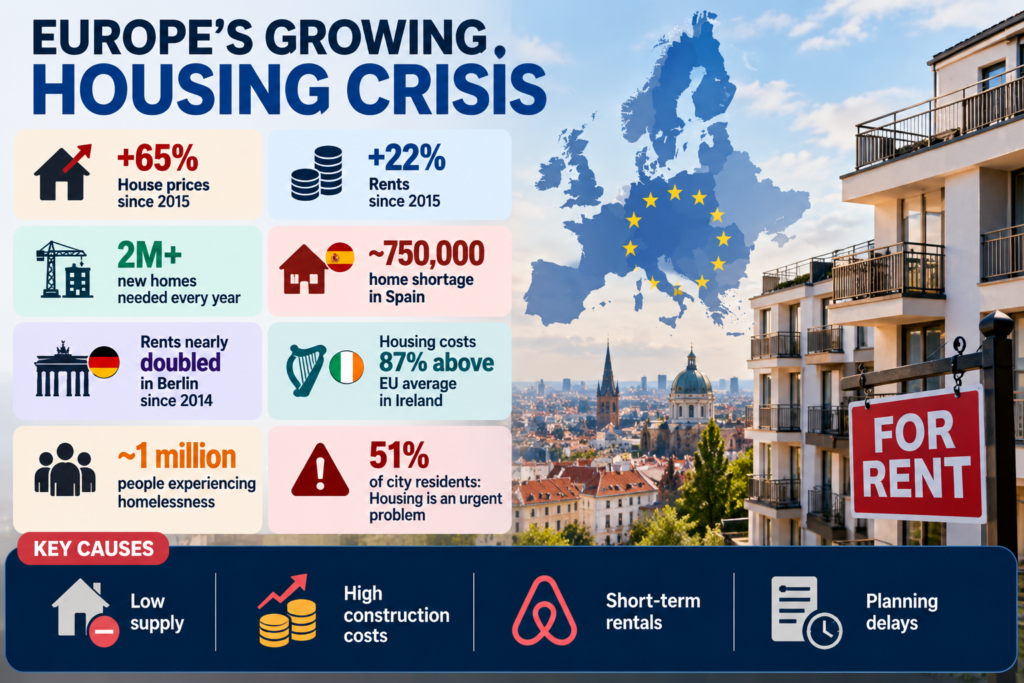
What is increasingly clear, however, is that housing has moved beyond being merely a property-market problem. With 51% of Europeans living in cities describing housing as an immediate and urgent local problem, affordability is becoming a major test of governments’ ability to maintain economic opportunity, generational mobility and confidence in Europe’s cities.