
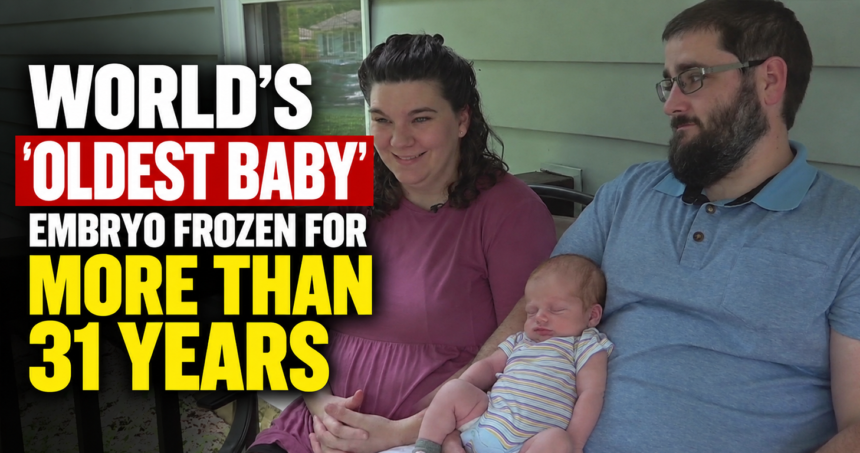
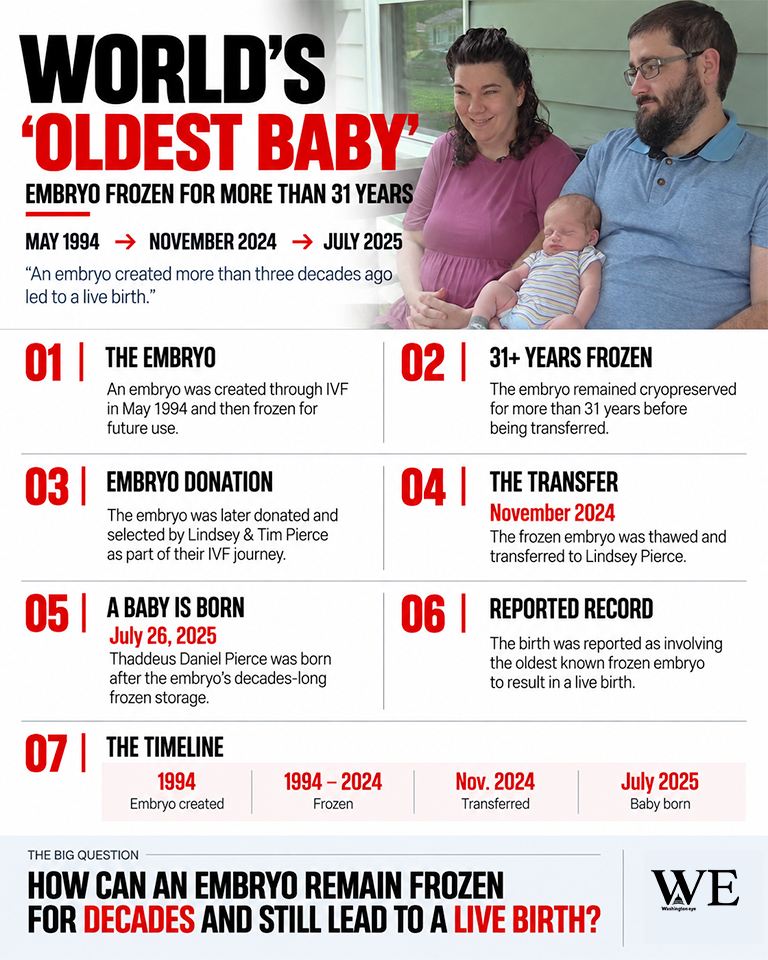
A baby boy born in the United States has made medical history after developing from an embryo that had been frozen for more than three decades. Thaddeus Daniel Pierce was born on July 26, 2025, to Lindsey and Tim Pierce, an Ohio couple who had struggled for years to have a child. The embryo that became Thaddeus was created through in vitro fertilisation (IVF) in May 1994, making it the oldest known frozen human embryo to result in a successful birth.
Guinness World Records has recognised the case as the oldest human embryo used in a successful pregnancy, calculating that the embryo had been preserved for at least 31 years and 56 days. The previous record was held by twins Lydia and Timothy Ridgeway, born in 2022 from embryos that had been frozen for approximately 30 years.
An Embryo Frozen Since 1994

The remarkable story began more than three decades ago with Linda Archerd, now in her 60s, who underwent IVF with her then-husband after experiencing infertility. Their treatment produced four embryos in May 1994. One was transferred to Archerd and eventually resulted in the birth of a daughter in 1995. The remaining three embryos were cryopreserved for possible future pregnancies.
Archerd later divorced and retained custody of the frozen embryos. Although she had hoped to have more children, the embryos remained in storage for decades. She continued paying storage fees because she did not want them discarded or donated anonymously for research.

Eventually, Archerd chose embryo donation through the Snowflakes Embryo Adoption Program, which allows people with unused embryos from fertility treatment to donate them to another family. Unlike traditional adoption, the term “embryo adoption” describes an arrangement involving donated embryos rather than the legal adoption of a child. Archerd wanted to know which family would receive the embryos and hoped to maintain some connection with them.
Lindsey and Tim Pierce’s Seven-Year Fertility Journey
For Lindsey and Tim Pierce, the embryos offered another route to parenthood. Lindsey, reported as 35 at the time of the birth, and Tim, 34, had been trying to have a child for around seven years. They were considering traditional adoption when they learned about embryo donation and were ultimately matched with Archerd’s embryos.

The embryos were transported to Rejoice Fertility in Knoxville, Tennessee, a clinic experienced in working with embryos that have been stored for unusually long periods and using older freezing techniques. After the embryos were thawed, two developed sufficiently to be transferred to Lindsey. One successfully implanted and developed into the pregnancy that produced Thaddeus.
The embryo transfer took place in November 2024, and Thaddeus was born the following July. The Pierces said their objective was never to establish a medical record. “We didn’t go into this thinking about records, we just wanted to have a baby,” Lindsey said in a statement reported by the Associated Press.
Why the Birth Matters for Reproductive Medicine
The case highlights the extraordinary possibilities created by embryo cryopreservation, a routine component of modern IVF. During IVF, eggs are retrieved and fertilised with sperm in a laboratory. Embryos that are not immediately transferred can be frozen and stored for later use.
Cryostorage typically uses extremely low temperatures, with reproductive material maintained in specialised liquid-nitrogen storage systems. Under such conditions, cellular activity is effectively halted, allowing embryos to remain preserved for long periods. The American Society for Reproductive Medicine describes embryo cryopreservation as an established fertility-preservation technique, although success after thawing depends on factors including embryo quality, developmental stage, freezing method and laboratory expertise.
Thaddeus’s case is particularly unusual because embryo-freezing technology was far less advanced in 1994 than it is today. Modern clinics commonly use vitrification, an ultra-rapid freezing technique that has significantly improved survival after thawing. Older embryos may have been preserved using earlier slow-freezing techniques, creating additional technical challenges when they are eventually warmed.
Importantly, calling Thaddeus the world’s “oldest baby” does not mean that he biologically aged for 31 years. He is a newborn whose embryonic development was effectively paused while cryopreserved. The record refers to the length of time the embryo remained frozen before producing a successful pregnancy and live birth.
The case also raises broader questions about the growing number of embryos remaining in long-term storage following IVF treatment. Families may choose to use them later, donate them to other intended parents, donate them for research where permitted, or make other disposition decisions depending on local law and personal circumstances.
For the Pierce family, however, the scientific record is secondary to becoming parents. A cluster of cells frozen in 1994, when the world looked very different and Thaddeus’s future father was himself still a small child, ultimately became a healthy baby more than three decades later.