
More than five decades ago, an unexpected encounter between two table tennis players helped transform international relations, opening diplomatic channels between the United States and China after more than 20 years of hostility. Known as “Ping-Pong Diplomacy,” the historic sporting exchange of April 1971 became one of the most remarkable examples of how sports and cultural engagement can influence global politics.
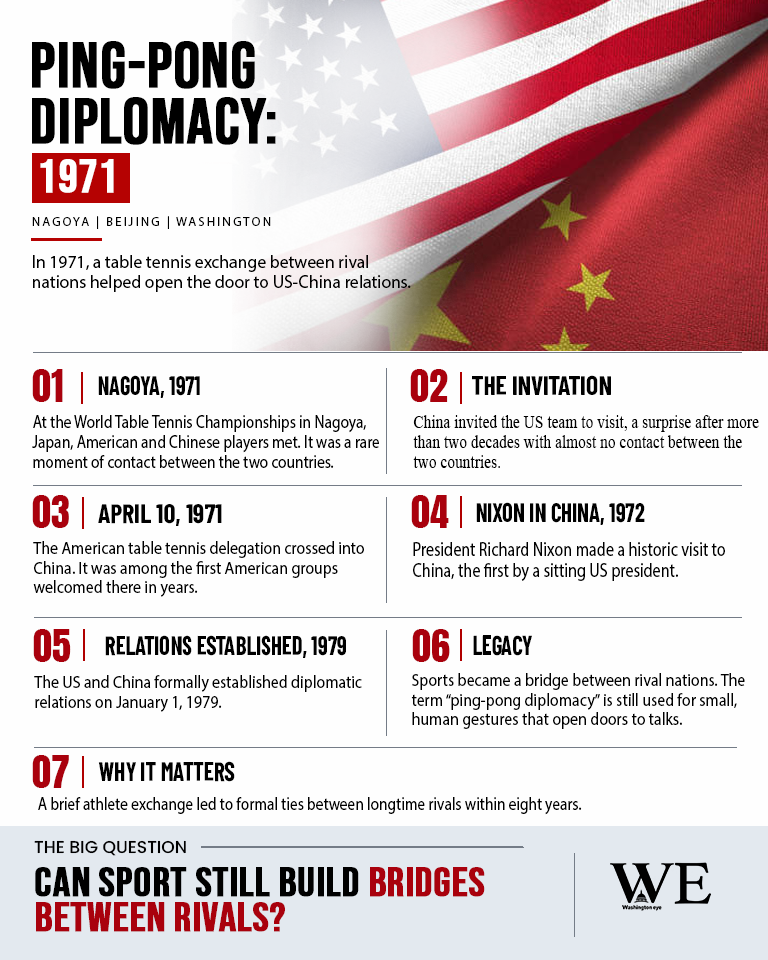
The breakthrough occurred during the 31st World Table Tennis Championships in Nagoya, Japan, when American player Glenn Cowan accidentally boarded a bus carrying members of the Chinese national team. At a time when Washington and Beijing had no formal diplomatic relations, Chinese champion Zhuang Zedong approached Cowan, shook his hand and presented him with a silk artwork depicting China’s Huangshan Mountains.
The friendly exchange attracted international media attention, creating an unexpected opportunity for dialogue between two countries divided by Cold War rivalries. Photographs of the athletes circulated widely, turning an ordinary sporting encounter into a symbol of possible reconciliation.

On April 6, 1971, China officially invited the American table tennis team to visit the country. Four days later, on April 10, nine American players, accompanied by officials and family members, crossed from Hong Kong into mainland China, becoming the first American delegation of its kind to enter the People’s Republic in decades.

During their visit, the athletes participated in exhibition matches, toured Chinese cities, visited the Great Wall and interacted with local communities. Chinese Premier Zhou Enlai personally welcomed the delegation, describing the exchange as the beginning of a new chapter in relations between the two peoples.
Why Ping-Pong Diplomacy Happened
The sporting exchange unfolded against a complicated geopolitical background. Following the Chinese Communist Revolution in 1949, the United States refused to recognize the newly established People’s Republic of China, maintaining diplomatic relations with the Republic of China government in Taiwan instead.
Tensions intensified during the Korean War, when American and Chinese forces fought on opposing sides. Throughout the 1950s and 1960s, ideological disagreements, restrictions on trade and competing strategic interests prevented meaningful diplomatic engagement.

However, by the early 1970s, both governments were reconsidering their positions. China faced deteriorating relations with the Soviet Union, while the United States sought to reshape the Cold War balance of power and explore opportunities for engagement with Beijing.
President Richard Nixon viewed improved relations with China as an important strategic objective. Chinese leader Mao Zedong similarly recognized that opening communication with Washington could strengthen China’s international position. The table tennis exchange therefore provided a politically acceptable opportunity to initiate public contact without immediately committing either government to formal diplomatic recognition.
From Sporting Exchange to Historic Diplomatic Breakthrough
The impact of Ping-Pong Diplomacy extended far beyond the sporting arena. On April 14, 1971, while the American delegation was still in China, Nixon announced measures easing restrictions on travel and trade involving the country. In July 1971, US National Security Adviser Henry Kissinger secretly traveled to Beijing, where he held discussions with Chinese leaders and prepared the groundwork for a presidential visit.
The diplomatic breakthrough culminated in February 1972, when Nixon became the first sitting American president to visit mainland China. During the historic trip, he met Mao Zedong and Zhou Enlai, opening negotiations that produced the Shanghai Communiqué. The document established a framework for improving bilateral relations despite continuing disagreements, particularly over Taiwan.
The sporting exchanges also continued. In April 1972, China’s table tennis team visited the United States, reinforcing the growing atmosphere of cooperation. Although full diplomatic normalization took several more years, Washington and Beijing formally established diplomatic relations on January 1, 1979, marking a major transformation in international politics.
Ping-Pong Diplomacy has since become a defining example of sports diplomacy, demonstrating how informal exchanges can create opportunities for political negotiations when conventional diplomatic channels remain restricted. Its legacy remains relevant in 2026 as the United States and China continue to navigate strategic competition, economic disagreements and geopolitical tensions.
While sporting exchanges cannot independently resolve complex political disputes, the events of 1971 illustrate how personal encounters and cultural engagement can help overcome diplomatic barriers. The historic episode ultimately demonstrated that international relations are not shaped exclusively by presidents, governments or military power. Sometimes, an unexpected conversation, a friendly gesture and a small table tennis ball can help change the course of world history.