
At least 68 people were killed and dozens injured after two high-speed passenger trains collided in central Spain on Wednesday morning, triggering a massive rescue operation and raising serious concerns about railway safety in a country that operates one of the world’s largest high-speed rail networks.
The accident occurred at approximately 8:53 a.m. local time near Urda on 28th Oct, 2026, in the province of Toledo, around 130 kilometres south of Madrid. The collision involved a train operated by Spain’s state-owned railway company Renfe and another belonging to private operator Iryo. Both trains were travelling along the Madrid-Seville high-speed corridor when the Renfe service struck the rear of the stationary Iryo train.
According to the latest figures reported by the Associated Press, the regional government of Castilla-La Mancha confirmed at least 68 fatalities, while 58 people required hospital treatment. Emergency officials warned that the situation remained serious as rescue teams continued searching damaged carriages for survivors and additional victims.

Authorities reported that approximately 544 passengers were aboard the two trains, including 397 travelling on the Renfe service and 147 on the Iryo train. The force of the collision derailed several carriages, leaving twisted metal and debris scattered along the railway embankment. Some passengers became trapped inside severely damaged compartments, complicating rescue operations.

Preliminary findings suggest that a malfunction in the railway signalling system, followed by an incorrect instruction from a central control centre, contributed to the disaster. Spanish Transport Minister Óscar Puente explained that a computer malfunction at approximately 8:30 a.m. disrupted the safety system across a 63-kilometre section of track, forcing trains operating in the affected area to stop.
However, the Renfe train was subsequently instructed to resume its journey without speed restrictions, despite a stop signal remaining active and the Iryo train still occupying the track ahead. The Renfe service collided with the stationary train approximately 23 minutes after the initial system failure.
Puente described the decision to allow the train to continue as inexplicable, although he emphasised that responsibility had not yet been formally established. Investigators were examining operational records, signalling information and train speeds to determine precisely how the accident occurred. The train may have been travelling at up to 200 kilometres per hour, but its actual speed at impact had not been confirmed.

Emergency services launched a large-scale response involving firefighters, police officers, medical personnel, ambulances and rescue helicopters. Spain’s Military Emergency Unit was also deployed to assist with operations. Temporary medical facilities were established near the accident site, while hospitals in the surrounding region prepared to receive injured passengers.
Witnesses described chaotic scenes as survivors attempted to escape through broken windows and damaged doors. Passengers reported being thrown from their seats as luggage and personal belongings flew through the carriages during the impact. Local residents and workers rushed towards the wreckage to provide assistance before emergency crews arrived.
The collision forced authorities to suspend high-speed railway services connecting Madrid with Ciudad Real and the southern Andalusia region. Railway infrastructure operator Adif confirmed that traffic had been halted, while affected passengers were offered options to change or cancel their journeys without additional charges.
Spanish Prime Minister Pedro Sánchez cancelled his scheduled engagements following the disaster and expressed solidarity with the victims and their families. King Felipe VI visited the crash site, while Queen Letizia joined him in expressing condolences. European Commission President Ursula von der Leyen also conveyed sympathy, saying Europe was mourning alongside Spain.
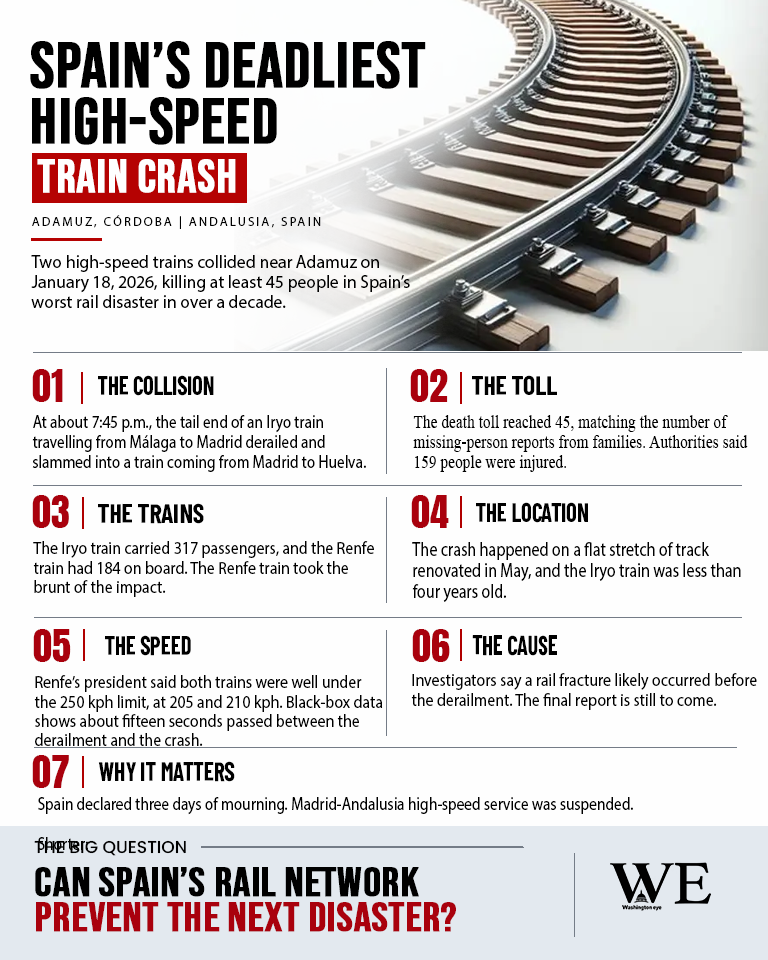
The tragedy comes just nine months after another deadly high-speed rail accident near Adamuz, in Córdoba province, on January 18, 2026. That collision claimed 46 lives and prompted widespread questions about the safety and maintenance of Spain’s railway infrastructure.
Spain operates approximately 3,900 kilometres of high-speed railway lines, making its network the second-largest in the world after China. The country has invested heavily in railway development over the past three decades, establishing high-speed trains as a central part of its national transportation system.
However, the second deadly high-speed rail disaster within a single year has intensified scrutiny of signalling systems, operational procedures and infrastructure maintenance. Railway union representatives have also raised concerns about whether maintenance investment has kept pace with increasing traffic following the introduction of private operators.
As investigations continue, Spanish authorities face mounting pressure to explain how a train was permitted to proceed towards an occupied section of track. The disaster has renewed urgent questions about passenger safety and the reliability of the systems designed to prevent collisions on Europe’s high-speed railway networks.