
Bank of America, the second-largest bank in the United States, has been hit with penalties totalling more than $1.21 billion by US financial regulators for widespread failures to detect and report suspicious financial transactions, including activities linked to Chinese money laundering networks and illicit financing along the US-Mexico border. The enforcement action, announced on October 13, represents the third-largest penalty in US Treasury Department history and has raised serious concerns about financial crime prevention within one of the world’s biggest banking institutions.
The penalties were imposed following investigations by the US Treasury Department’s Financial Crimes Enforcement Network (FinCEN), the Office of the Comptroller of the Currency (OCC) and the Office of Foreign Assets Control (OFAC). Regulators concluded that Bank of America had failed to maintain effective systems for identifying suspicious transactions, monitoring high-risk customers and reporting potential money laundering activities to federal authorities.
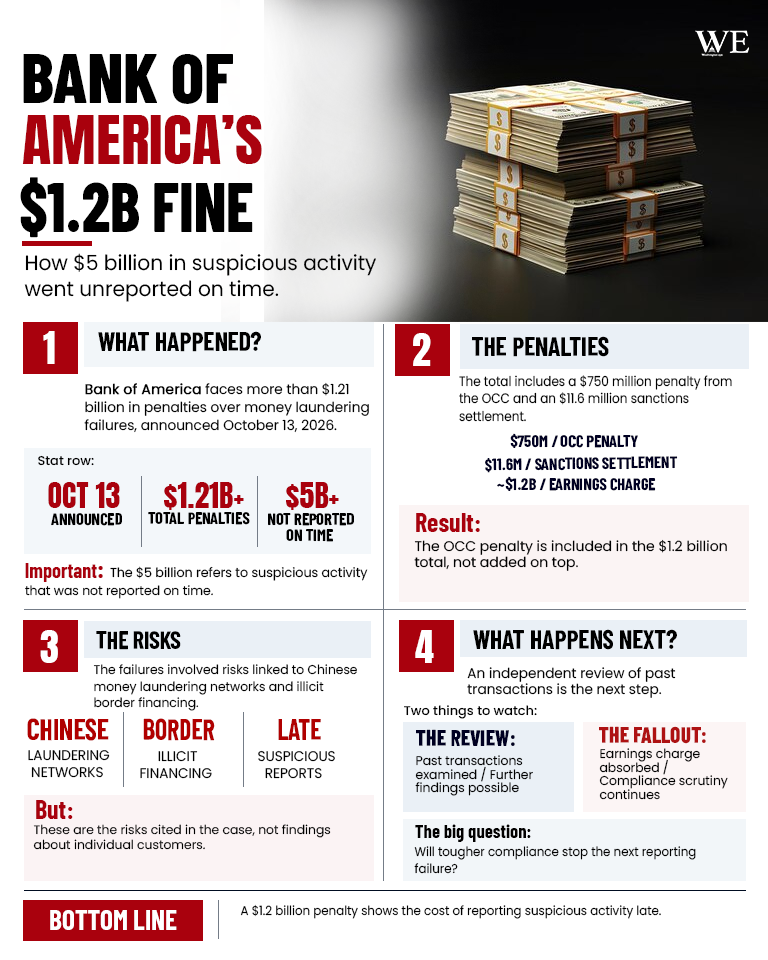
According to the Treasury Department, the bank failed to report more than $5 billion in suspicious financial activity on time, including over $1 billion associated with national security concerns and priority illicit finance risks. Investigators identified transactions potentially connected to Chinese money laundering networks and financial activities along the southwestern US border, areas that federal authorities consider particularly vulnerable to organised financial crime.
The largest component of the enforcement action was a $1.2 billion penalty assessed by FinCEN, which included a $750 million civil penalty imposed by the OCC. The OCC penalty was the largest in the regulator’s history. Separately, Bank of America agreed to pay approximately $11.6 million to settle apparent violations of US economic sanctions, bringing the overall financial penalties to more than $1.21 billion.

The investigation found that the bank’s anti-money laundering programme suffered from longstanding weaknesses, including inadequate transaction monitoring, delayed suspicious activity reports and insufficient internal controls. Regulators said the deficiencies allowed potentially suspicious financial activities involving billions of dollars to pass through the banking system without timely investigation or reporting.
Under the Bank Secrecy Act of 1970, American financial institutions are required to establish effective programmes to detect money laundering and report suspicious transactions to federal authorities. These requirements are intended to prevent banks from being used to facilitate drug trafficking, fraud, terrorism financing and other illegal activities.
Bank of America admitted that it had willfully violated provisions of the Bank Secrecy Act by failing to implement and maintain an adequate anti-money laundering programme, conduct required due diligence on certain foreign financial institution accounts and submit suspicious activity reports as required.
The OCC also criticised the bank for failing to resolve problems identified during previous regulatory examinations. In December 2024, the regulator issued a cease-and-desist order requiring Bank of America to strengthen its financial crime compliance systems. However, investigators found that significant deficiencies persisted despite the earlier warning.
According to the OCC, the bank’s transaction monitoring system failed to properly examine trillions of dollars in transactions. This resulted in numerous delayed suspicious activity reports involving billions of dollars, some displaying indicators commonly associated with money laundering. Regulators also identified weaknesses in staff training, management oversight and internal auditing procedures.
The separate sanctions settlement involved more than 400 apparent violations of US restrictions targeting countries and activities associated with Iran, Russia, narcotics trafficking and global terrorism. Authorities said the bank had processed millions of dollars in payments that potentially violated federal sanctions programmes.
US Treasury Secretary Scott Bessent emphasised the importance of financial institutions in protecting national and economic security, warning that failures by major banks can expose the wider financial system to illicit financial activity. He said the enforcement action demonstrated that large financial institutions remain accountable for complying with federal law.
Responding to the penalties, Bank of America acknowledged its responsibility to maintain effective financial crime controls and said it had invested billions of dollars in technology and employed thousands of staff members to combat financial crime. The bank maintained that it was making substantial progress towards addressing the issues identified by regulators.
As part of the settlement, Bank of America must appoint an independent third party to review historical transactions, identify suspicious activities that may have been overlooked and submit additional reports to FinCEN. The requirement is intended to strengthen accountability and ensure that previously undetected financial risks receive further scrutiny.
The financial consequences are also significant. Bank of America disclosed that the penalties would result in a non-tax-deductible charge of approximately $1.2 billion against its third-quarter 2026 earnings, reducing reported earnings by roughly 17 cents per share. Following the announcement, the bank’s shares declined approximately 2.7% in after-hours trading, reflecting investor concerns about compliance costs and regulatory scrutiny.
The enforcement action follows heightened scrutiny of major financial institutions over failures to prevent illicit transactions. Earlier in October, American Express also faced a $350 million penalty related to weaknesses in its anti-money laundering controls. The case highlights growing pressure on global banks to strengthen financial monitoring systems as international transactions become increasingly complex. Regulators are placing greater emphasis on identifying suspicious activities before they facilitate organised crime, sanctions evasion or other threats to financial security.
For Bank of America, the settlement represents a significant regulatory and financial setback. Beyond the immediate penalties, the bank faces continued oversight and the challenge of rebuilding confidence in its compliance procedures. The case also serves as a warning to financial institutions worldwide that inadequate monitoring and reporting systems can result in substantial penalties, even for the largest and most established banking organisations.