
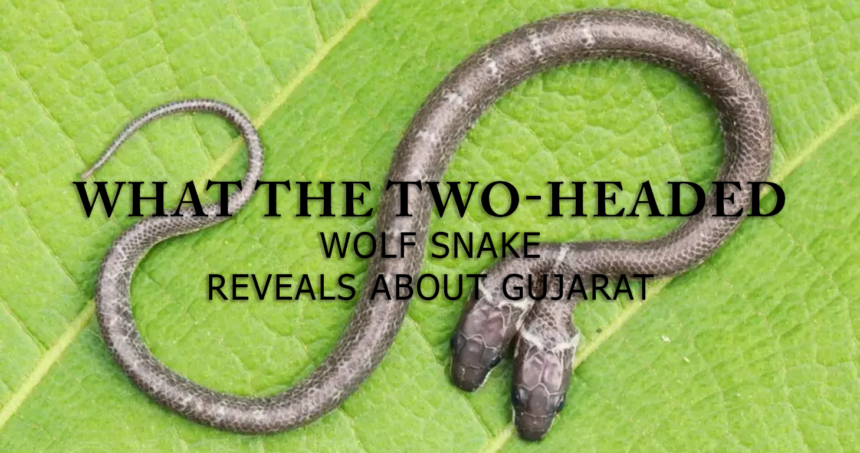
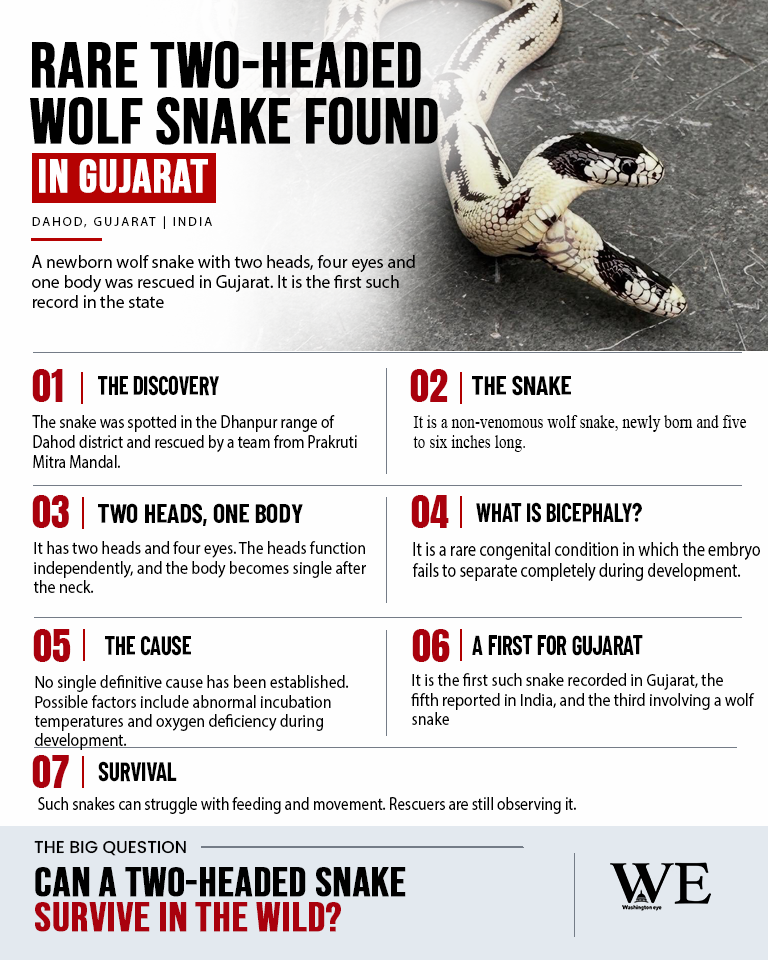
A rare two-headed wolf snake with four eyes and a single body has been discovered in India’s western state of Gujarat, attracting widespread attention from wildlife enthusiasts and researchers. The unusual reptile, measuring approximately five to six inches in length, was rescued from a village in Dahod district in early October, marking what rescuers describe as the first recorded case of a two-headed snake in the state and the fifth reported occurrence of its kind in India.
The extraordinary discovery was made in Agaswani village, located in Dhanpur taluka of Dahod district, where local residents spotted the unusual snake in a field and alerted a wildlife conservation organisation. Members of the Dahod Prakruti Mitra Mandal, a local nature protection group, subsequently arrived at the location and safely rescued the animal. The discovery was reported on October 6, 2026, with photographs and videos of the reptile quickly circulating across social media platforms.
Unlike ordinary snakes, the rescued reptile possesses two distinct heads, each with its own pair of eyes, connected to a single body below the neck. Both heads appear capable of functioning independently, making the animal an exceptionally rare example of a developmental abnormality known as bicephaly. Despite its unusual appearance, experts identified the creature as a wolf snake, a non-venomous reptile generally considered harmless to humans.
Kinnar Desai, convener and rescue team leader of Prakruti Mitra Mandal, explained that the team initially transported the snake to Dahod for observation before sending photographs to wildlife specialists for identification. The experts confirmed that the reptile belonged to the wolf snake group and displayed an exceptionally uncommon physical condition.

According to Desai, the discovery is particularly significant because such abnormalities are rarely documented in snakes. The rescue team estimates that the condition may occur in approximately one in a million snakes, although reliable population-wide estimates remain difficult to establish. The organisation also reported that four comparable two-headed snake cases had previously been documented in India, including examples involving cobras and sand boas.
The condition responsible for the snake’s unusual appearance is scientifically known as bicephaly, a form of polycephaly in which an animal develops more than one head. It generally occurs during embryonic development when the normal formation or separation of developing body structures is disrupted. In some cases, an embryo may begin dividing into identical twins but fail to separate completely, resulting in two heads sharing a single body.
Although the phenomenon may appear extraordinary, scientists have documented similar abnormalities in several animal groups, including reptiles, amphibians, birds and mammals. Two-headed snakes are among the better-known examples because their elongated bodies make the unusual anatomy particularly noticeable. However, the precise biological causes can vary, and not every case can be attributed to a single developmental mechanism.

One of the most fascinating aspects of bicephaly is the potential independence of the two heads. Each may possess separate brain structures and sensory organs, allowing them to respond differently to environmental stimuli. Consequently, one head might attempt to move in one direction while the other responds to something entirely different, creating serious coordination challenges.
These difficulties can make survival particularly challenging in natural habitats. Two-headed snakes may struggle to hunt, swallow prey, escape predators or coordinate movement. Feeding can become especially complicated if the two heads compete for food or if the internal digestive anatomy is abnormal. As a result, many animals born with such conditions have reduced chances of surviving in the wild.
Wolf snakes, belonging to the genus Lycodon, are generally small, non-venomous reptiles found across parts of Asia. They are known for their distinctive teeth and commonly feed on lizards and other small animals. Despite their intimidating name, wolf snakes are not wolves’ relatives; the name refers to their tooth structure. Following the rescue, the unusual snake was placed in a secure environment for observation and subsequently handed over to the Gujarat Forest Department for further care. Wildlife specialists have also received photographs to support scientific documentation and identification of the rare occurrence.
The discovery has attracted attention beyond India, with international media reporting on the reptile’s extraordinary appearance. Videos showing its two heads moving independently have generated curiosity about the biological processes responsible for such unusual physical development. Although the snake’s long-term survival remains uncertain, its discovery offers researchers an opportunity to better understand rare developmental abnormalities in reptiles. It also highlights the importance of wildlife rescue organisations in protecting vulnerable animals and documenting unusual occurrences in nature.