
Canada has confronted a significant challenge to its national unity after residents of Alberta, the country’s energy-rich western province, voted in a historic referendum on whether to begin a process that could eventually lead to independence. Although voters overwhelmingly rejected the proposal on October 19, the debate has exposed longstanding tensions over oil revenues, federal authority, economic inequality and Alberta’s relationship with Ottawa.
With approximately 76% voting to remain in Canada and 24% supporting the start of a separation process, the non-binding referendum delivered a clear result. However, separatist campaigners have insisted that the independence movement will continue, raising questions about the future of Canada’s federal system. Alberta is frequently described as Canada’s richest province because of its substantial oil and gas resources and high economic output per resident.
However, Ontario has Canada’s largest provincial economy in total GDP, making the distinction important. Alberta’s economic strength comes largely from its vast oil sands, petroleum production, agriculture and energy-related industries. The province has long been central to Canada’s position as a major global energy producer. Its economic contribution has also fuelled political disagreements, with some Albertans arguing that federal taxation, environmental policies and redistribution arrangements prevent the province from fully benefiting from its natural resources.

These grievances form part of a historical phenomenon known as Western alienation, referring to the perception that political decisions made in Ottawa disproportionately favour central Canadian provinces such as Ontario and Quebec. The roots of the dispute stretch back decades, particularly to the National Energy Program introduced by Prime Minister Pierre Trudeau’s government in 1980. The policy sought greater federal influence over the energy sector and became deeply unpopular in Alberta, contributing to lasting distrust of federal intervention.

More recently, disagreements intensified during former Prime Minister Justin Trudeau’s administration, when federal climate policies and restrictions affecting energy development generated strong opposition among some provincial politicians and industry groups. Supporters of independence argue that Alberta could exercise greater control over its resources, taxation, immigration and international trade as a sovereign country. They believe its substantial energy wealth could support an independent economy without the constraints imposed by the federal government.
However, opponents question whether resource wealth alone could offset the enormous financial and institutional costs of separation. An independent Alberta would need to establish or renegotiate arrangements involving national defence, currency, pensions, international borders, trade agreements and public administration.
Premier Danielle Smith, who called the referendum amid pressure from separatist elements within her governing United Conservative Party, did not campaign for independence. She previously estimated that establishing a separate country could involve approximately C$400 billion in transition costs, alongside substantial additional annual expenses. Other economic assessments have offered different estimates, illustrating the uncertainty surrounding such a scenario.

The referendum also highlighted the constitutional and Indigenous rights questions that any separation effort would face. First Nations leaders have opposed the independence movement, emphasising that historic treaties with the Crown predate Alberta’s establishment as a province in 1905. Under Canadian constitutional principles, a province cannot simply declare independence unilaterally. A clear expression of support for separation would require complex negotiations involving the federal government and other affected parties, with constitutional obligations and Indigenous treaty rights forming important considerations.
Prime Minister Mark Carney, who grew up in Alberta, campaigned for Canadian unity ahead of the vote. His government has also sought to address some of the province’s economic concerns by supporting energy infrastructure development and measures intended to diversify Canada’s international trade. Carney has emphasised Alberta’s importance to Canada’s economic future, particularly as the country faces trade tensions with the United States. His government has promoted infrastructure projects designed to expand energy exports and reduce dependence on American markets.
The United States has also entered the discussion. President Donald Trump’s previous statements about Canada becoming part of the United States, alongside comments by US Treasury Secretary Scott Bessent about Alberta, have complicated the political atmosphere surrounding the independence debate. Nevertheless, the referendum result indicates that dissatisfaction with Ottawa does not necessarily translate into support for leaving Canada. Many voters appear to favour stronger provincial autonomy while retaining the economic, political and social advantages of Canadian citizenship.
The result has also created political difficulties for Smith, whose party contains both supporters of Canadian unity and advocates of greater independence. Some separatist figures have criticised her position and signalled that they will continue organising despite the referendum defeat. The Alberta debate comes at a time when separatist politics have also regained attention in Quebec, where an independence-oriented party recently won provincial power. Together, these developments demonstrate the continuing challenges of maintaining unity within a geographically vast and politically diverse federation.
The October referendum did not end Alberta’s disagreements with Ottawa. It did, however, establish that a substantial majority of participating voters opposed initiating the path toward separation. For Canada, the next challenge is not an immediate loss of Alberta but the unresolved political and economic grievances that made independence a serious subject of public debate.
Opinion: Is Alberta’s Independence Debate Really About Leaving Canada?
The Alberta referendum presents an important distinction between economic frustration and the desire for political independence. Supporters of separation see an opportunity for Alberta to gain greater control over its energy wealth and government decisions. Their argument centres on provincial autonomy, fiscal fairness and the belief that federal policies have historically restricted Alberta’s economic potential.
Opponents argue that independence would introduce substantial financial uncertainty, disrupt established trade relationships and create difficult questions involving Indigenous treaties, national institutions and citizenship. The referendum suggests that many Albertans distinguish between dissatisfaction with federal policies and support for separation. The 76% vote to remain in Canada does not eliminate longstanding grievances, but it provides clear evidence that most participating voters did not want to initiate the independence process.
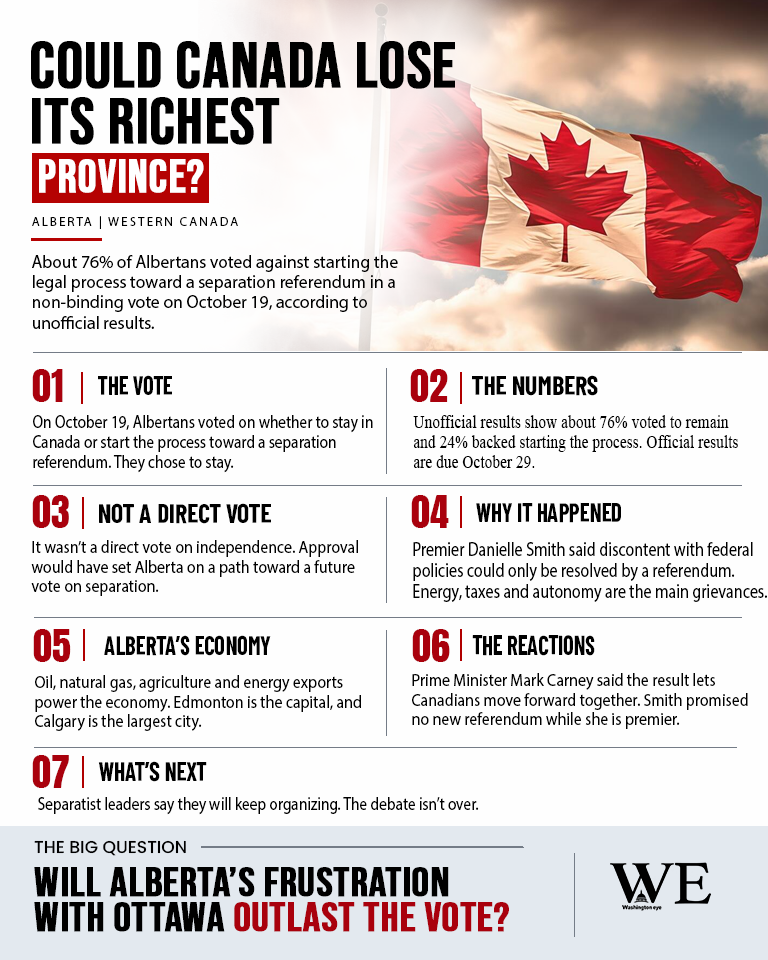
An important policy question now emerges: Can Ottawa and Alberta develop a more effective relationship over energy policy, economic development and provincial autonomy without reopening the question of national unity? The answer will depend on negotiations, government decisions and public confidence in the years ahead. The referendum has settled the immediate ballot question, but the broader debate over the balance of power within Canada’s federation remains relevant.