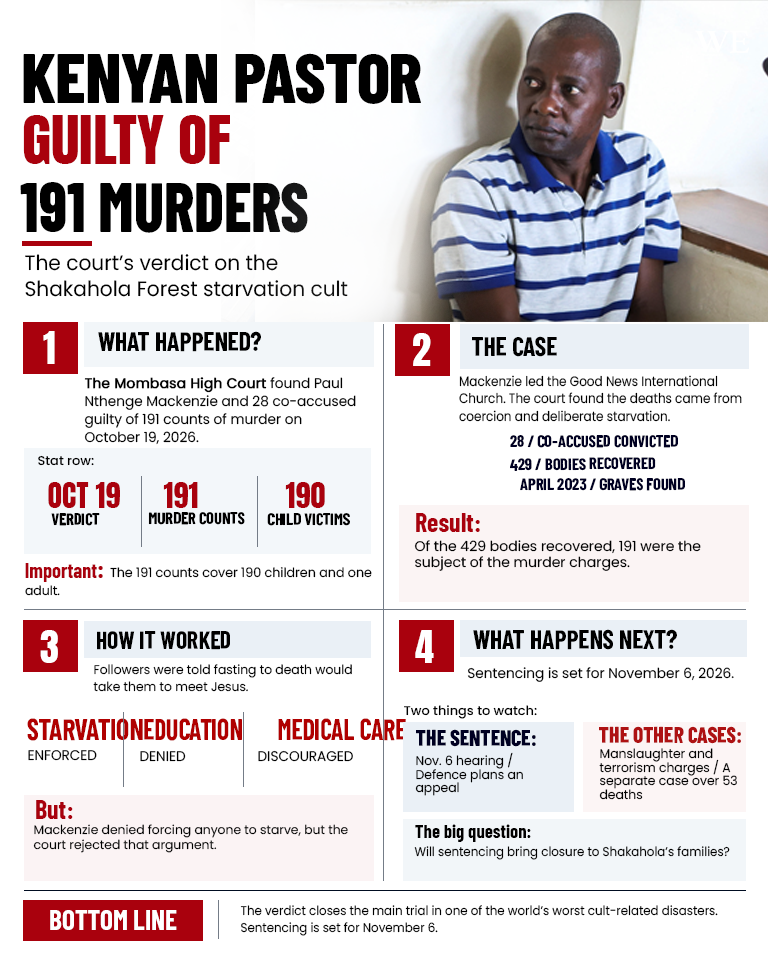
A Kenyan court has found self-proclaimed pastor Paul Nthenge Mackenzie guilty of murdering 191 people, including 190 children, in one of the most devastating cult-related tragedies in recent history. The verdict, delivered on October 19, 2026, follows a three-year investigation into a religious group whose followers were instructed to starve themselves and their children to death in the belief that they would reach heaven before the end of the world.
Mackenzie, the leader of Good News International Church, was convicted alongside 28 co-accused at the High Court in Mombasa. Justice Diana Kavedza Mochache ruled that prosecutors had established an organised system of enforced starvation in the Shakahola Forest, near the coastal town of Malindi. Sentencing is scheduled for November 6, with a mitigation hearing expected on October 30.
The case first shocked Kenya in April 2023, when police discovered shallow graves containing human remains in a remote forest in Kilifi County. What initially appeared to be an isolated incident soon developed into a massive investigation, with authorities eventually recovering more than 400 bodies. The victims included men, women and children who had reportedly been persuaded to abandon their homes and relocate to a secluded religious settlement. There, followers were subjected to increasingly extreme teachings about the end of the world and the supposed spiritual importance of fasting until death.
According to prosecutors, Mackenzie instructed his followers to stop eating so they could meet Jesus. The court heard that children were deliberately targeted first, followed by women, young men and eventually older men. Guards were reportedly deployed to prevent people from escaping or obtaining food, while those who resisted faced physical violence.

The court rejected Mackenzie’s defence that fasting had been voluntary. Evidence presented during the proceedings indicated that children had been denied food and isolated, sometimes while their parents watched. The judge concluded that the deaths resulted from deliberate actions and omissions by those implementing the fasting regime rather than from ordinary religious observance.
Mackenzie, a former taxi driver, established Good News International Church in 2003. Over the following years, he attracted followers through sermons, television broadcasts and online platforms, promoting apocalyptic teachings and warning that the world was approaching its end. He also discouraged followers from attending school or seeking medical treatment, portraying educational and healthcare institutions as incompatible with his religious doctrine. Families who joined the movement reportedly became increasingly isolated from wider society, making it difficult for relatives and authorities to intervene.
The tragedy has raised serious questions about how Mackenzie continued operating despite previous encounters with law enforcement. Kenyan authorities had investigated him as early as 2017, when police discovered children living at his compound without attending school. His church was shut down in 2019, but he subsequently relocated his activities to the Shakahola Forest.

The Kenya National Commission on Human Rights later criticised failures in investigation and prosecution, arguing that earlier intervention might have prevented numerous deaths. President William Ruto also acknowledged that government agencies should have acted to prevent the tragedy, accepting responsibility for the institutional failures that allowed the deaths to occur.
For the victims’ families, the verdict represents a significant moment after years of grief and uncertainty. Many relatives had struggled to locate missing family members, while the advanced decomposition of bodies complicated identification efforts. Francis Wanje, a 62-year-old grandfather who lost eight relatives, including two grandchildren, welcomed the judgment. He expressed hope that the case would encourage greater public awareness of religious organisations that exploit vulnerable followers.
Other families continue to await identification of their loved ones and answers about the circumstances of their deaths. Of the more than 400 bodies recovered from Shakahola, many remain unidentified, while investigations into deaths beyond the 191 murder counts are continuing. Mackenzie also faces separate legal proceedings involving allegations of terrorism-related offences and the deaths of 52 additional people in Kwa Binzaro village, approximately 30 kilometres from Shakahola. Prosecutors allege that he continued influencing followers while in detention. He has pleaded not guilty to those separate allegations.
His defence lawyer, Lawrence Obonyo, has indicated that the convictions will be appealed. The October 19 verdict therefore represents a major legal development, but further proceedings remain ahead. The case has renewed debate in Kenya over the regulation of religious organisations and the balance between protecting freedom of worship and preventing exploitation, coercion and abuse.
Kenya’s constitution protects religious freedom, but the Shakahola tragedy has prompted calls for stronger oversight, improved intelligence-sharing and faster intervention when children or vulnerable adults face serious harm. The conviction of Mackenzie and his associates marks an important stage in the pursuit of accountability for the Shakahola deaths. As families prepare for sentencing on November 6, the tragedy continues to raise urgent questions about institutional responsibility, safeguarding and the dangers of coercive religious control.