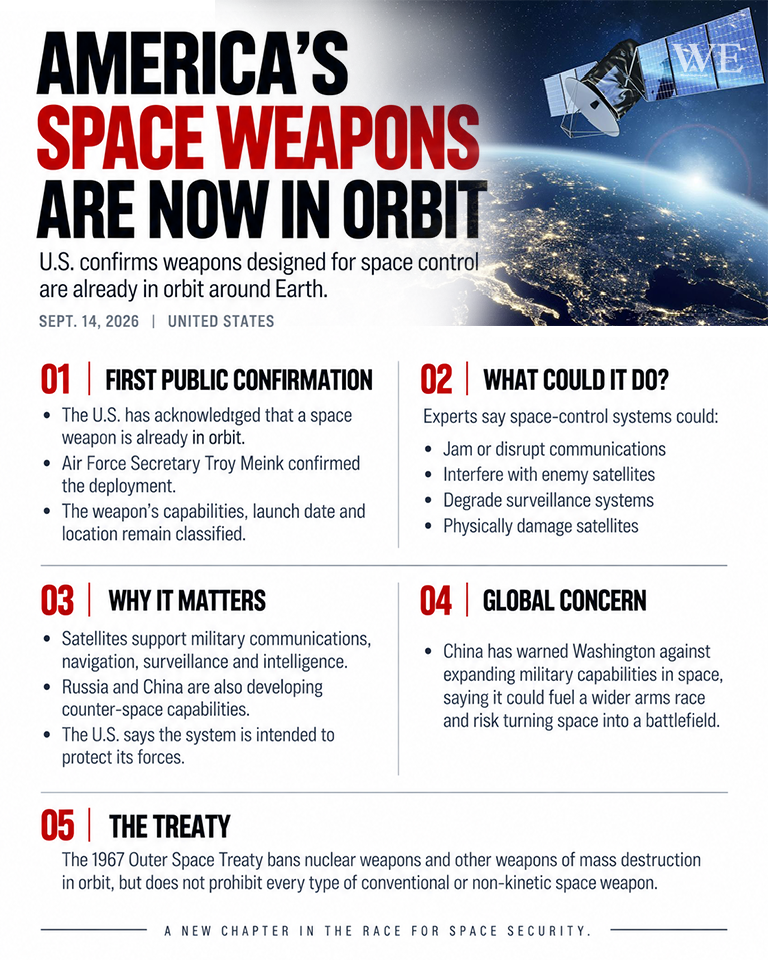
The United States has publicly confirmed something it had never acknowledged before: weapons designed for space control are already in orbit around Earth.
US Air Force Secretary Troy Meink made the disclosure on September 14 at the Air, Space and Cyber Conference in Maryland. He said the weapons were deployed to protect American forces from hostile actions.
What exactly is the weapon?
Meink did not reveal its design, number, launch date or location. US officials have also not said whether the system is designed to physically destroy another satellite or disable it without causing an explosion. That secrecy has opened the door to speculation.
Military experts say a space-control weapon could take several forms. It might use electronic warfare to disrupt satellite communications. It could potentially interfere with an enemy satellite’s systems. Another possibility is a kinetic weapon capable of physically damaging a spacecraft.
A destructive system, however, could create dangerous clouds of orbital debris. That debris can travel at enormous speeds and threaten other satellites, including those belonging to the country using the weapon.
The US says the capability is part of its response to an evolving security environment. Washington has repeatedly warned about Chinese and Russian advances in space, including technologies that could interfere with or attack satellites.
Satellites are now central to modern military operations. They support communications, navigation, surveillance and intelligence. That makes them valuable targets in any major conflict.
The announcement also highlights the growing role of the US Space Force, created in 2019 to organise and strengthen American military operations in space.
China reacted quickly.
Beijing urged Washington to stop expanding its military capabilities in outer space. Chinese Foreign Ministry spokesperson Guo Jiakun said China opposed turning space into a battlefield and warned that the move could fuel a wider arms race.
The disclosure comes against a wider backdrop of growing competition between Washington, Beijing and Moscow.
For decades, space was treated mainly as a domain for satellites, exploration and communications. Military powers have long used space technology, but openly acknowledging weapons in orbit marks a new level of transparency about offensive capabilities.
The 1967 Outer Space Treaty prohibits placing nuclear weapons and other weapons of mass destruction in orbit. It does not, however, ban every type of conventional or non-kinetic space weapon.