
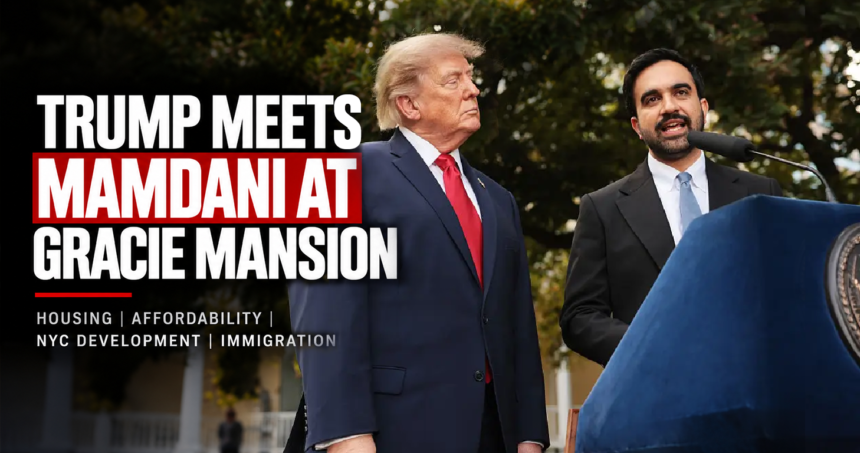
New York City Mayor Zohran Mamdani hosted US President Donald Trump at Gracie Mansion on September 21, 2026, for an unusual high-level meeting that brought together two political figures with sharply different ideologies but a shared focus on New York’s housing and cost-of-living challenges.
Trump visited the mayor’s official residence while in New York for the United Nations General Assembly, making the stop before his scheduled address to world leaders. The approximately hour-long meeting was the third face-to-face encounter between Trump and Mamdani and their first in New York since Mamdani took office. Their previous meetings were held at the White House.
The meeting attracted particular attention because Mamdani, a democratic socialist, and Republican President Trump have frequently disagreed on immigration, economic policy and the role of government. Their political relationship, however, has become notably more cooperative since Mamdani’s election as mayor.
Housing Takes Centre Stage
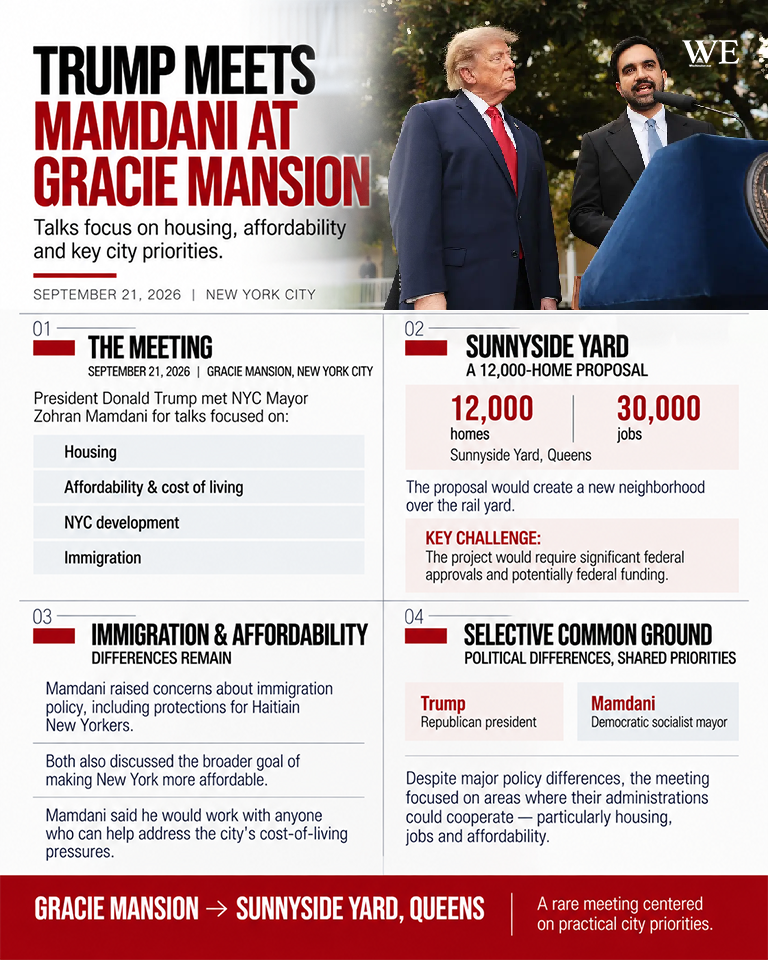
The most concrete issue discussed at Gracie Mansion was Sunnyside Yard, the enormous rail yard in Queens that New York officials have long considered for redevelopment. Mamdani said the proposed development could create as many as 12,000 homes and 30,000 jobs, potentially establishing an entirely new neighbourhood at a time when housing costs remain one of the biggest financial pressures facing New Yorkers.
The mayor announced that City Hall and the White House had agreed to establish a new level of discussions between their housing and operations teams to examine how the project could move forward. Trump acknowledged that the project would be difficult because of its scale and the federal government’s involvement. He said Sunnyside Yard would require significant federal approvals and probably federal financial support. No final agreement on funding was announced, meaning the meeting opened another channel for negotiations rather than securing the project’s construction.
Trump also indicated that a substantial portion of any development should provide housing for low- and moderate-income residents. The scale of the proposal helps explain why cooperation between City Hall and Washington matters. Mamdani has made affordability and housing central to his administration, while federal approvals and potentially billions of dollars in federal assistance could be necessary to transform the rail yard.
Immigration and Political Differences Remain

Housing was not the only subject discussed. Mamdani also raised concerns about the Trump administration’s immigration policies, particularly the removal of Temporary Protected Status for Haitian immigrants. Mamdani argued that Haitian New Yorkers contribute significantly to the city, including through healthcare, hospitality and other sectors. Trump acknowledged that the mayor had raised the issue but gave no indication after the meeting that his administration would reverse its policy.
The exchange demonstrated the unusual nature of the Trump-Mamdani relationship. Cooperation on housing and affordability has not eliminated substantial differences over immigration and other national policies. Mamdani said he was willing to work with people from any political party when cooperation could improve New Yorkers’ lives. Trump similarly stressed that he wanted the mayor and New York City to succeed.
The atmosphere contrasted sharply with the rhetoric surrounding Mamdani during his rise to City Hall. Trump had previously attacked Mamdani politically and called him a communist, while Mamdani has strongly criticised Trump and his policies. Their meetings since the mayoral election, however, have generally been far more cordial.
Why the Gracie Mansion Meeting Matters
Beyond the immediate policy discussions, the setting carried political symbolism. Gracie Mansion is the official residence of New York City’s mayor, and Trump described returning there as something resembling “old home week,” recalling his long history in New York before entering national politics.
The meeting also came as the United States moves closer to the 2026 midterm elections, when control of Congress will be at stake. Mamdani has become one of the country’s most visible democratic socialist politicians, while Trump and other Republicans have repeatedly criticised democratic socialism and sought to connect Democratic candidates with its policies.
That creates an apparent political tension: the president continues to attack left-wing politics nationally while maintaining a comparatively cooperative relationship with one of its most prominent elected representatives. Some political coverage has consequently focused on whether the cordial relationship complicates Republican attempts to use Mamdani as a symbol in midterm campaigning.
For Mamdani, maintaining communication with the White House has practical implications. New York relies on federal cooperation and funding across housing, infrastructure, immigration, security and other areas, making a functioning relationship with Washington potentially valuable even where major political disagreements remain.
For Trump, the meeting provided an opportunity to focus on an issue closely connected to his pre-political career in New York real estate while presenting cooperation with a political opponent on a major urban development proposal.
The critical question is whether the warm public appearance produces concrete results. Sunnyside Yard has been discussed for decades, and its engineering complexity, cost and need for federal involvement remain substantial obstacles. Trump himself noted the project’s long history and did not announce a funding commitment.
For now, the Gracie Mansion meeting represents an unusual example of political rivals maintaining sharp ideological disagreements while pursuing selective cooperation. The next test will be whether the newly promised discussions between City Hall and White House officials can turn the ambitious Sunnyside Yard proposal from a long-discussed idea into an achievable housing project.