
Protein powders have moved far beyond bodybuilding culture. Whey, casein, soy, pea and other protein supplements are now routinely added to smoothies, breakfasts and post-workout drinks by athletes, older adults and people simply trying to increase their daily protein intake. But as their popularity grows, an important question remains: is protein powder actually healthy?
For most healthy adults, protein powder can be a convenient and generally safe way to supplement dietary protein. However, nutrition experts emphasise that it is not essential for good health, does not automatically build muscle and should not replace a balanced diet. Its usefulness depends largely on how much protein a person already consumes, their activity level, health conditions and the quality of the product.
Research supports a role for additional protein in promoting muscle growth and recovery when combined with resistance exercise. A major meta-analysis involving 49 studies and 1,863 participants found that protein supplementation produced modest additional improvements in muscle mass and strength during prolonged resistance training. Importantly, the benefit levelled off at around 1.6 grams of total protein per kilogram of body weight per day.

What Is Protein Powder and Why Do People Use It?
Protein powders are concentrated sources of dietary protein. Whey and casein come from milk, while plant-based versions can be produced from peas, soy, rice, hemp and other sources. Whey is particularly popular because it contains all nine essential amino acids and is rich in leucine, an amino acid involved in stimulating muscle protein synthesis.

People commonly use protein powder to support muscle growth, exercise recovery, maintenance of muscle mass or simply to reach their daily protein target when obtaining enough from meals is difficult. A scoop commonly supplies around 20–30 grams of protein, although the amount varies substantially between products.
The important distinction is that protein powder itself does not create muscle. Resistance training provides the major stimulus for muscle growth, while sufficient dietary protein supplies amino acids needed to repair and build tissue. Research suggests exercise itself contributes much more to strength and muscle development than adding a protein supplement alone. Protein also has functions extending far beyond muscles. It is required for enzymes, hormones, antibodies and the maintenance and repair of tissues throughout the body.
How Much Protein Do You Actually Need?

Protein requirements vary considerably. Rather than thinking in terms of “how many scoops of protein powder,” the more useful question is how much total protein a person consumes from food plus supplements. For a relatively sedentary healthy adult, commonly used baseline recommendations are around 0.8 grams of protein per kilogram of body weight each day. People who exercise regularly, particularly those performing resistance training, commonly consume more.
Evidence from resistance-training research suggests that around 1.6 g/kg/day of total protein is sufficient to maximise muscle-building benefits for many healthy adults. Increasing intake beyond this point did not produce further average gains in fat-free mass in a large meta-analysis.
For example, a 70 kg adult consuming 1.6 g/kg would be targeting approximately 112 grams of protein per day. That does not mean 112 grams should come from protein shakes. If the person’s normal meals already provide 90 grams, one shake containing approximately 20–25 grams could conveniently close the gap.
Research also suggests spreading protein across the day is sensible rather than consuming enormous amounts at once. The same meta-analysis highlighted approximately 0.25 g/kg per serving as a practical approach in younger adults undertaking resistance training. For many people, a serving containing roughly 20–30 grams of protein is therefore adequate.
Does It Have to Be Taken Immediately After Exercise?
The famous post-workout “anabolic window” is less rigid than supplement marketing sometimes suggests. Protein around exercise can be useful, but evidence indicates that total daily protein intake is more important than obsessing over the exact minute a shake is consumed.
The meta-analysis found that factors including precise post-exercise dose and timing played relatively minor roles in long-term improvements compared with obtaining sufficient protein overall. Someone who has eaten a protein-rich meal close to their workout therefore does not necessarily need to immediately drink a shake.
Benefits: Who May Actually Gain From Protein Powder?
Protein powder is primarily about convenience. Someone who already obtains sufficient protein from eggs, fish, meat, dairy products, lentils, beans, tofu, nuts and other foods may gain little from adding a supplement. It can be useful, however, for athletes with higher protein requirements, people performing regular resistance training, vegetarians or vegans struggling to reach their targets, people with limited time for meals and selected older adults who have difficulty consuming enough protein.
Protein supplementation alongside resistance training has been associated with additional improvements in fat-free mass and strength, although the improvements from supplementation are modest compared with those produced by resistance training itself.
Protein may also increase satiety, potentially helping some people feel fuller for longer. But a protein shake should not automatically be regarded as a weight-loss drink: calories still count, and products containing large amounts of sugar, fats or other ingredients can substantially increase total energy intake.
What Are the Risks?
For most healthy people, sensible protein supplementation is unlikely to cause major problems. But “protein powder” describes thousands of different products rather than one standardised substance. Some powders contain added sugar, sweeteners, flavourings, thickeners, caffeine, vitamins, herbal ingredients or other supplements. Consumers therefore need to look beyond the protein number on the front of the package.
Quality control is another consideration. In the United States, the Food and Drug Administration does not approve dietary supplements for safety and effectiveness before they reach the market. Manufacturers are responsible for ensuring their products meet applicable safety requirements. FDA manufacturing rules are intended to protect against contamination with substances including pesticides, heavy metals and other impurities.
This is not merely theoretical. In February 2026, the FDA issued a warning letter concerning a facility processing whey protein isolate after identifying manufacturing and sanitation violations. The case does not mean whey protein generally is unsafe, but it illustrates why manufacturer quality matters. Choosing products independently tested by reputable third-party certification programmes can therefore provide additional reassurance about composition and contamination.
Digestive symptoms are another common issue. Whey concentrate contains lactose and can cause bloating, abdominal discomfort or diarrhoea in some people with lactose intolerance. Whey isolate generally contains less lactose, while plant proteins offer an alternative. Milk, soy and other ingredients can also trigger reactions in people with relevant allergies.
What About the Kidneys and Liver?
One of the biggest concerns surrounding protein powder is whether high-protein diets damage the kidneys. The distinction between healthy people and people with existing kidney disease is important. Evidence does not justify treating ordinary protein intake or moderate supplementation as inherently kidney-damaging in healthy adults.
However, people with chronic kidney disease may need carefully controlled protein intake because the kidneys are involved in handling the metabolic products generated from protein. Their appropriate intake depends on kidney function, dialysis status and other clinical factors.
Anyone with kidney disease should therefore discuss protein supplements with their doctor or dietitian rather than following gym-oriented high-protein recommendations. People with significant liver disease, metabolic disorders, pregnancy-related nutritional concerns or complex medical conditions should similarly obtain individual advice before making major changes to protein intake.
The Critical View: Useful Supplement, Not a Health Requirement
The biggest misconception may be that protein powder is inherently healthier than ordinary food. It is not. A chicken breast, eggs, Greek yoghurt, fish, beans, lentils, tofu and other protein-rich foods provide protein while also delivering varying combinations of iron, calcium, vitamins, healthy fats, fibre and other nutrients. A purified protein powder cannot necessarily provide that nutritional complexity.
Protein powder should therefore be viewed exactly as its name suggests: a supplement. Its strongest case is convenience. If someone requires 100 grams of protein each day and comfortably obtains that amount through nutritious meals, there is little reason to add another 30 grams simply because protein shakes are popular.
Conversely, if someone regularly struggles to meet an appropriate protein target, a simple, well-tested powder can be an efficient solution. More is also not automatically better. Research showing diminishing muscle-building benefits beyond roughly 1.6 g/kg/day illustrates why repeatedly adding shakes to an already high-protein diet may provide little additional benefit.
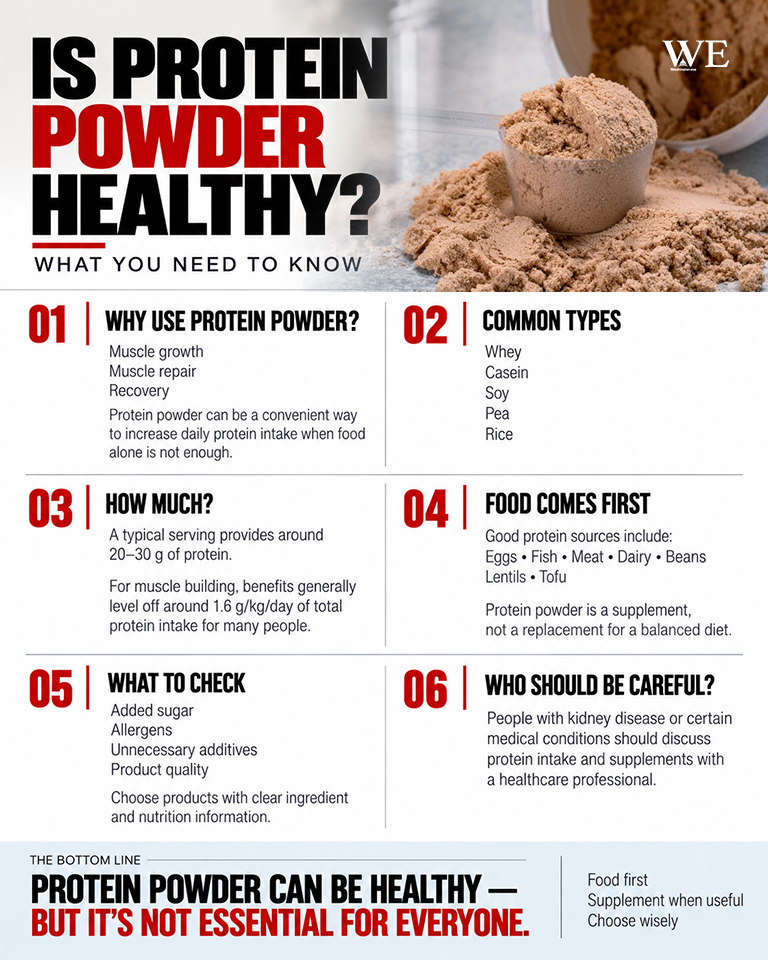
Ultimately, protein powder can be healthy, unnecessary or poorly chosen, depending on the individual and product. The strongest evidence supports a straightforward approach: prioritise a balanced diet, exercise regularly, calculate protein needs based on individual circumstances and use protein powder to fill a genuine nutritional gap rather than treating it as a shortcut to fitness.