When wars divide the international community, some countries choose a different path: they remain neutral. But neutrality does not necessarily mean staying silent, avoiding diplomacy or refusing to condemn another country. It is primarily a legal and security status governing how a state behaves during armed conflict.
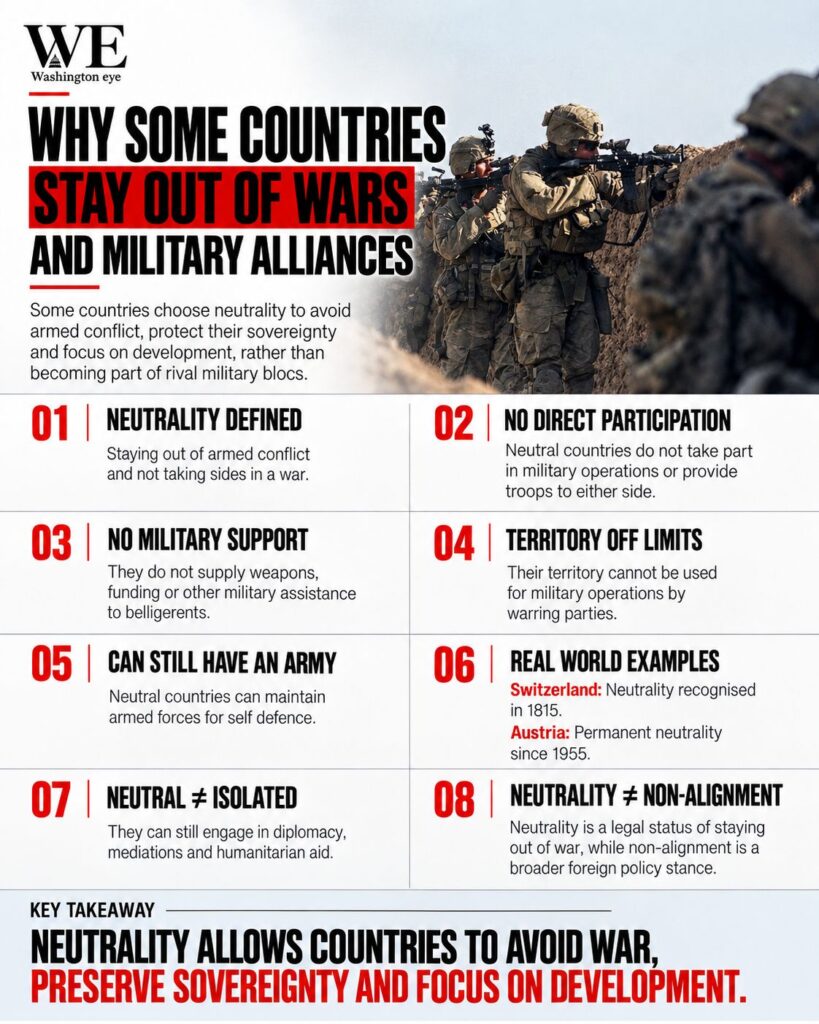
In international law, a neutral state is one that does not become a party to an international armed conflict. The modern legal framework is rooted largely in the Hague Conventions of 1907, which establish rights and obligations for neutral countries during war. At its simplest, neutrality means not taking part militarily in a war between other states.
A neutral country generally cannot send its armed forces to fight for one side, provide direct military support to a belligerent or allow its territory to be used for military operations. In return, the territory of a neutral state is supposed to be respected by the warring parties. Neutrality, however, is much more complicated in modern international politics.
Switzerland, Austria and Different Forms of Neutrality
Perhaps the world’s best-known example is Switzerland, whose neutrality was formally recognised internationally in 1815. Switzerland describes its system as “permanent and armed neutrality.” Permanent means it intends to remain neutral in future wars between states rather than deciding its position only after a particular conflict begins. Armed means Switzerland maintains military forces capable of defending its territory. Neutrality therefore does not mean having no army.
Switzerland does not belong to NATO, but it joined the United Nations in 2002 and participates in NATO’s Partnership for Peace. It also conducts diplomacy, participates in international organisations and can provide humanitarian assistance. Austria adopted permanent neutrality in 1955, after the post-Second World War Allied occupation ended. Its constitutional Neutrality Act states that Austria will maintain and defend its permanent neutrality, will not join military alliances and will not permit foreign military bases on its territory.
Yet Austria is also a member of the European Union. This demonstrates an important distinction: political and economic integration does not automatically eliminate military neutrality. Austria’s legal framework has been adapted over time to accommodate its EU membership. Neutrality also varies between countries. Switzerland’s government notes that states including Austria, Ireland and Costa Rica pursue forms of permanent neutrality, but each country interprets and implements its position differently.
Neutrality Does Not Mean Being Neutral About Everything

One of the biggest misconceptions is that a neutral country must have no opinion about a war. That is not necessarily true. The law of neutrality primarily concerns military conduct during international armed conflict. A neutral government can maintain diplomatic relations, participate in international organisations and, depending on its legal interpretation and policies, adopt economic or political measures.
Neutrality is therefore different from political indifference. A government might condemn an invasion, support humanitarian assistance or participate in diplomatic negotiations while continuing to regard itself as militarily neutral. Switzerland, for example, adopted economic sanctions against Iraq during the Gulf War and has continued to develop its interpretation of neutrality as the international system has changed.
There is also an important difference between neutrality and non-alignment. A country that does not belong to a military alliance is not automatically neutral. “Non-aligned” broadly describes a state that avoids formal alignment with major military blocs, whereas neutrality carries particular implications during armed conflict. Similarly, neutrality can be permanent or conflict-specific. A state may have a longstanding policy of neutrality, or it may simply remain neutral in one particular war.
Why Do Countries Choose Neutrality?
Countries adopt neutrality for different historical and strategic reasons. For smaller states, neutrality can be intended to protect sovereignty and reduce the risk of being drawn into conflicts between larger powers. Geography can also matter, particularly when a country sits between competing military blocs.
Austria’s experience demonstrates this logic. During the Cold War, its neutrality emerged partly from negotiations surrounding the end of Allied occupation and the country’s position between NATO members in Western Europe and the Soviet-led bloc in the east. Neutrality can also strengthen a country’s diplomatic role.
Switzerland has used its neutral status and humanitarian tradition to offer diplomatic “good offices,” represent countries that lack diplomatic relations and host negotiations and international organisations. Geneva consequently became one of the world’s major centres of international diplomacy.
Does Neutrality Protect a Country From Attack?
Not automatically. Neutrality creates legal rights, including respect for neutral territory, but it is not a physical guarantee against invasion. A state may therefore combine neutrality with substantial national defence. Switzerland’s concept of armed neutrality explicitly assumes that the country must be capable of defending its territory and preventing belligerents from using it for military purposes.
This produces one of neutrality’s central paradoxes: remaining outside a war may require maintaining credible military capabilities. Neutrality also becomes harder to define when warfare involves cyberattacks, sanctions, intelligence cooperation, weapons transfers and multinational organisations rather than conventional armies alone.
Critical View: Can Neutrality Still Work Today?
The wars and geopolitical tensions of the 21st century have renewed debate over whether traditional neutrality remains practical. Supporters argue that neutral countries can avoid military entanglements, preserve diplomatic channels and act as intermediaries during conflicts. Neutrality may also give smaller countries greater independence from competing military powers.
Critics argue that neutrality can become increasingly difficult when countries are deeply economically, politically and technologically interconnected. Questions over sanctions, military equipment, intelligence sharing and collective security can blur the boundary between neutrality and participation.
Even the legal framework is evolving. Austria’s Parliament notes that scholars continue to debate how rules originating in the Hague Conventions apply to today’s international system, particularly alongside the United Nations and modern international humanitarian law. Neutrality therefore does not simply mean “we don’t choose sides.”
In its legal sense, it means a country does not become a participant in an international armed conflict and accepts corresponding restrictions on how it can assist the warring parties. In its broader political sense, neutrality is a strategic choice about how a state protects its independence while navigating rival powers.
For countries such as Switzerland and Austria, it has survived world wars, the Cold War and profound changes in European security. The question today is not whether neutrality still exists, but how far its traditional rules can stretch in an era when the line between war, economic pressure and security cooperation is increasingly difficult to draw.