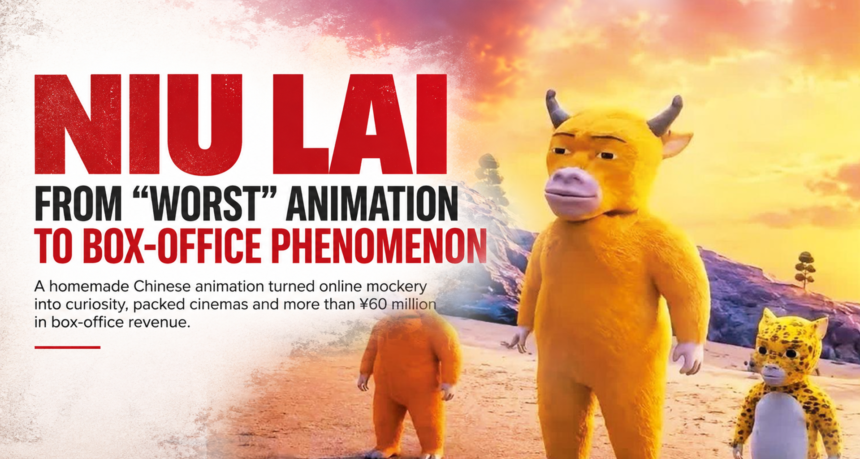
A crudely animated film about a young calf has become one of China’s strangest entertainment success stories of 2026. Niu Lai (牛来), variously translated as The Cow Is Coming or The Bull Comes, arrived in cinemas with almost no publicity, primitive-looking visuals and tiny initial ticket sales. Weeks later, it had become an internet obsession, generating memes, handmade posters, merchandise and tens of millions of yuan at the box office.
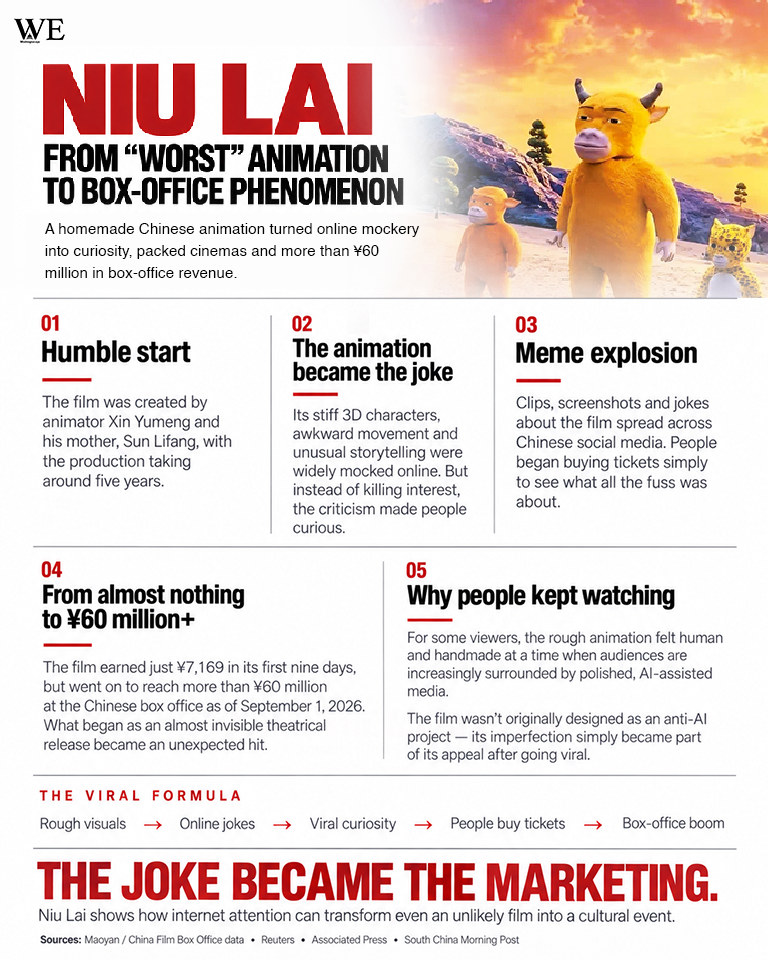
Released in China on August 5, 2026, the 86-minute animated film initially appeared destined to disappear unnoticed. Reports citing Chinese box-office trackers showed it earning only around 7,000–8,000 yuan during its first nine or ten days. By September 1, however, its cumulative box office had crossed 60 million yuan, illustrating one of the most dramatic viral turnarounds of China’s summer movie season.
From Tiny Homemade Project to Internet Sensation
Niu Lai was directed by Xin Yumeng and made largely by Xin and his mother, Sun Lifang, over roughly five years. Their production company, Dalian Jingyuan Culture Film and Television Media, had roots in the interior decoration business rather than mainstream animation. The mother-and-son team reportedly took on numerous jobs themselves, including writing, animation, production and voice work. Its exact production cost has been inconsistently reported online. Viral claims that the entire movie cost only a few hundred dollars are poorly substantiated. More reliable reporting describes a shoestring budget costing only thousands of dollars, still extraordinarily small compared with conventional feature animation.
The story follows a newborn calf through a surreal, dreamlike coming-of-age adventure involving his mother, other animals and his gradual discovery of courage. Yet it was not primarily the plot that caught viewers’ attention. It was how the movie looked. Characters appeared stiff, environments were extremely basic and some objects looked more like unfinished computer models than cinema-quality animation. Critics and social-media users mocked its visual effects, awkward movements and unusual storytelling. One widely discussed example showed grass represented by crude yellow blocks, while other elements were compared to objects from an old video game. Instead of destroying the movie, those criticisms became its greatest advertisement.

Memes, Handmade Posters and the “So Bad It’s Good” Effect
By mid-August, clips and screenshots began spreading rapidly across Chinese social media. People started buying tickets simply to discover whether Niu Lai really was as strange as the internet claimed. Audiences filmed reactions, created memes and jokingly treated the film as a cinematic masterpiece. Its ironic fandom was later compared internationally with the meme-driven cult popularity surrounding movies such as Morbius and The Room.
The lack of conventional marketing made the story even more unusual. Some cinemas reportedly received few or no proper promotional materials, leading employees to draw their own Niu Lai posters by hand. Photos of these improvised signs circulated online, becoming another meme and reinforcing the film’s homemade identity.

Soon, watching Niu Lai became less about judging animation quality and more about participating in an internet event. Memes, cosplay and merchandise followed. Its roughness was even celebrated by some younger viewers as evidence that the movie had actually been made by humans rather than generated or polished using artificial intelligence. Reuters reported that the phenomenon fed a broader conversation among young Chinese audiences about rejecting slick marketing and AI-produced content.
The numbers reflected the transformation. After earning barely more than $1,000 during its disastrous opening period, Niu Lai crossed $4 million while the craze was accelerating in August. By August 31, trackers were reporting close to 60 million yuan, or more than $8 million, in cumulative ticket sales; the 60-million-yuan milestone was subsequently reported on September 1.
Why Did Niu Lai Become So Popular?
The success of Niu Lai demonstrates how internet culture can overturn traditional ideas about what makes a movie successful. Normally, poor reviews, limited advertising and visibly inexpensive production would be commercial disadvantages. For Niu Lai, they became the selling points. Its bizarre visuals provided endlessly shareable material, while its mother-and-son production story gave audiences an underdog to support. The handmade cinema posters added another layer to the joke, and each new box-office milestone generated more social-media attention, encouraging another group of curious viewers to buy tickets.
Still, industry observers have cautioned against treating the phenomenon as a repeatable formula. Deliberately producing a bad-looking movie is unlikely to guarantee viral success. Niu Lai benefited from a rare combination of irony, authenticity, timing, memes and audience participation. What began as one of the summer’s smallest releases ultimately became a cultural event. Niu Lai may never be remembered for technical animation excellence, but its journey from near-empty screenings to a multimillion-yuan viral hit shows that in the social-media age, sometimes being mocked by everyone can be far more valuable than being advertised to everyone.