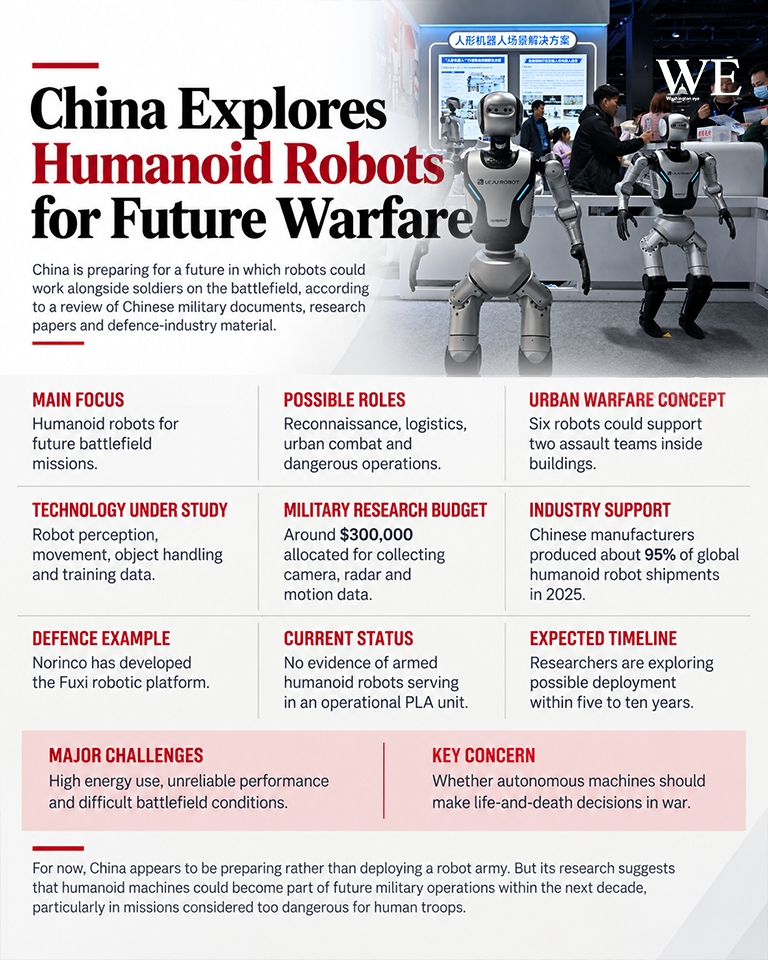
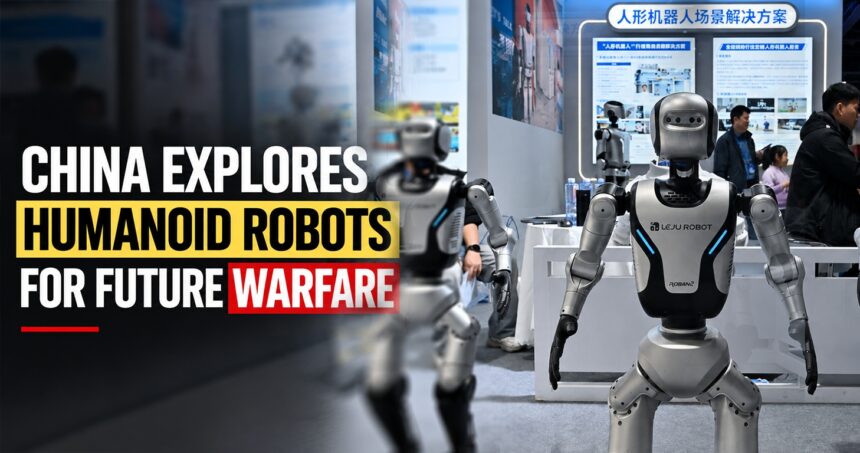
China is preparing for a future in which robots could work alongside soldiers on the battlefield, according to a review of Chinese military documents, research papers and defence-industry material.
The People’s Liberation Army is studying how humanoid robots could be used for reconnaissance, logistics, urban combat and other high-risk missions. The research comes as China’s commercial robotics industry expands rapidly and military planners seek to transfer civilian technology into defence applications.The issue gained attention after the World Humanoid Robot Games, where machines competed in running, boxing and other events. Soon after the competition, the PLA’s official newspaper urged researchers to speed up the movement of advanced technologies from laboratories into military training and operations.
Chinese military institutions are now testing robots against battlefield requirements. Their work focuses not only on the machines themselves, but also on perception systems, movement, object handling and the large amounts of data needed to train them.
One proposed scenario involves six robotic platforms, including humanoid robots, robot dogs and unmanned vehicles supporting two assault teams during an urban operation. The robots could potentially enter dangerous buildings, carry equipment, gather information or perform tasks that would expose human soldiers to serious risks.
Chinese researchers have also examined systems capable of collecting camera, radar and motion data. Such technology could help robots understand difficult terrain and operate in environments that are unpredictable and dangerous.

Norinco, a state-owned military company, has developed the Fuxi robot, one example of China’s growing interest in remotely operated and potentially autonomous battlefield systems.
Now what are the obstacles? Humanoid robots require substantial energy, can be unreliable outside controlled environments and may struggle with damaged buildings, rough ground, poor visibility and rapidly changing combat conditions. Experts say robots that perform well during demonstrations may not yet be ready for real battlefield conditions.
Chinese manufacturers accounted for about 95% of global humanoid robot shipments in 2025, providing access to components, engineering expertise and production capacity.

But, the use of autonomous machines in war raises concerns about accountability, civilian protection and whether a robot should ever be allowed to make life-and-death decisions without direct human control. For now, China appears to be preparing rather than deploying a robot army. But its research suggests that humanoid machines could become part of future military operations within the next decade, particularly in missions considered too dangerous for human troops.