
From ancient Roman cities and imperial palaces to coral reefs, forests and archaeological landscapes, the UNESCO World Heritage List continues to grow as countries seek international recognition and protection for places considered to have “outstanding universal value.” Following the latest round of inscriptions in 2026, Italy remains the country with the largest number of UNESCO World Heritage Sites, closely followed by China.
The World Heritage Committee added 25 new properties to the list during its 48th session in Busan, Republic of Korea, in July 2026. The additions brought the worldwide total to 1,273 World Heritage Sites across 173 countries, according to UNESCO. Of the newly inscribed properties, 19 are cultural, five natural and one mixed.
Italy and China Lead the World

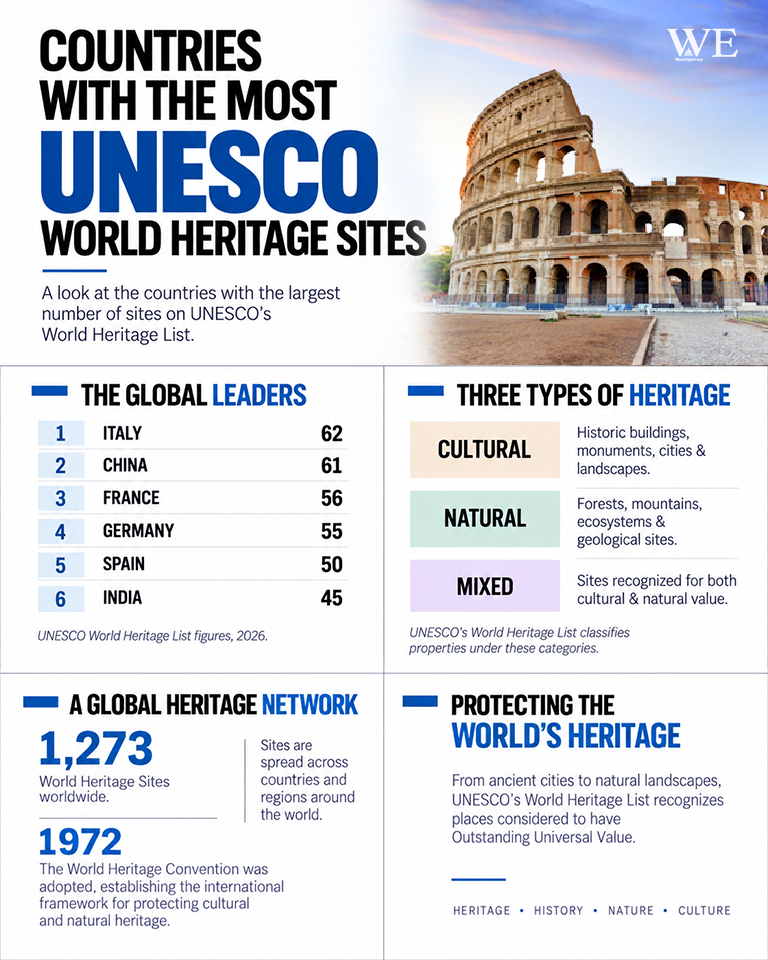
Italy holds the top position with 62 UNESCO World Heritage Sites. Its enormous concentration of historic cities, archaeological remains, churches, landscapes and artistic centres reflects the many civilizations that have shaped the Italian peninsula. Among its internationally recognised treasures are the historic centres of Rome, Florence and Naples, the archaeological areas of Pompeii, Venice and its lagoon, and the Dolomites. UNESCO currently classifies 56 of Italy’s properties as cultural sites.
China follows closely with 61 World Heritage Sites. Its collection stretches across thousands of years of history and an enormous geographical area, ranging from the Great Wall and the Forbidden City to ancient settlements, mountains, forests and areas of exceptional biodiversity. China currently has 42 cultural World Heritage properties, alongside natural and mixed sites.

France is in third place with 56 sites, including the Palace and Park of Versailles, Mont-Saint-Michel, Chartres Cathedral and the historic centre of Avignon. France increased its total in 2026 with the inscription of the Beaches of the D-Day Landings, Normandy, 1944, recognising a landscape with major historical significance connected to the Second World War.
Germany follows with 55 World Heritage Sites, ranging from Aachen Cathedral and Cologne Cathedral to the Bauhaus sites and historic towns, industrial complexes and cultural landscapes. Spain has 50 sites, including the Alhambra in Granada, the works of Antoni Gaudí, the historic centre of Córdoba and the archaeological site of Atapuerca.
India has also rapidly expanded its presence on the World Heritage List and now has 45 properties. Its latest addition in 2026 was the Ancient Buddhist Site of Sarnath, one of Buddhism’s most important sacred locations. India’s total includes 37 cultural, seven natural and one mixed World Heritage property. Outside Europe and Asia, Mexico leads the Americas with 36 sites, including major archaeological and natural areas. The United Kingdom has 35 World Heritage properties.

Why Does UNESCO World Heritage Status Matter?
The modern World Heritage system originates from the 1972 Convention Concerning the Protection of the World Cultural and Natural Heritage. Countries nominate places that they believe possess outstanding universal value, but inscription requires detailed assessment and a decision by the World Heritage Committee.
Being added to the list is more than a tourism distinction. Governments accept long-term responsibilities for conservation, management and protection. UNESCO describes inscription as the beginning of an enduring commitment to safeguard a property and ensure that local communities can benefit from it.
World Heritage status can significantly increase international attention and tourism, creating economic opportunities for surrounding communities. At the same time, popularity can create new pressures. Overcrowding, uncontrolled construction, pollution, climate change, natural disasters and armed conflict can threaten heritage properties, requiring authorities to balance visitor access with conservation.
When a World Heritage property faces serious threats, UNESCO can place it on the List of World Heritage in Danger, drawing international attention to the need for urgent conservation measures. During the 2026 committee session, six properties were added to that list.
A More Global World Heritage List
The 2026 meeting also highlighted efforts to make the World Heritage List more geographically representative. Comoros, São Tomé and Príncipe and South Sudan received their first-ever World Heritage inscriptions, expanding representation from countries that previously had no properties on the list.
The development is important because the number of sites held by a country does not necessarily measure the value of its heritage. Countries entered the World Heritage Convention at different times and have different financial, technical and administrative capacities to prepare nominations and conservation plans.
UNESCO says 23 States Parties still have no inscribed World Heritage property, even after the latest additions. The organisation has therefore continued efforts to address geographical imbalances and provide greater support to underrepresented countries.
More than five decades after the World Heritage Convention was adopted, the list has become a global record of humanity’s cultural achievements and the planet’s exceptional natural environments. Italy may currently have the highest number of sites, but the continued expansion of the list shows that World Heritage is increasingly being understood not as a competition between countries, but as a shared responsibility to preserve irreplaceable places for future generations.