The Swiss Alps, long celebrated as a symbol of natural beauty and stability, are increasingly becoming a warning sign of the climate crisis as scientists, authorities and mountain communities grapple with the growing threat of collapsing glaciers. A series of alarming incidents, including the catastrophic destruction of the Alpine village of Blatten in 2025, has intensified concerns that Switzerland’s glaciers are entering a dangerous new phase marked not only by melting ice but also by sudden and devastating collapses.
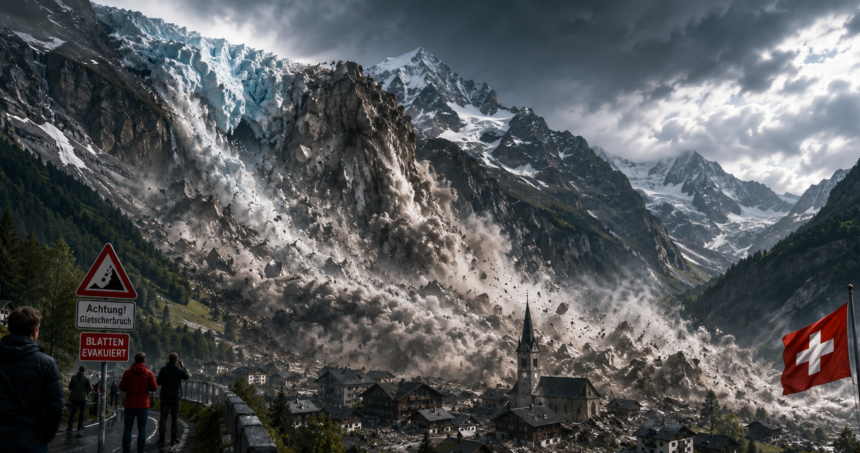
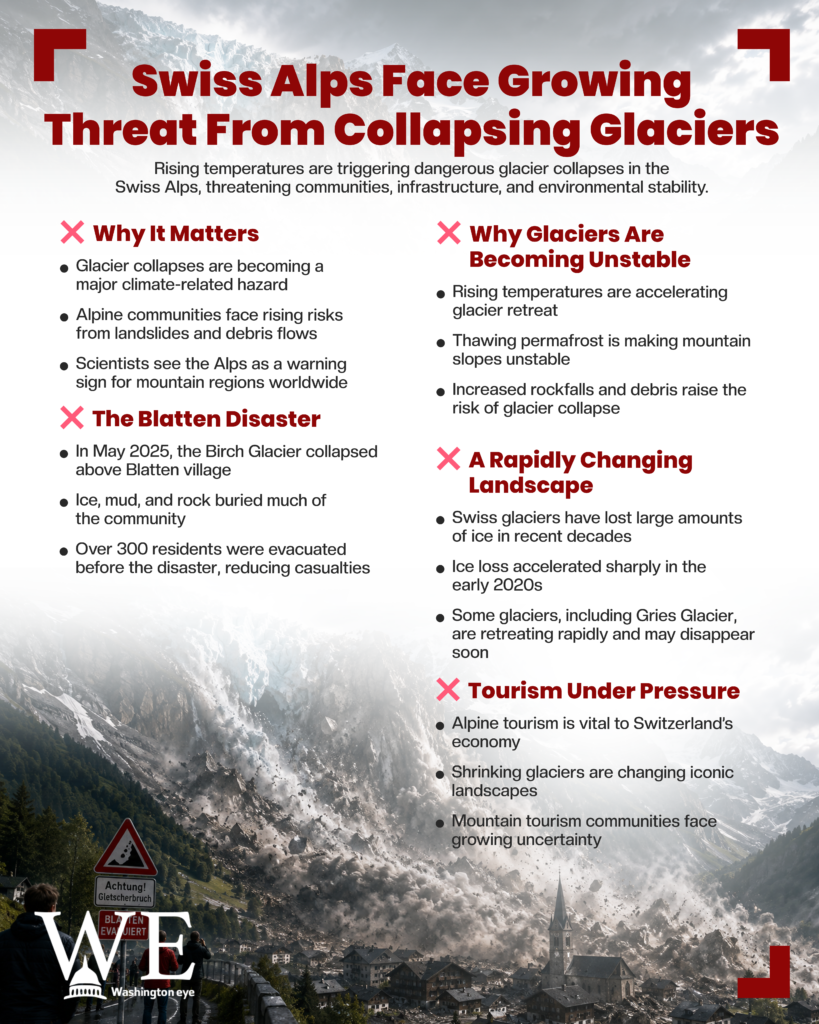
The issue has become particularly urgent in the canton of Valais, where mountain communities live beneath glaciers and steep rock faces that have remained relatively stable for centuries. In May 2025, the Birch Glacier above the village of Blatten collapsed after millions of tonnes of rock and debris accumulated on its surface, triggering a massive avalanche of ice, mud and rock that buried much of the village. More than 300 residents had been evacuated days earlier after geologists detected signs of instability, preventing a far greater human tragedy. Nevertheless, the event destroyed homes, infrastructure and livelihoods, leaving a lasting scar on the region.
Scientists say the collapse is part of a broader pattern linked to climate change. Rising temperatures across the Alps are accelerating glacier retreat while simultaneously thawing permafrost, the permanently frozen ground that acts like a natural cement holding mountain slopes together. As this frozen foundation weakens, rock faces become unstable, sending large volumes of debris onto glaciers below. The additional weight and friction can destabilize glaciers and increase the likelihood of sudden collapse. Experts caution that while each event has unique geological factors, climate change is amplifying the risks across high-mountain environments.

The scale of glacier loss in Switzerland is already dramatic. According to glacier monitoring data, Swiss glaciers have lost a substantial share of their ice volume over recent decades, with particularly severe losses recorded in the early 2020s. Researchers warn that many smaller glaciers could disappear entirely within decades if current warming trends continue. The Gries Glacier, one of the country’s monitored glaciers, has been retreating rapidly, while scientists estimate that some lower-elevation ice masses may vanish within just a few years.

Beyond the immediate danger of glacier collapses, the melting ice is reshaping Switzerland’s environmental and economic landscape. Glaciers serve as natural water reservoirs, feeding rivers that support agriculture, hydropower generation and drinking-water supplies. Their decline threatens long-term water security and could increase the frequency of floods, landslides and debris flows. Tourism, a cornerstone of many Alpine economies, is also under pressure as iconic glaciers shrink and mountain landscapes change.
Communities across the Alps are adapting to a reality that would have seemed unimaginable only a generation ago. Advanced monitoring systems now track glacier movement, rockfall activity and seismic signals around vulnerable mountain regions. Authorities have increasingly relied on early-warning systems and precautionary evacuations to protect residents. The successful evacuation of Blatten before the glacier collapse is widely viewed as evidence that modern monitoring can save lives, even when it cannot prevent destruction.
Public reaction in Switzerland has been a mixture of grief, resilience and concern. Former residents of Blatten have begun rebuilding their lives in nearby communities while debating whether and how the village can be reconstructed. Many remain determined to return despite the uncertainty. Swiss officials have pledged financial support for recovery efforts, while scientists continue studying the disaster to better understand how climate-driven changes are altering Alpine landscapes.

The challenge extends beyond Switzerland. Similar glacier-related disasters have occurred in other mountain regions, including Italy and parts of the Caucasus, highlighting the global nature of the threat. Researchers increasingly view the Alps as a frontline laboratory where the impacts of climate change can be observed in real time. What happens in Switzerland today may foreshadow risks facing mountain communities worldwide in the decades ahead.
Looking to the future, scientists warn that glacier retreat and mountain instability are likely to intensify as global temperatures continue to rise. While improved monitoring and adaptation measures can reduce casualties, they cannot halt the underlying warming trend. For Switzerland, the challenge is no longer simply preserving its glaciers; it is learning how to live with a rapidly changing Alpine environment where landscapes once considered permanent are becoming increasingly unpredictable. The fate of the Swiss Alps is emerging as one of the clearest illustrations of how climate change is transforming the world’s high mountains and the communities that depend on them.