Health authorities are warning residents and tourists to take precautions against so-called “flesh-eating bacteria” after new cases were reported during the 2026 summer season. The renewed concern mainly involves Vibrio vulnificus, a potentially deadly bacterium found naturally in warm coastal and brackish waters, particularly where freshwater mixes with seawater. At least nine infections had been confirmed in Florida by July 8, exceeding the number recorded at the same point in 2025. Earlier cases were identified in Miami-Dade, Hillsborough, Lee, Palm Beach and St. Johns counties.
Although commonly described as “flesh-eating,” the bacterium does not literally consume human flesh. Instead, severe infections can destroy skin, fat and tissue surrounding the muscles, producing a rapidly progressing condition called necrotising fasciitis. Vibrio vulnificus is one possible cause, while Group A Streptococcus and several other bacteria can also trigger the condition. The infection is considered a medical and surgical emergency because tissue damage and bloodstream infection can develop within hours.
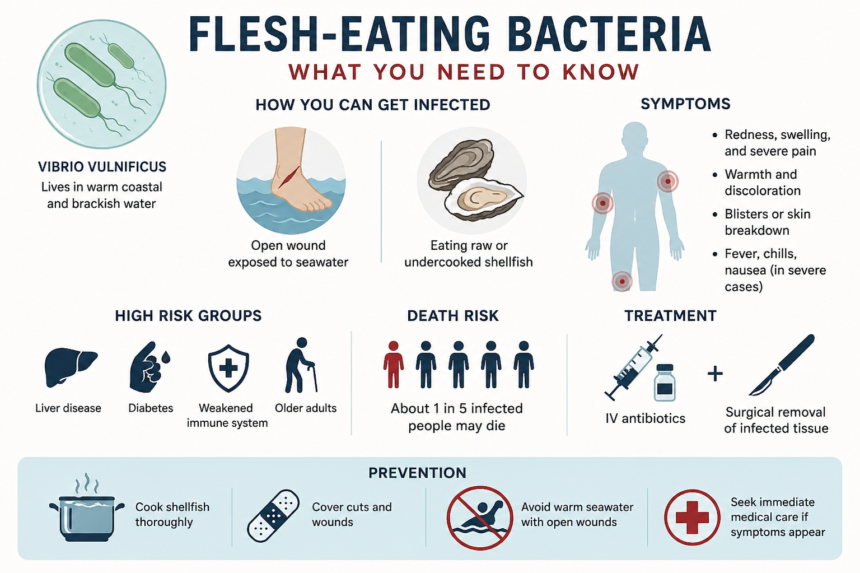
People usually become infected when an open wound, cut, burn, piercing or recent surgical site is exposed to contaminated seawater or brackish water. Infection may also follow the consumption of raw or insufficiently cooked seafood, particularly oysters and other shellfish. However, eating contaminated seafood more commonly causes diarrhoea or bloodstream infection rather than a wound infection. There is no evidence that ordinary Vibrio vulnificus infections spread directly from one person to another.
The bacterium becomes more active between May and October as water temperatures rise. Florida and Louisiana have historically recorded many US cases because their warm coastal environments provide favourable conditions. Florida experienced a major increase after Hurricane Helene in 2024, when flooding increased contact between people, contaminated coastal water and debris. State figures recorded 82 Vibrio vulnificus cases and 19 related deaths during 2024. In 2025, Florida reported 33 cases and five deaths.

The threat is not limited to the United States. European health specialists have warned that warmer seas are making coastal regions increasingly suitable for Vibrio bacteria. Risk areas have been identified around parts of France, the Netherlands, Germany, Denmark, Poland, Romania, Bulgaria, Estonia, Finland, Spain and the United Kingdom. Scientists say higher sea temperatures, heatwaves, storms and coastal flooding may lengthen the period during which the bacteria can survive and expand their geographical range.
Early symptoms of a wound infection include increasing redness, swelling, warmth, discharge and severe pain, particularly pain that appears greater than expected from the visible injury. The skin may become discoloured, and fluid-filled blisters can appear. If the infection reaches the bloodstream, patients may develop fever, chills, dangerously low blood pressure, confusion and septic shock. Gastrointestinal infection may cause watery diarrhoea, abdominal cramps, nausea and vomiting.
People with chronic liver disease, diabetes, cancer, weakened immune systems, kidney problems or conditions requiring immune-suppressing medicines face the greatest danger. Older adults and people with excessive alcohol-related liver damage are also more likely to develop life-threatening bloodstream infections. Florida health authorities say approximately one in five people infected with Vibrio vulnificus dies, sometimes within one or two days of becoming seriously ill. Many survivors require intensive care, repeated operations or limb amputation.

Treatment must begin immediately. Doctors normally administer intravenous antibiotics, while surgeons urgently remove infected and dead tissue through a procedure known as surgical debridement. The US Centers for Disease Control and Prevention recommends combinations including doxycycline and a third-generation cephalosporin for serious Vibrio vulnificus infections, although treatment may be adjusted according to the patient’s condition and laboratory findings. Severely damaged limbs may require amputation to prevent the infection from spreading.
The World Health Organization does not treat “flesh-eating bacteria” as the name of one specific disease; it is a popular term covering several forms of necrotising soft-tissue infection. Public-health agencies emphasise surveillance, rapid diagnosis, infection prevention and appropriate antibiotic use rather than panic. Experts advise people to cook shellfish thoroughly, avoid eating raw oysters, cover wounds with waterproof dressings and stay out of coastal water when cuts or broken skin are present. Anyone experiencing rapidly worsening pain, swelling, fever or skin changes after seafood consumption or seawater exposure should seek emergency medical care without delay.