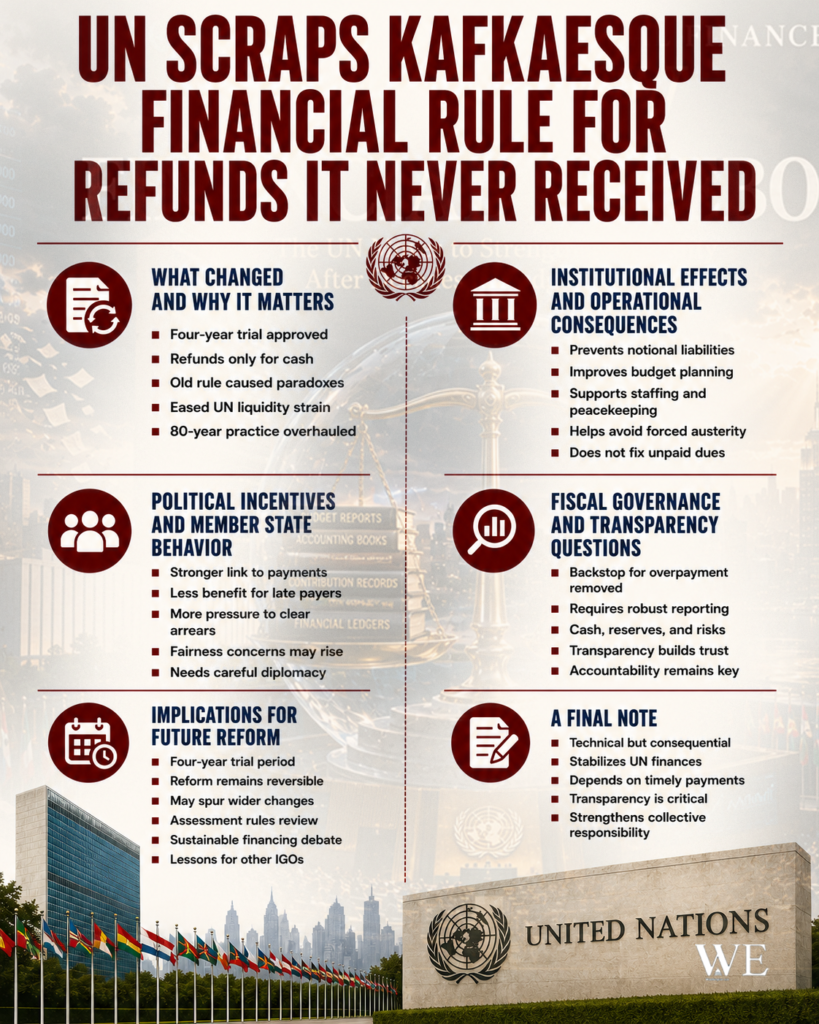

The United Nations General Assembly has approved a procedural change removing a long standing requirement that the Organization refund unspent budget credits to Member States even when those funds were never paid, a move framed by officials as a pragmatic fix to an increasingly acute liquidity problem. This decision alters an 80 year old accounting practice and shifts how the UN matches budget authority to actual cash flows, with implications for institutional resilience, member state incentives, and fiscal governance.
What Changed and Why it Matters
The Assembly accepted a Fifth Committee recommendation to trial, for four years, a new methodology under which unspent amounts will be returned to Member States only when those amounts are backed by cash rather than by notional credits. UN leadership argued the old rule produced paradoxical outcomes where the Organization was obliged to issue credits against future assessments for funds that had never been collected, amplifying a liquidity shortfall and complicating budget execution. Secretary General António Guterres and other officials have warned that record arrears left the UN exposed to a potential cash crisis, and that the refund rule was an avoidable source of fiscal strain.
Institutional Effects and Operational Consequences
At a practical level, the rule change should prevent the automatic creation of liabilities on the books that do not reflect actual cash, improving the Secretariat’s ability to plan and to honour operational commitments such as staffing and peacekeeping expenditures. Analysts note the UN entered 2026 with unusually high outstanding dues and near depleted reserves, forcing austerity measures that risk program continuity; removing the obligation to refund uncollected sums reduces one driver of forced cuts. That said the adjustment does not solve the underlying problem of late or withheld contributions, which continue to pose existential risks to the Organization’s regular and peacekeeping budgets.
Political Incentives and Member State Behavior
Changing the refund rule alters the incentives facing Member States. Under the old rule, delayed payments could paradoxically produce refunds that softened the fiscal signal for nonpayment; the new approach strengthens the link between payment behavior and the costs of underfunding. This may increase pressure on major contributors to settle arrears, while also heightening disputes over fairness if cash based refunds are perceived to disadvantage states with legitimate payment constraints. Diplomatically sensitive implementation and clear communication will be essential to avoid politicization of the issue during the trial period.
Fiscal Governance and Transparency Questions
While the reform simplifies the cash accounting picture, it raises governance questions about transparency and accountability. Member States historically adopted the refund provision as a backstop against budget excess and to protect contributors from overpayment; removing it requires equally robust reporting on cash inflows, reserves, and contingency planning so contributors retain confidence that budgets are neither inflated nor mismanaged. The Secretariat’s pledge to use the change to manage resources more predictably will be judged against the timeliness of published financial statements and the effectiveness of any new liquidity mechanisms.
Implications for Future Reform
The four year trial frames the change as experimental and reversible, which may ease acceptance but also leaves open the prospect of further reform to assessment rules, arrears management and contingency reserves if cash shortfalls persist. This episode could catalyze broader debates about sustainable financing for multilateral institutions in a period of geoeconomic strain, with lessons applicable beyond the UN to other international organizations reliant on assessed contributions.
A Final Note
The General Assembly’s recalibration is a technical but consequential step toward stabilizing UN finances; its ultimate success will depend less on accounting mechanics than on member states’ willingness to pay on time and on the Secretariat’s transparency in demonstrating that the reform strengthens, rather than circumvents, collective fiscal responsibility