The latest United Nations report on children and armed conflict portrays 2025 as a turning point, not only in the sheer number of violations against children but in who is responsible for them and how they are carried out. It signals a deeper crisis in the international protection regime and raises uncomfortable questions about the conduct of national armed forces and the credibility of global norms.
National Forces as Primary Perpetrators
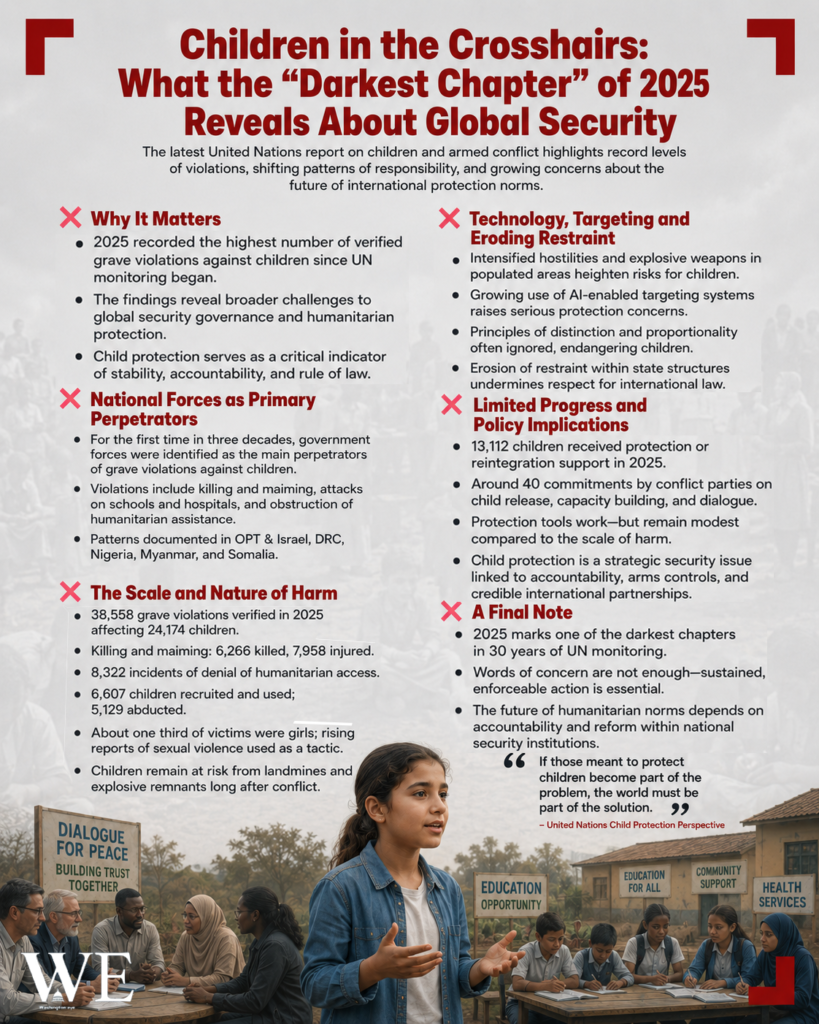
For the first time since the Children and Armed Conflict mandate was created three decades ago, government forces, rather than non State armed groups, were identified as the main perpetrators of grave violations against children. These violations include killing and maiming, attacks on schools and hospitals, and the obstruction of humanitarian assistance in contexts such as the Occupied Palestinian Territory and Israel, the Democratic Republic of the Congo, Nigeria, Myanmar and Somalia.
The report verified 38,558 grave violations in 2025 affecting 24,174 children, many subjected to more than one violation, making this the highest number of affected children since UN monitoring began. This pattern challenges the conventional narrative that the primary threat to children comes from irregular actors and suggests that state militaries and security forces are increasingly willing or able to disregard established legal constraints.
The Scale and Nature of Harm
Killing and maiming remained the most frequently documented violations, with 6,266 children killed and 7,958 injured, figures that the report describes as reflecting increases of roughly one third and one tenth respectively compared with earlier levels. Denial of humanitarian access was recorded in 8,322 incidents, while 6,607 children were recruited and used in hostilities and 5,129 were abducted, often linked to forced recruitment or sexual violence.
The report also stresses that about one third of the verified child victims were girls, and highlights rising reports of gang rape and other forms of sexual violence being used as deliberate tactics in war. Children remain exposed to landmines and explosive remnants that continue to kill or injure long after fighting subsides, creating lasting barriers to education, psychosocial recovery and social reintegration.
Technology, Targeting and Eroding Restraint
The UN attributes part of this shift to intensified hostilities, increased use of explosive weapons in densely populated areas and a growing integration of artificial intelligence systems into targeting processes. According to the report, in many situations military strategies ignored the principles of distinction and proportionality and the special protections granted to children under international humanitarian law, placing them in foreseeable and avoidable danger.
This erosion of restraint is particularly troubling because it occurs within state structures that are formally committed to treaty obligations and that possess the institutional capacity to prevent such violations. When, as the UN Special Representative Vanessa Frazier notes, states that are legally obliged to protect children instead contribute to their suffering, it reflects a broader weakening of respect for international law and raises concerns about the future enforceability of protection norms.
Limited Progress and Policy Implications
Despite the grim trends, the report notes that 13,112 children formerly associated with armed forces or armed groups received protection or reintegration support in 2025, alongside around forty commitments by conflict parties involving protocols for child release, capacity building and dialogue. These figures illustrate that protection tools can work when they are politically and financially supported, yet they remain modest relative to the overall scale of violations.
Strategically, the findings suggest that child protection can no longer be treated as a peripheral humanitarian concern but as an indicator of broader security governance failure. When national forces dominate the list of perpetrators, questions arise about command responsibility, rules of engagement, export controls for weapons and technologies, and the credibility of international partnerships that prioritize counterterrorism or geopolitical alignment over compliance with child protection standards.
A Final Note
Marking thirty years of the Children and Armed Conflict mandate, the UN warns that 2025 represents one of the darkest chapters since monitoring began and that words of concern are insufficient without sustained, enforceable measures. If national forces continue to lead in violations against children, the legitimacy of international humanitarian norms will increasingly depend on whether states are willing to subject their own security institutions to real accountability and reform.