From separating children whose brains and blood vessels are intertwined to replacing a face, hands or beating heart, the world’s most difficult operations test the limits of surgery. There is no official ranking because difficulty can be measured through operating time, risk, anatomical complexity or the number of specialists involved. Recent medical achievements, however, show how imaging, transplantation, robotics and international cooperation are making previously impossible procedures achievable.
One of the latest examples involved Nigerian sisters Mercy and Goodness, who were born joined at the head. The craniopagus twins had fused skulls, connected brain tissue and shared blood vessels, meaning one wrong cut could cause fatal bleeding or brain damage. More than 60 specialists from the United Arab Emirates, Britain, Nigeria and Brazil participated in their treatment at Sheikh Khalifa Medical City in Abu Dhabi.
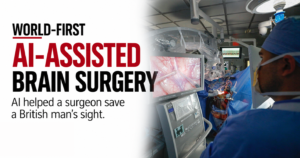
Doctors completed four operations over several months, amounting to more than 40 hours of surgery. Artificial intelligence, augmented-reality simulations and three-dimensional models helped surgeons study the twins’ circulation and rehearse the separation. Silicone expanders were inserted beforehand to grow enough skin to cover their heads, while customised titanium implants helped rebuild their skulls. The final procedure lasted approximately 12 hours. In June 2026, Abu Dhabi authorities announced that both girls had recovered and could see and play with each other for the first time.
The international team included British paediatric neurosurgeon Professor Noor ul Owase Jeelani, founder of the charity Gemini Untwined. Jeelani’s teams also separated Brazilian brothers Arthur and Bernardo Lima in 2022. The boys, almost four years old, were reportedly the oldest craniopagus twins with fused brain tissue to undergo successful separation. They required seven procedures, with more than 33 hours spent in operating theatres. Gemini Untwined said the children shared vital veins, forcing doctors to rehearse the surgery for months through virtual-reality technology.

Some operations are remembered for their extraordinary duration. In April 2001, Nepalese twins Ganga and Jamuna Shrestha underwent a separation operation at Singapore General Hospital. Around 20 doctors worked in shifts during the surgery, which lasted approximately 96 hours over five days. The babies shared a skull cavity and had partially fused brains. Both survived the immediate operation, although Ganga later developed serious health problems and died in 2008. The case demonstrated that surviving an operating theatre does not always mean complete or permanent recovery.
A more tragic case occurred in Singapore in July 2003. Iranian sisters Ladan and Laleh Bijani, both 29, wanted independent lives after spending their entire lives joined at the head. An international team led by neurosurgeon Dr Keith Goh began a highly risky operation at Raffles Hospital on July 6. Doctors encountered an unexpected major vein while separating their brains. After 52 hours, uncontrollable blood loss killed both women within 90 minutes of each other. Singapore’s National Library records the procedure as the first attempt to separate adult craniopagus twins. The outcome produced lasting debate about consent, risk and whether technically possible surgery should always be attempted.
Transplantation has created similarly difficult decisions. On Dec. 3, 1967, South African surgeon Dr Christiaan Barnard performed the first human-to-human heart transplant at Groote Schuur Hospital in Cape Town. The recipient, Louis Washkansky, received the heart of accident victim Denise Darvall. Although the transplanted heart functioned, Washkansky died from pneumonia 18 days later after anti-rejection treatment weakened his immune system. Barnard’s second transplant patient survived for almost 19 months, showing that an operation considered a short-term failure could still open an important medical field. A medical review of Barnard’s work describes how later improvements in immunosuppression transformed heart transplantation.

In August 2020, surgeons at NYU Langone Health in New York performed the first successful face and double-hand transplant. Joe DiMeo, then 22, had suffered burns over 80 percent of his body in a car crash. A team of more than 140 healthcare professionals, led by Dr Eduardo Rodriguez, completed the operation in 23 hours. Surgeons simultaneously recovered the donor’s face and hands, connected bones and tendons, and joined tiny arteries, veins and nerves. NYU Langone reported that earlier combined attempts elsewhere had resulted in death or removal of the transplanted hands.
Rodriguez’s team went further in May 2023, performing the world’s first whole-eye and partial-face transplant on Aaron James, who had survived a high-voltage electrical accident. The 21-hour operation involved more than 140 professionals. The donor eye remained alive with blood flow and retinal activity, but James did not regain vision. Follow-up findings therefore presented the operation as a major scientific achievement but not yet a successful restoration of sight.
The meaning of “success” remains complicated. Patients may survive but face disability, rehabilitation, rejection, infection and lifelong medication. Experimental operations can also cost millions and are available at only a few specialist centres. Families must make decisions under emotional pressure, while hospitals and media may emphasise breakthroughs more than uncertain outcomes.
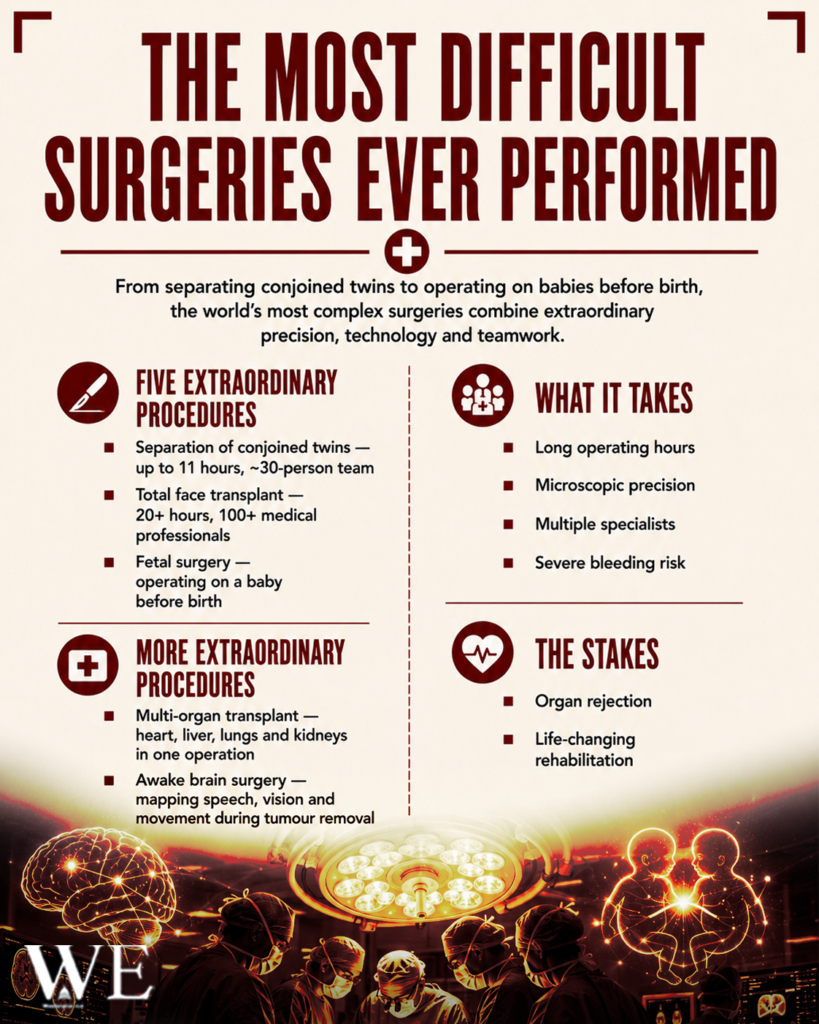
The hardest surgery is consequently not always the longest. It is often the procedure in which doctors must balance innovation against safety, separate structures measured in millimetres and accept that technical success may still carry a heavy human cost.