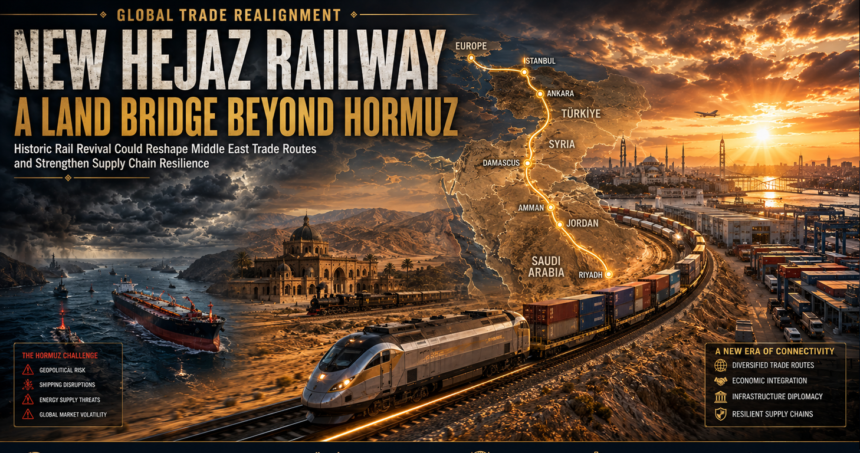
As global trade routes face renewed scrutiny following disruptions in the Strait of Hormuz, policymakers and transport planners across the Middle East are increasingly looking toward the revival of the historic Hejaz Railway as a possible overland alternative connecting the Gulf with Europe. The project, which has gained momentum in recent months through agreements between Saudi Arabia and Türkiye, is being presented as a strategic solution to reduce dependence on one of the world’s most critical maritime chokepoints. However, experts caution that while the railway could enhance regional connectivity and strengthen supply chains, it is unlikely to replace Hormuz entirely in the foreseeable future.
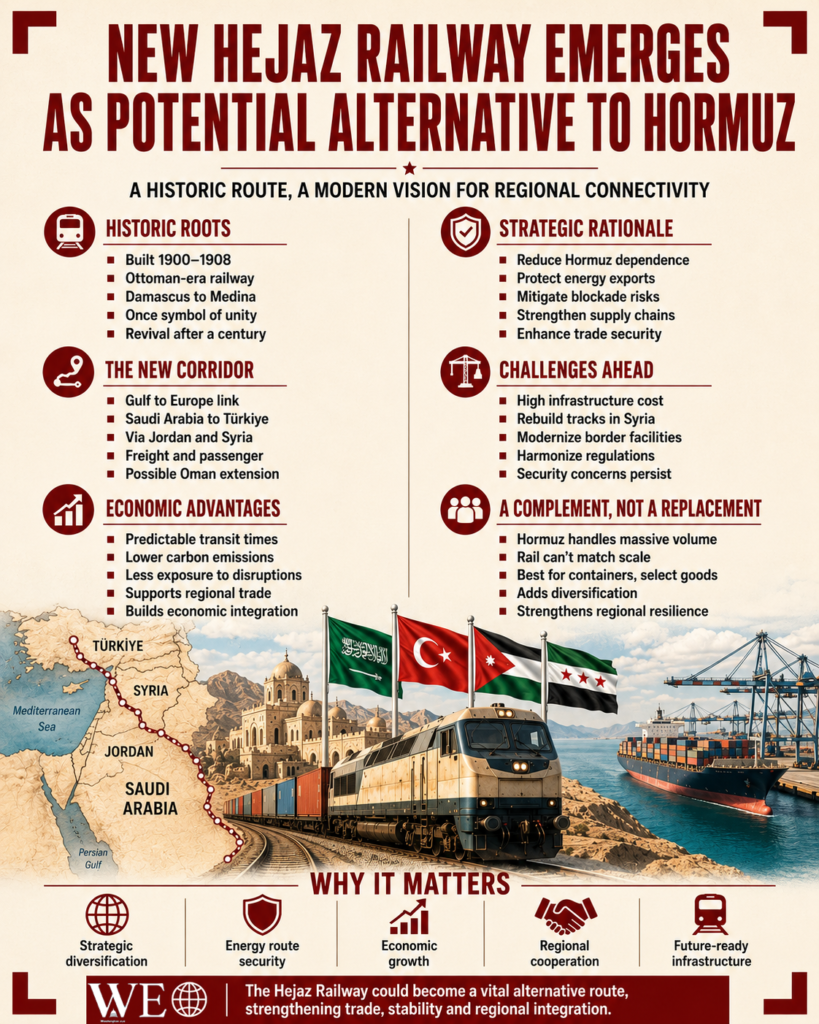
The original Hejaz Railway was constructed during the Ottoman era between 1900 and 1908, linking Damascus to Medina. Once a symbol of regional integration and pilgrimage travel, much of the network fell into disrepair after World War I. More than a century later, governments in Türkiye, Saudi Arabia, Jordan and Syria are discussing a modern revival that would transform the historic route into a major freight and passenger corridor stretching from the Gulf to Europe. Recent agreements signed in Riyadh have accelerated planning efforts, with officials envisioning a railway capable of transporting goods, energy products and travelers across multiple countries.
Interest in the railway has intensified following the regional tensions that exposed the vulnerability of the Strait of Hormuz. The narrow waterway between Iran and Oman handles a significant portion of global oil and liquefied natural gas shipments. Recent disruptions demonstrated how easily global energy markets can be affected when traffic through the strait is threatened. According to analysts, Gulf nations are now seeking alternative routes that can protect exports and reduce economic risks associated with future blockades or military confrontations.

Under current proposals, the revived railway would connect Saudi Arabia’s rail network with Jordan and Syria before continuing into Türkiye and eventually Europe. Some officials have even discussed extending the corridor eastward toward Oman, potentially creating a continuous land route from the Gulf to the Mediterranean and beyond. Such a corridor could facilitate the movement of containers, manufactured goods, agricultural products and selected energy-related cargo without relying entirely on maritime transport through Hormuz.

The economic rationale behind the project is compelling. Rail transport can offer predictable transit times, lower carbon emissions and reduced exposure to maritime disruptions. Saudi Arabian Railways has already launched freight services linking Gulf ports with the Jordanian border, promoting them as alternatives during periods of uncertainty in the Gulf shipping lanes. The broader Hejaz corridor could build upon these existing networks and integrate regional economies more closely.
Yet significant hurdles remain. The railway would require substantial investment in infrastructure rehabilitation, particularly in Syria, where years of conflict damaged transport networks. Several hundred kilometers of track would need reconstruction, border facilities would require modernization, and participating countries would need to harmonize customs procedures and regulations. Security concerns along parts of the route also continue to raise questions among investors and logistics operators.
The exact cost of the project has not yet been officially finalized, as feasibility studies remain underway. However, analysts expect the investment to run into several billions of dollars given the scale of reconstruction and modernization required across multiple countries. Saudi officials have indicated that technical and economic studies are expected to provide clearer estimates before the end of the year.

Despite the enthusiasm surrounding the project, experts argue that the railway should be viewed as a complement rather than a replacement for Hormuz. The volume of oil, gas and commercial cargo transported through the strait is enormous and cannot be replicated by rail infrastructure alone. While trains can efficiently move containers and certain commodities, maritime shipping remains far more cost-effective for bulk energy exports. Even supporters of the railway acknowledge that its primary value lies in diversification and resilience rather than outright substitution.
From a geopolitical perspective, the revival of the Hejaz Railway could reshape regional relationships. By linking Türkiye, Syria, Jordan and Saudi Arabia through a shared infrastructure project, the corridor may encourage greater economic cooperation and support post-conflict reconstruction efforts. Some observers also view the initiative as part of a broader competition among regional trade corridors seeking to connect Asia, the Middle East and Europe.
For now, the Hejaz Railway remains an ambitious vision rather than a completed reality. Nevertheless, the renewed focus on alternative trade routes highlights how recent events in Hormuz have transformed strategic thinking across the Middle East. If realized, the railway could become one of the most significant infrastructure projects in the region, offering a valuable backup route for trade and strengthening economic integration. Whether it can fundamentally alter the dominance of Hormuz, however, remains an open question that only time, investment and regional stability can answer.