Dramatic footage from the Ecuadorian Amazon has renewed attention on evidence that the world’s heaviest snake may comprise two species rather than one. Released with National Geographic’s Pole to Pole with Will Smith in January 2026, the video follows scientists and Indigenous Waorani guides as they approach an anaconda and collect a scale for genetic and pollution research.
The expedition took place in the Bameno region of the Baihuaeri Waorani Territory. Invited by Waorani Chief Penti Baihua, researchers spent 10 days travelling by canoe through rivers and flooded forest in search of snakes regarded as sacred locally. One female measured approximately 6.3 metres, while Waorani people described animals exceeding 7.5 metres. Scientists stressed that the larger estimates remain anecdotal.
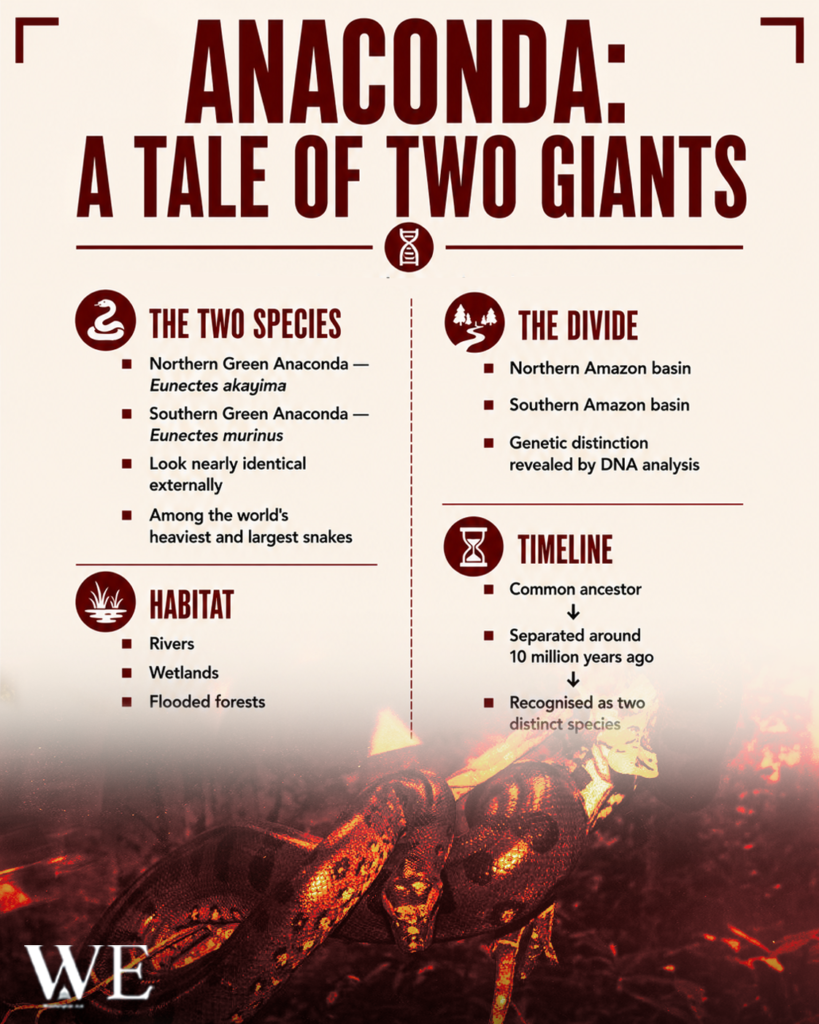
The scientific tale began before the documentary appeared. In February 2024, an international team published genetic data from anacondas sampled across nine South American countries. Researchers argued that snakes long grouped under the name green anaconda, Eunectes murinus, contain two separated lineages: the northern green anaconda, proposed as Eunectes akayima, and the southern green anaconda, which retains the name Eunectes murinus.

The two giants appear almost identical, with olive-green bodies, dark oval markings and eyes positioned high on the head. Nevertheless, the study reported a genetic difference of approximately 5.5 percent in the markers examined and estimated that the lineages separated nearly 10 million years ago. The research team compared the figure with the roughly 2 percent difference commonly cited between humans and chimpanzees.

The proposed northern species occupies the Orinoco and northern Amazon regions, including Ecuador, Colombia, Venezuela, Guyana, Suriname, French Guiana and Trinidad, with northern Brazil also considered likely. The southern lineage is associated mainly with Brazil, Peru and Bolivia. Precise boundaries remain uncertain because the snakes cannot be separated reliably by appearance and much of the Amazon has not been genetically sampled.
Green anacondas are members of the boa family and are nonvenomous, not “poisonous.” They produce no venom requiring antivenom. Instead, they seize prey with backward-facing teeth, wrap it in powerful coils and restrict breathing and blood circulation. Their diet includes fish, turtles, birds, capybaras, caimans, deer and wild pigs. Attacks on humans are extremely rare, despite the monster image created by films and folklore.
They are not usually the world’s longest snakes; that distinction generally belongs to the reticulated python. Anacondas are, however, the heaviest because of their extraordinary girth. Females grow much larger than males, and confirmed individuals can exceed six metres. Claims of nine-metre or 500-kilogram snakes frequently circulate, but such extremes have rarely been independently verified. Smaller relatives include yellow, Bolivian and dark-spotted anacondas.

Anacondas have a limited connection to medicine. Because they lack venom, they are not a source of venom-derived drugs. Green-anaconda fat has, however, been used in traditional Amazonian medicine for wounds and inflammation. A laboratory study involving rats reported possible wound-healing effects, but this does not prove safety or effectiveness in people, and the practice may encourage hunting. It is not a scientifically approved treatment.
The scale and tissue samples collected by the expedition have a different health value. Scientists are using anacondas as indicators of environmental contamination because long-lived apex predators can accumulate metals and petrochemical pollutants through the food chain. Pollution detected in snakes and large fish may signal risks to Indigenous communities relying on the same rivers and animals for food.
The two-species conclusion is not universally accepted. Other taxonomists have criticised the reliance on mitochondrial DNA, limited geographic sampling and problems involving historic specimens and naming rules. A later review argued that denser sampling and nuclear DNA are required before the split can be considered settled. Researchers who proposed Eunectes akayima subsequently published clarifications defending the name and presenting additional evidence.
Resolving the dispute matters for conservation. A single widespread green-anaconda species has generally been considered at low risk of extinction, but a northern species with a smaller range could face greater danger from deforestation, fires, drought, oil extraction, pollution and hunting. Whether ultimately recognised as two species or two ancient populations, the giants demonstrate how much Amazonian biodiversity remains undocumented, and how quickly it could disappear.