
Can people live in space? After more than two decades of continuous human occupation aboard the International Space Station and a new series of Moon and Mars experiments, scientists have a qualified answer: yes, but only inside carefully engineered environments. Outer space, the Moon and Mars are not naturally habitable for humans. Every breath, drink of water, meal and safe night’s sleep must be provided by technology.
Interest in the question has intensified following NASA’s Artemis II mission, which carried four astronauts around the Moon from April 1 to April 10, 2026. The nearly 10-day flight was the first crewed mission of the Orion spacecraft and the first journey by humans towards the Moon in more than 50 years. In addition to testing navigation, communications and life-support equipment, the mission carried “organ-on-a-chip” devices containing astronauts’ cells. Researchers are studying the chips to learn how deep-space radiation and microgravity affect bone marrow and immune health. NASA says the results could help doctors prepare personalised medical protection for future explorers.
The most convincing evidence that space can support human life remains the International Space Station, orbiting roughly 400 kilometres above Earth. It has been continuously occupied since November 2000. Its machines produce oxygen, remove carbon dioxide, regulate temperature and recover water from cabin humidity and human waste. However, the station still requires regular deliveries of food, equipment, replacement parts and some water. NASA’s figures show that its water-recovery system reduces the amount of water that must be delivered by cargo spacecraft by about 65 percent. The station is therefore liveable, but it is not independent of Earth.

Food production is another major challenge. Astronauts have successfully cultivated lettuce, kale, Chinese cabbage, tomatoes, radishes, mustard greens and chilli peppers in orbit. In 2025, the VEG-03 MNO experiment allowed crew members to select and grow vegetables from a small seed library, helping researchers study nutrition, food safety and the psychological value of gardening. Plants could eventually provide food, oxygen and water recycling inside distant habitats, although present space gardens produce only a tiny fraction of an astronaut’s diet. NASA’s crop programme is examining which plants and growing systems are dependable enough for longer missions.

Meanwhile, four volunteers are living inside NASA’s 1,700-square-foot Mars Dune Alpha habitat at Johnson Space Center in Houston. The second CHAPEA simulation began on Oct. 19, 2025, and is scheduled to end on Oct. 31, 2026. During the 378-day experiment, Ross Elder, Ellen Ellis, Matthew Montgomery and James Spicer face limited resources, isolation, equipment problems, simulated Mars walks and communication delays. The mission is designed mainly to measure human health, behaviour and performance rather than prove that a Mars settlement is ready.
Technology may allow future settlers to use local resources. NASA’s toaster-sized MOXIE instrument aboard the Perseverance rover demonstrated that oxygen can be extracted from Mars’s carbon-dioxide atmosphere. Between 2021 and 2023, it produced 122 grams of oxygen over 16 runs, reaching at least 98 percent purity. That was an important achievement, but NASA’s results also show the scale of the problem: a human expedition would require a much larger, continuously operating system for breathing and rocket fuel.
Of the possible locations, low-Earth orbit is currently the most practical because rescue and resupply are relatively close. The Moon is more difficult. It has virtually no atmosphere, dangerous radiation, extreme temperatures and abrasive dust that can damage lungs, spacesuits, seals and machinery. NASA reported in 2026 that electrically charged lunar dust clings stubbornly to equipment, making filtration and dust-repelling surfaces essential for any base. Permanently shadowed craters near the lunar south pole may contain useful water ice, while some nearby areas receive extended sunlight for power. These advantages explain why the region is a leading target for exploration.

Mars offers water ice and a day lasting about 24 hours and 39 minutes, but it is colder, farther away and covered by a thin, mostly carbon-dioxide atmosphere. Messages between Earth and Mars take approximately four to 24 minutes in one direction, preventing immediate assistance during emergencies. Its weak atmosphere also provides little radiation protection. NASA describes Mars as a cold desert where temperatures can fall to about minus 153 degrees Celsius.
Human biology may prove harder to protect than machines. Astronauts can lose around 1 to 1.5 percent of mineral density in weight-bearing bones for every month spent in microgravity, while muscles weaken and fluids shift towards the head. Radiation raises concerns about cancer, nervous-system damage and impaired immunity. Exercise and shielding reduce these dangers but do not eliminate them. NASA classifies radiation as one of the most serious hazards of deep-space flight.
The critical conclusion is that “liveable” does not mean Earth-like. Space habitats remain expensive artificial islands whose failure could quickly become fatal. The ISS is expected to operate through 2030 before NASA moves towards commercial stations, but regulators have questioned whether replacements will be ready in time. Settlement also raises ethical questions about public spending, unequal access and contaminating worlds that may preserve evidence of past life.
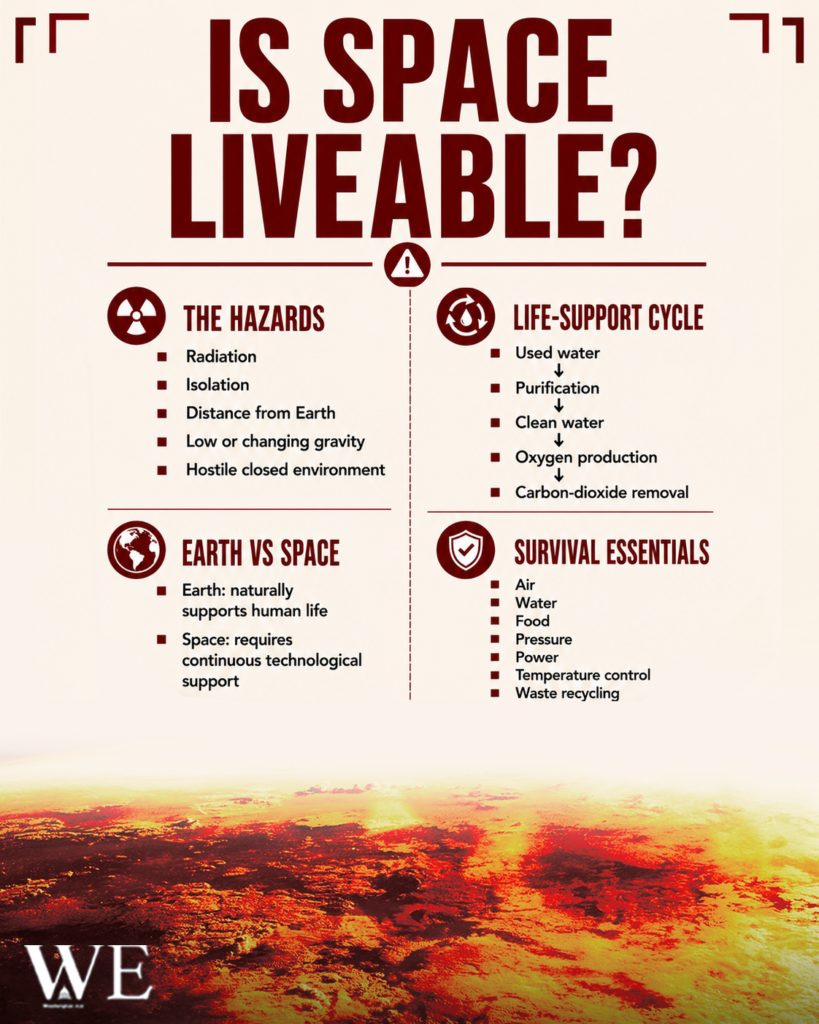
For now, space is survivable rather than truly liveable. Experiments are steadily extending how long people can remain away from Earth, but no tested habitat can yet support a community for generations without resupply. The research may eventually build safer lunar or Martian outposts; it also underlines a sobering fact: Earth remains the only known world where humans can live without carrying their environment with them.