
Copenhagen has been named the world’s most liveable city for the second consecutive year, leading a 2026 ranking dominated by wealthy European, Australian, Canadian and Japanese cities. The Danish capital finished ahead of Vienna and Melbourne in the Economist Intelligence Unit’s latest assessment of living conditions in 173 cities.
The EIU conducted its survey in May and released the results in July. Cities were assessed through more than 30 indicators covering stability, healthcare, culture and environment, education and infrastructure. The global average remained unchanged at 76.1 points out of 100, although declining stability was balanced by improvements in healthcare, education and infrastructure. The complete EIU summary describes significant differences between regions.
Copenhagen received an overall score of 98. It achieved perfect marks for stability, education and infrastructure, while scoring 96 for healthcare and 95 for culture and environment. Residents benefit from reliable public transport, extensive cycling routes, accessible services, clean public spaces and relatively low crime. Parks, waterfront areas, restaurants and cultural institutions also support a lifestyle in which daily journeys can often be completed without a car.

Vienna placed second with 97 points. The Austrian capital received perfect scores for healthcare, education and infrastructure. Its extensive tram, underground and bus networks make movement around the city comparatively easy, while parks, museums, concert halls and historic neighbourhoods strengthen its cultural appeal. Vienna’s long-term investment in publicly owned and subsidised housing also distinguishes it from many other European capitals facing severe housing shortages.

Melbourne ranked third, followed by Sydney in fourth place. Both Australian cities scored 97 overall and received full marks for healthcare and education. Melbourne performed particularly strongly for culture and environment, supported by its restaurants, sporting events, universities, parks and arts scene. Sydney combined high-quality public services with beaches, employment opportunities and international connections. However, expensive housing and long commutes remain serious concerns for residents in both cities.
Switzerland took the next two positions, with Zurich fifth and Geneva sixth. Each scored 96 overall, supported by excellent healthcare, education, public transport and political stability. Zurich offers efficient rail connections, high salaries and access to lakes and mountains, while Geneva combines public services with an international community centred on United Nations agencies and humanitarian organisations. Both cities, however, are among Europe’s most expensive places to rent, buy property and obtain everyday services.
Osaka placed seventh, Adelaide eighth, Vancouver ninth and Tokyo tenth. Osaka and Tokyo earned perfect marks for stability, healthcare and education. Their safety, dependable railway systems and dense networks of shops and services allow residents to complete many daily activities conveniently. Tokyo entered the top 10 after rising three places, partly because of an improved culture and environment score.

Adelaide was recognised for healthcare, education, manageable urban scale and access to green space and beaches. Vancouver, the only North American city in the top 10, received the group’s highest culture and environment score at 97. Its natural setting, multicultural population and public services remain major attractions, although its housing costs have placed home ownership and even renting beyond the reach of many average-income residents.
Western Europe remained the strongest region, with an average score of almost 92, but its performance stagnated during the year. Asia was the most improved region and now has nine cities in the global top 20, compared with seven from Europe. Healthcare investment pushed several Chinese cities upwards, while Tokyo’s improvement strengthened Japan’s position. Fuzhou was the year’s biggest upward mover, climbing seven places to 93rd, while Lisbon rose six positions following improvements in healthcare.
At the lower end, Damascus remained 173rd, below Tripoli, Dhaka, Karachi, Algiers and Lagos. Cities at the bottom were generally affected by war, poverty, political instability, weak infrastructure or limited healthcare. Karachi ranked 170th, scoring particularly poorly for stability and culture and environment. Tehran entered the bottom 10 following a sharp decline in regional security. The EIU said the Middle East and North Africa experienced the largest average deterioration in 2026.
The ranking is influential among governments, investors and multinational employers, which use it to compare cities and calculate hardship allowances for relocated staff. Stability and culture each represent 25 percent of the final score, healthcare and infrastructure receive 20 percent each, and education accounts for 10 percent. Some measures are quantitative, while others depend on assessments by EIU analysts and contributors living in the cities.
A critical reading is therefore essential. Liveability is not the same as affordability, equality or ease of immigration. The index considers the availability of good-quality housing but does not directly place household costs at the centre of its calculation. An OECD review of Denmark found that housing affordability concerns are concentrated in cities such as Copenhagen, where prices and rents have risen faster than the national average.
Different methods consequently produce different winners. A separate 2026 ranking designed specifically for expatriates placed Lisbon first because it gave greater importance to cost of living, air quality, language and residency options. That survey placed Copenhagen ninth.
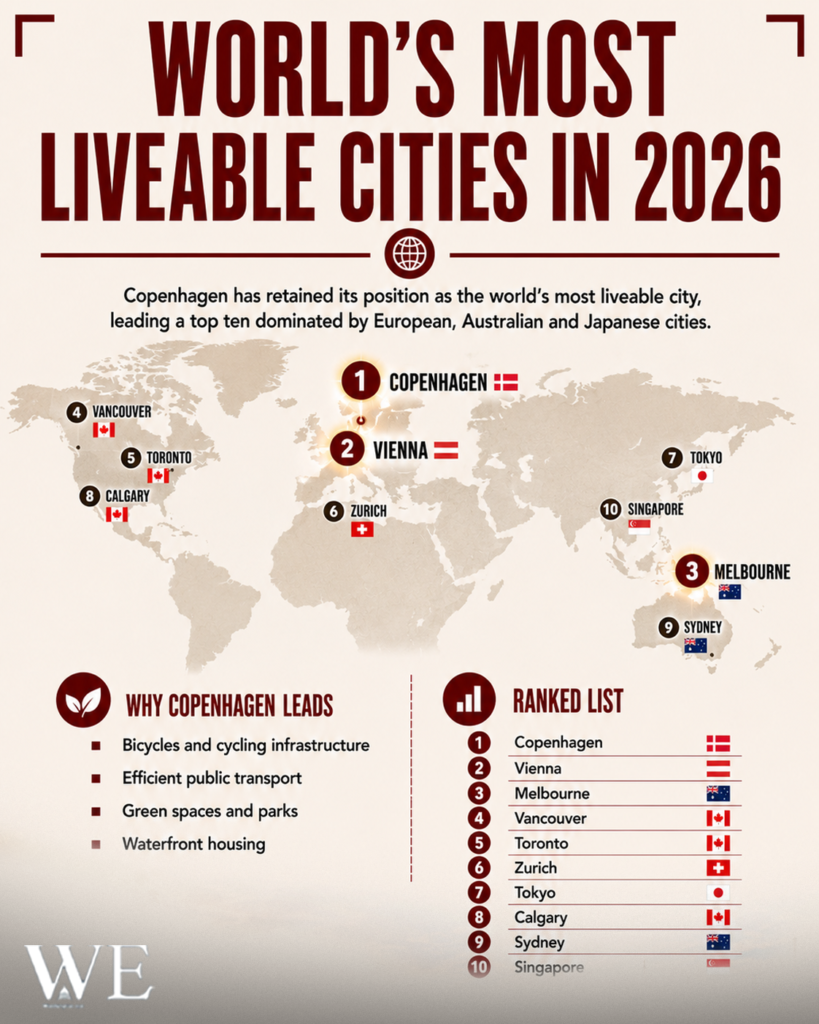
The 2026 results nevertheless reveal a consistent pattern: cities perform best when safety, healthcare, education, transport and cultural life operate together. Copenhagen may hold the global title, but whether it is the best place for an individual still depends on income, housing, language, family needs and the legal right to live there.