

A worn leather football believed to be the oldest surviving football in the world is once again attracting global attention after being displayed during events surrounding the 2026 FIFA World Cup, highlighting Scotland’s centuries-old connection to the sport and offering a rare glimpse into football’s earliest origins.
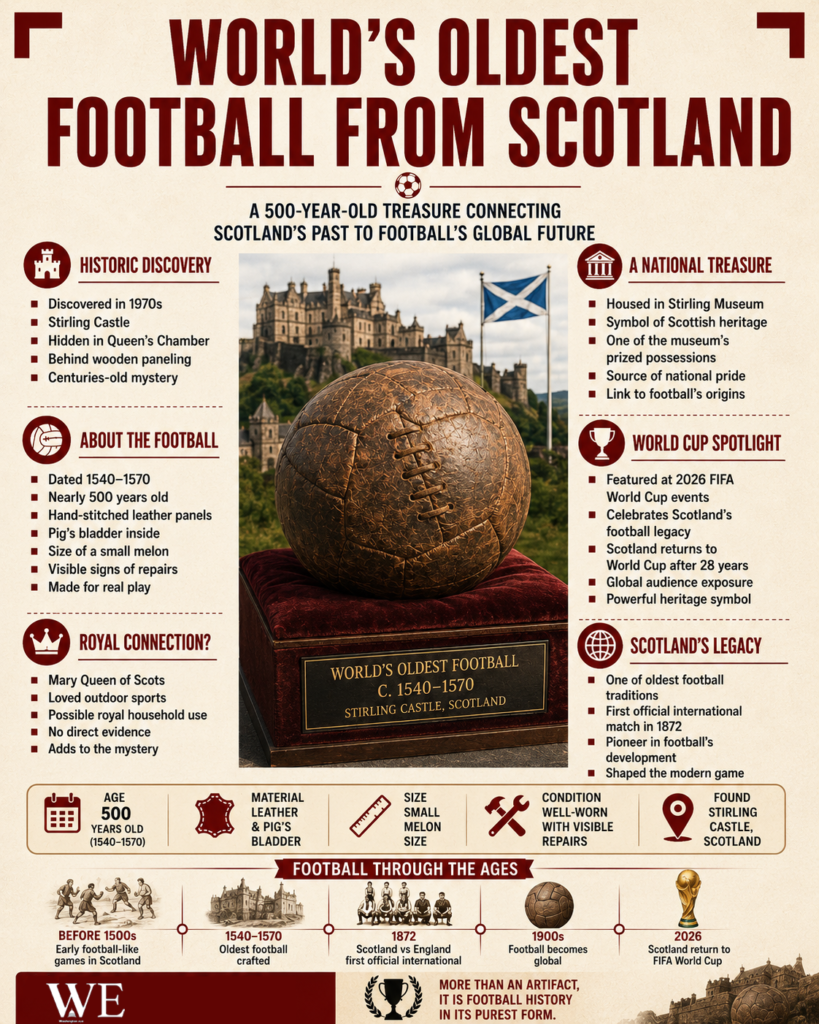
The remarkable artifact, estimated to be nearly 500 years old, dates from between 1540 and 1570 and was discovered hidden inside Stirling Castle, one of Scotland’s most historic royal residences. Historians and museum experts consider it the oldest known football still in existence, predating the formal codification of modern football by more than three centuries. The ball has recently traveled outside Scotland for a special exhibition linked to the FIFA World Cup, allowing international audiences to witness one of the sport’s most valuable historical treasures.
The football was originally discovered during restoration work at Stirling Castle in the late 1970s. Workers found it concealed behind wooden paneling in the Queen’s Chamber, a section of the castle associated with the childhood residence of Mary Queen of Scots. The unusual hiding place sparked decades of speculation among historians. Some believe the ball may have accidentally become lodged in the castle’s rafters during play, while others suggest it may have been deliberately hidden for safekeeping or even as a traditional good-luck charm.

Unlike modern footballs manufactured with synthetic materials and advanced engineering, the centuries-old ball was handcrafted using thick leather panels stitched together by hand. The interior was made from a pig’s bladder that could be inflated and replenished with air when necessary. Measuring roughly the size of a small melon, the ball demonstrates how football equipment was produced long before industrial manufacturing transformed the sport. Experts have also noted visible repairs on the surface, indicating that it was frequently used rather than serving merely as a decorative object.

Although historians cannot definitively identify its original owner, the football’s age and location have fueled fascination among researchers. Since Mary Queen of Scots was known to enjoy a variety of sports, including football, golf and tennis, some historians have speculated that the ball may have been used by members of the royal household during the 16th century. While no direct evidence confirms such claims, the possibility has added to the artifact’s mystique.
The football is currently housed at the Stirling Smith Art Gallery and Museum, where it remains one of the institution’s most prized possessions. Museum officials describe it as a symbol of Scotland’s deep-rooted football heritage and a tangible connection to the sport’s early development. The artifact has become a source of local pride, particularly as Scotland continues to emphasize its historical role in shaping the modern game.
Its recent appearance during World Cup-related events comes at a significant moment for Scottish football. Scotland returned to the FIFA World Cup in 2026 after a 28-year absence, generating renewed interest in the nation’s football history. Heritage organizations viewed the exhibition as an opportunity to present Scotland’s contribution to the sport on a global stage, using the centuries-old ball as a powerful symbol of continuity between football’s origins and its modern international spectacle.

The artifact also reignites a broader historical discussion about Scotland’s place in football history. The country boasts one of the world’s oldest football traditions, with references to football-like games dating back centuries. Scotland was also a pioneer of organized football, hosting the first official international football match against England in 1872 and helping shape many of the tactical and organizational developments that define the modern game.
Experts estimate that if the ball were ever placed on the open market, its historical significance could make it worth an extraordinary sum, though no official valuation has been publicly announced. Museums and cultural institutions generally regard it as priceless because of its unique status as the oldest surviving football known to exist. Its cultural value far exceeds any commercial price tag, serving instead as an irreplaceable record of sporting history.
As millions of fans around the world celebrate football during the 2026 World Cup, the nearly 500-year-old leather ball offers a reminder that the global game began long before television broadcasts, sponsorship deals and packed stadiums. From a hidden corner of a Scottish castle to the world stage, the artifact stands as a testament to football’s enduring appeal and the generations of players and supporters who have carried the sport forward across five centuries.