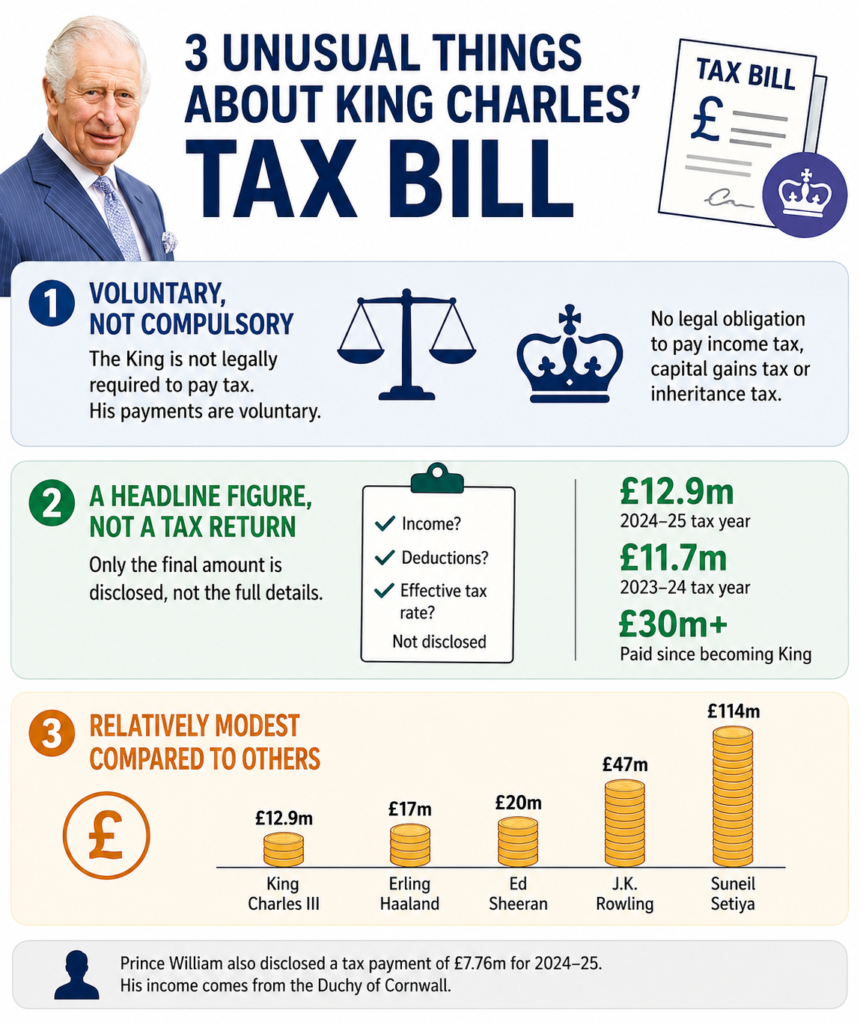
King Charles III has made royal financial history by disclosing his personal tax bill, but the landmark announcement has raised almost as many questions as it answered. Buckingham Palace published the figures on June 25 as part of its 2025–26 financial reports, revealing that the King’s tax payable was £12.9 million for the 2024–25 tax year, up from £11.7 million in 2023–24. He has paid more than £30 million since succeeding Queen Elizabeth II in September 2022. It is the first time a reigning British monarch in modern history has publicly disclosed the amount of personal tax paid.
The first unusual feature is that Charles is not legally required to pay the tax at all. Unlike ordinary British taxpayers, the monarch has no statutory obligation to pay income tax, capital-gains tax or inheritance tax. The current arrangement is voluntary and operates under a non-statutory agreement between the Royal Household and the Treasury. Queen Elizabeth began making voluntary income-tax payments in 1993, during a period of intense criticism over royal expenditure and the cost of restoring Windsor Castle after a major fire. Charles followed the same arrangement as Prince of Wales and continued it after becoming King.
This creates an extraordinary constitutional situation: the King pays an amount calculated broadly according to normal tax rates, but the payment ultimately depends on royal consent rather than the legally enforceable obligation applying to other citizens. Tax lawyer Dan Neidle described the transparency exercise as largely theatrical, arguing that the monarch does not pay tax in precisely the same legal sense as the public because taxes are formally collected in the name of the Crown.
The second unusual thing is how little information the historic disclosure actually contains. Buckingham Palace released the final amounts, but not a full tax return. It did not disclose the King’s total taxable income, the division between income tax and capital-gains tax, his effective tax rate or the deductions used in reaching the final bill. Official expenses connected with royal duties may be deducted before tax is calculated, but the Palace has not revealed how large those deductions were. Consequently, the public cannot independently determine whether the £12.9 million figure represents a high or comparatively low proportion of Charles’s private income.
The King receives substantial income through the Duchy of Lancaster, a historic property and investment estate held for the reigning sovereign. The Duchy had net assets of approximately £687.3 million in March 2026 and produced a £25.2 million revenue surplus in 2025–26. Charles also has undisclosed investments and receives income from privately owned estates including Balmoral and Sandringham. However, the value and earnings of those private holdings remain confidential.
The third unusual feature is that the King’s bill appears relatively modest when compared with some wealthy celebrities and businesspeople. The Guardian estimated Charles’s personal fortune at at least £1.8 billion, although Buckingham Palace disputed that estimate as speculative and inaccurate. The newspaper compared his payment with hedge-fund executive Suneil Setiya, reportedly worth a similar amount but listed as paying about £114 million in annual tax. It also reported that author J.K. Rowling paid approximately £47 million, musician Ed Sheeran £20 million and footballer Erling Haaland £17 million, all more than Charles’s disclosed annual figure. Such comparisons are imperfect because income, asset structures and taxable gains differ, but they have intensified demands for a fuller explanation.
Charles’s position is also unusual because the Duchy of Lancaster itself does not pay corporation tax like a conventional company. Rental income and gains made within the estate can therefore be reinvested without the same corporate taxes that competing property businesses might face. The King instead voluntarily pays personal tax on the income he receives after eligible official expenditure has been deducted. Critics argue that this combination of exemptions, voluntary payments and limited disclosure prevents meaningful comparison with ordinary taxpayers.

Prince William released figures at the same time, reporting tax payments of £7.76 million for 2024–25 and £8.34 million the previous year. His income comes mainly from the Duchy of Cornwall, an estate valued at approximately £1.2 billion. Both disclosures form part of a broader royal attempt to improve accountability as the monarchy faces scrutiny over public funding and recent controversies surrounding Andrew Mountbatten-Windsor. Constitutional expert Craig Prescott said greater openness could reinforce the distinction between the working monarchy and the controversy associated with Charles’s brother.
Buckingham Palace says publishing the figures was the King’s “express wish” and evidence of his commitment to transparency. Supporters see the announcement as a significant break from royal secrecy. Critics, however, maintain that publishing one headline number without income, deductions or calculation details offers only a narrow glimpse behind the palace’s financial curtain. The disclosure is therefore historic, but its three unusual characteristics show why Britain’s debate over royal wealth and taxation is far from settled.

![Infographic about the Supreme Court's 6-3 decision rejecting Trump's bid to end birthright citizenship, with courthouse backdrop and Trump silhouette on the left and a baby wrapped in an American flag on the right.] ,](https://thewashingtoneye.com/wp-content/uploads/2026/07/ChatGPT-Image-Jul-20-2026-12_27_09-AM-150x150.png "birthright citizenship us - washington eye")