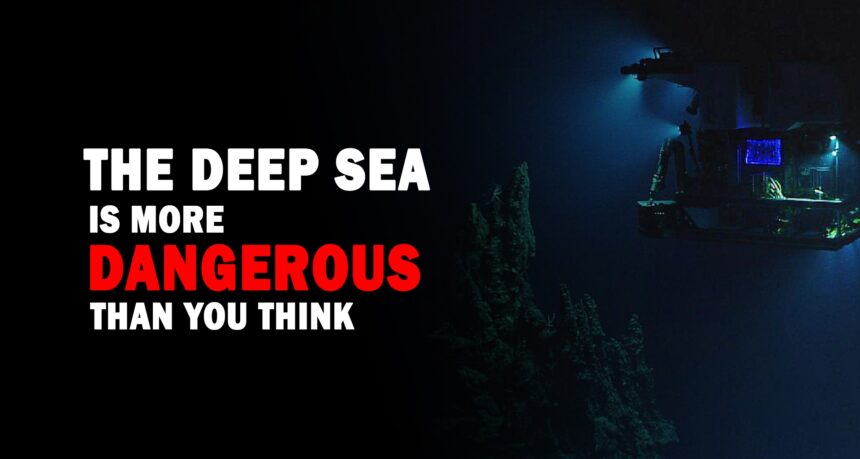
Humans have walked on the Moon, sent spacecraft beyond the Solar System’s outer planets and built telescopes capable of observing galaxies billions of light-years away. Yet beneath the waves of our own planet lies an enormous environment that remains difficult to observe directly. The deep ocean, with crushing pressure, permanent darkness, unusual animals and vast unexplored areas, has helped inspire the popular claim that “the ocean is scarier than space.”
The comparison is partly subjective. Space is unquestionably hostile: humans cannot survive its vacuum, radiation and extreme temperatures without sophisticated technology. But the ocean produces a different kind of fear because it is here on Earth, relatively close to us, yet still largely inaccessible.
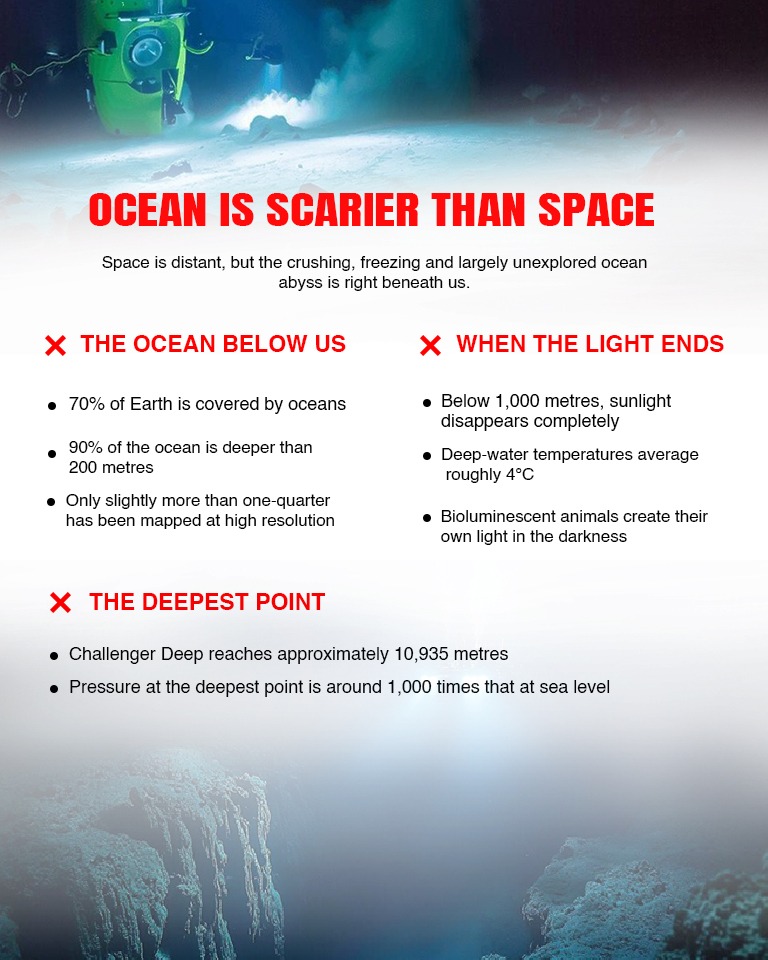
Scientists have mapped the global seafloor from satellites at relatively coarse resolution, but detailed modern mapping remains incomplete. The international Seabed 2030 project reported in 2025 that only 27.3% of the world’s ocean floor had been mapped to modern high-resolution standards.

A Dark World Under Enormous Pressure
The ocean covers roughly 71% of Earth’s surface and contains around 97% of the planet’s water. Its average depth is approximately 3.7 kilometres, while its deepest known point lies nearly 11 kilometres below sea level in the Mariana Trench. Sunlight rapidly disappears as a person descends. Below roughly 1,000 metres lies the aphotic zone, where sunlight essentially does not penetrate. Animals there spend their lives in perpetual darkness.

Pressure presents an even greater challenge. Water pressure increases by approximately one atmosphere for every 10 metres of depth. At the deepest parts of the Mariana Trench, pressures exceed 1,000 times atmospheric pressure at sea level. A conventional submarine or improperly designed vessel cannot simply descend to such depths. Deep-sea exploration requires specialized submersibles engineered to withstand extraordinary pressure. That makes exploring Earth’s deepest waters expensive, technically challenging and potentially dangerous.
Creatures That Look Like Science Fiction
The darkness has produced some of the most unusual adaptations known in nature. Deep-sea environments contain anglerfish, giant isopods, gulper eels, vampire squid and transparent or bioluminescent organisms. Some generate their own light through bioluminescence, using chemical reactions to communicate, attract prey or avoid predators. Their frightening appearance does not necessarily mean they pose a danger to humans. Many deep-sea animals are relatively small and live at depths humans would never encounter without specialized equipment.

Scientists are still discovering new marine species. The deep sea contains habitats ranging from hydrothermal vents and underwater mountains to trenches and cold seeps, some supporting ecosystems that do not depend directly on sunlight. Hydrothermal vents are particularly remarkable. Organisms around them can ultimately depend on chemosynthesis, in which microbes obtain energy from chemicals rather than sunlight. Their discovery transformed scientists’ understanding of where and how life can survive.
Why Do We Know So Little About Our Own Ocean?
One reason is deceptively simple: water makes observation difficult. Telescopes can collect electromagnetic radiation travelling across enormous distances through space. Ocean water, by contrast, absorbs light and other electromagnetic signals relatively quickly. Researchers therefore rely on sonar, remotely operated vehicles, autonomous underwater vehicles and crewed submersibles to investigate deep environments.
Each method has limitations. Deep-sea vehicles must survive pressure, communicate through water and operate in darkness over an enormous geographical area. Even reaching the bottom can take hours. The result is an unusual scientific situation: researchers can observe distant astronomical objects while many features of Earth’s seafloor have never been directly seen by human eyes.
Is the Ocean Really More Dangerous Than Space?
Scientifically, saying that the ocean is “scarier” than space is not an objective conclusion. Both environments are extremely hostile to unprotected humans. In space, the absence of breathable air and atmospheric pressure creates an immediate threat, while radiation and extreme thermal conditions add further dangers. In the deep ocean, humans face enormous pressure, cold temperatures, darkness and isolation.
There is also a major difference in accessibility. Millions of people enter the ocean every year for swimming, fishing, diving and transportation. Almost nobody goes to space. The ocean therefore feels more immediate. A person standing on a beach is effectively looking across the surface of an enormous environment whose deepest regions remain inaccessible without sophisticated technology.
Critical View: Fear Versus Reality
Popular videos sometimes exaggerate the idea that scientists have “only explored 5% of the ocean.” There is no single scientifically meaningful percentage for how much of the ocean has been “explored,” because mapping, visually observing, sampling and biologically studying the ocean are different measurements.
What can be measured more clearly is detailed seafloor mapping. Even there, major gaps remain, which is why Seabed 2030 aims to produce a complete modern map of the world’s ocean floor by 2030. The greatest threats associated with the ocean are also not mysterious sea monsters. Climate change, warming waters, ocean acidification, plastic pollution, overfishing and habitat destruction represent far more significant concerns.
Understanding the deep ocean could consequently have enormous practical value. Its ecosystems influence global carbon cycles, its geology helps scientists understand earthquakes and tsunamis, and its organisms may contain biological compounds useful for future medicines and technologies.
Space may appear more alien, but the deep ocean demonstrates that an alien-looking world already exists on Earth. Thousands of metres beneath familiar waves lies a realm without sunlight, under crushing pressure, populated by creatures adapted to conditions humans could not survive unaided. Perhaps that is what makes the ocean uniquely unsettling: space is frightening because it is unimaginably far away; the deep ocean is frightening because it is right beneath us.