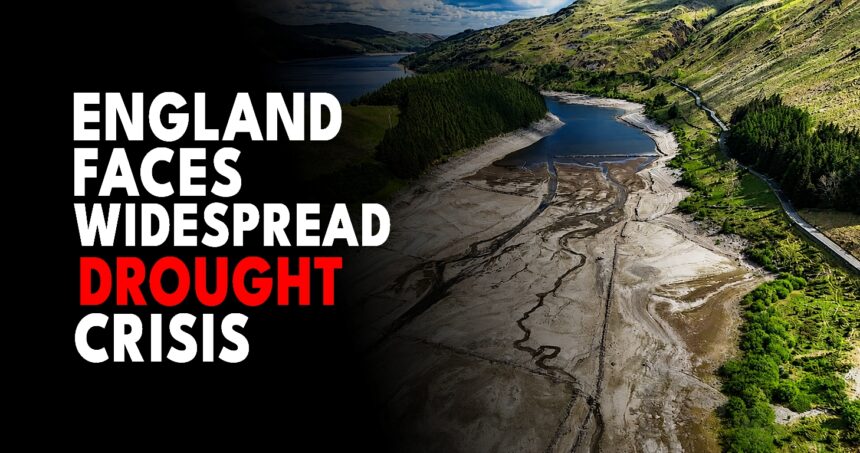
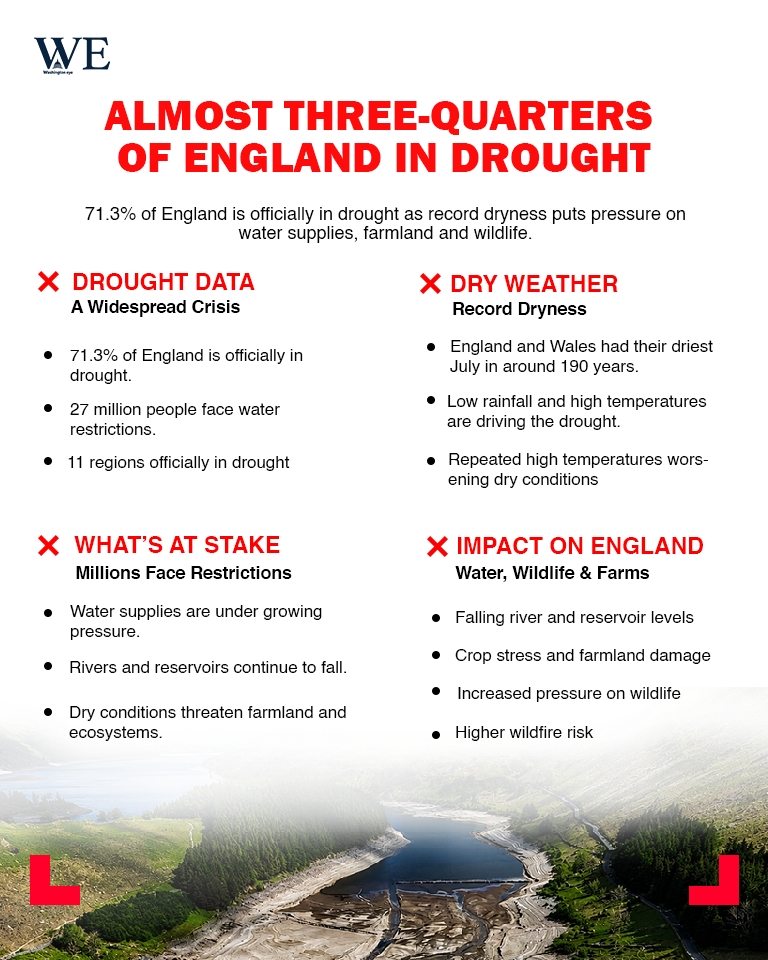
More than two-thirds of England remains officially in drought, after an exceptionally hot and dry summer depleted rivers, reservoirs and groundwater supplies, imposed water restrictions on millions of people and placed increasing pressure on farms, wildlife and the country’s ageing water infrastructure. The latest Environment Agency assessment says 71% of England by land area is classified as being in drought.
Despite thunderstorms and periods of heavy rain towards the end of August, officials have warned that a few wet days cannot reverse the effects of months of exceptionally dry conditions. The drought has affected large parts of southern, eastern and central England, including East Anglia, London and surrounding areas, the Thames region, Devon and Cornwall, the East Midlands, Lincolnshire, Northamptonshire, Kent, East Sussex and parts of the Solent and South Downs.
How Did Two-Thirds of England Fall Into Drought?

England entered summer with increasingly severe rainfall shortages before experiencing repeated periods of high temperatures. By late July, half of England had already been declared in drought. Conditions then deteriorated rapidly. On August 10, the government announced that 71.3% of the country was experiencing what officials described as a “flash drought”, a drought that develops unusually quickly because of the combination of extremely low rainfall and high temperatures.
July was exceptionally dry, with England receiving only around 10% of its long-term average rainfall during the month. By August 27, rainfall for August had reached only 34% of the amount normally expected, according to the Environment Agency. The summer of 2026 was also confirmed as Britain’s warmest on record, with an average temperature of 16.5°C, surpassing the previous record established only a year earlier. The combination created severe pressure on water resources. Rivers fell to unusually low levels, reservoirs declined and soils became extremely dry and compacted.

Millions Face Water Restrictions
For households, one of the most visible consequences has been the expansion of temporary use bans, commonly called hosepipe bans. By late August, restrictions were operating across the supply areas of companies including Thames Water, Anglian Water, Affinity Water, Southern Water, South East Water and Wessex Water, among others. Earlier in August, approximately 29 million people were already subject to restrictions on water use.
Hosepipe bans generally restrict activities such as watering gardens, washing private vehicles with a hose and filling domestic swimming pools. Their purpose is to reduce non-essential demand and preserve supplies for drinking, sanitation and essential services. Reservoir levels have provided another warning. National reservoir storage fell to 62.6% by August 18, with seven major reservoirs classified as exceptionally low for the time of year. Water companies have consequently faced the difficult task of maintaining supplies while demand remains high.

Farmers, Wildlife and Sport Hit Hard
The crisis extends far beyond household water use. Farmers have reported lower crop yields, poor grass growth and dwindling livestock feed supplies. Some agricultural boreholes have dried up, while farm reservoirs have reached critically low levels. More than 1,500 restrictions on water abstraction have been introduced, limiting the amount farmers and other users can remove from rivers and groundwater sources. The natural environment is also showing signs of stress. The Environment Agency recorded hundreds of drought and dry-weather incidents during 2026, including algal blooms, fish deaths and extremely low river flows.
Falling water levels have also disrupted navigation on canals. Even British sport has been affected. Grassroots football and rugby clubs have struggled with pitches that have become dangerously hard. Some lower-level football matches have been postponed, while rugby authorities delayed some grassroots activity because extremely dry playing surfaces increased injury risks. Professional clubs with sophisticated irrigation systems can often maintain green pitches, raising concerns that extreme weather could widen the financial divide between wealthy professional sport and community clubs.
How Can England Have Drought and Flooding Together?
Perhaps the strangest feature of the crisis arrived at the end of August: parts of drought-stricken England began flooding. Thunderstorms produced intense rainfall, leading the Environment Agency to issue dozens of flood alerts. Some homes were damaged as water rapidly overwhelmed drainage systems. But heavy rain does not automatically end a drought. After prolonged dry weather, soil can become extremely hard and compacted.
Instead of slowly soaking into the ground and replenishing groundwater, intense rainfall can rapidly run across the surface, increasing the possibility of flash flooding. Environment Agency chief executive Philip Duffy warned that even several days or weeks of wetter weather cannot reverse months of exceptionally dry conditions. England can therefore experience the apparently contradictory situation of flooding while officially remaining in drought.
Is England’s Water System Prepared?
The drought has renewed criticism of England’s water infrastructure. Climate change is increasing the likelihood of hotter conditions and more extreme weather, while population growth is increasing demand for water. At the same time, critics have repeatedly highlighted leakage, ageing infrastructure and the slow development of new reservoirs and other water-storage capacity. The 2026 drought demonstrates that the challenge is no longer simply about surviving an unusually dry summer. England needs a water system capable of handling rapid swings between extreme heat, prolonged drought and intense rainfall.
The immediate priority remains conserving existing supplies and allowing reservoirs, rivers and groundwater to recover. That recovery could require sustained rainfall through autumn and winter rather than a handful of thunderstorms. With 71% of England still officially in drought, the summer of 2026 has delivered a stark warning: in a country famous for rain, reliable water can no longer be taken for granted.