
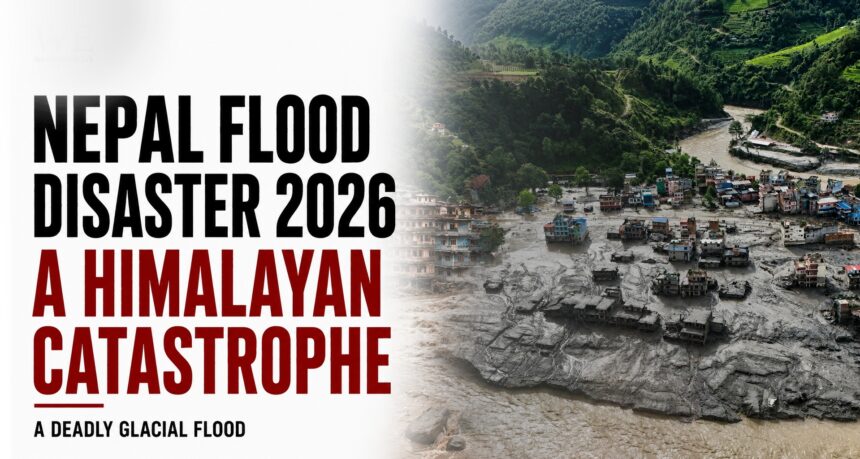
Nepal is confronting one of the worst natural disasters in its recent history after a catastrophic glacier-triggered flash flood swept through the Himalayan north on August 26, destroying villages, roads, bridges and hydropower facilities and leaving thousands of people dead or missing. The confirmed death toll in Nepal has risen to at least 1,252, while more than 4,200 people remain missing, according to the latest figures reported on Thursday. Around 20,000 homes will require rebuilding, including approximately 7,500 that were completely destroyed.
Disable the highlighter for this post
The disaster began close to the Nepal-China border, when a massive collapse involving glacier ice, rock and debris sent an enormous surge into the Lhende Khola and subsequently through the Trishuli River system. The flood moved downstream with extraordinary force, carrying mud, boulders, trees and ice through settlements and infrastructure. China’s neighbouring Tibet region was also hit, turning the event into a cross-border Himalayan disaster.
What Caused the Nepal Flood?

Unlike a conventional monsoon flood produced solely by prolonged rainfall, scientists believe the August 26 disaster originated with a major glacier collapse high in the Himalayas. The initial collapse displaced enormous quantities of ice, sediment and water, producing a sudden torrent capable of travelling rapidly through narrow mountain valleys. Researchers are examining the precise trigger. Early assessments have considered seismic activity and unusually warm conditions that may have destabilised snow and ice.
Scientists have also highlighted the broader vulnerability created by rising temperatures in the Himalayas. Nepal has lost nearly a third of its mountain ice over approximately three decades, according to reporting on the disaster. Nepal is particularly exposed because its steep valleys can funnel floodwater and debris towards communities with very little warning. The latest catastrophe follows repeated floods, landslides and glacial-lake outburst events across the Himalayan country, where climate change is increasingly complicating traditional disaster-risk calculations.

Thousands Missing as Rescue Operation Continues
The scale of the missing-person crisis remains one of the most alarming aspects of the disaster. More than 9,300 Nepali troops have been deployed alongside police, emergency workers and international specialists. Helicopters, excavators, drones and heavy machinery are being used to reach communities cut off by destroyed roads and bridges. Attention has focused particularly on damaged hydroelectric facilities and tunnels.
Authorities believe around 900 people could remain trapped or missing around hydropower tunnels, creating an extremely difficult rescue operation. Search teams have been removing debris while attempting to determine whether air pockets or protected areas inside the tunnels could have allowed workers to survive.

Foreign tourists have also been caught in the disaster. Hundreds of trekkers, pilgrims and other foreign nationals were initially reported missing, although some have subsequently contacted authorities or been rescued. India, China, South Korea, Australia and other international partners have provided specialist teams, equipment or humanitarian assistance.
Homes, Power Plants and Trade Routes Destroyed
The physical destruction extends far beyond the immediate death toll. Around 20,000 homes need rebuilding, while entire communities along the flood corridor have been left covered in mud and debris. Survivors in some areas have asked the government to relocate their settlements rather than reconstruct houses in the same vulnerable locations. Roads and bridges have disappeared, isolating mountain communities. In some locations, residents have resorted to zip lines to cross the Trishuli River because normal transport connections no longer exist.
The energy sector has suffered particularly serious damage. At least 12 power projects were damaged, affecting electricity generation and disrupting Nepal’s ability to export electricity to neighbouring countries. Nepalese power supplies to Bangladesh were interrupted following damage to hydropower infrastructure. The flood also produced an estimated 2.2 million tonnes of debris, creating an enormous challenge for reconstruction teams. Preliminary estimates have put rebuilding costs at approximately $4 billion to $5 billion, an enormous burden for Nepal’s relatively small economy.
Humanitarian and Economic Effects
Around 4,000 displaced people are living in dozens of relief camps, where authorities and aid organisations are attempting to provide food, clean water, sanitation and medical treatment. The health consequences could continue long after the floodwater disappears. Contaminated water can increase the risk of diarrhoeal diseases and other infections, while disrupted medical supply chains can leave people with chronic illnesses unable to obtain essential medication.
Children are particularly vulnerable. Around 22,000 children urgently require basic services, and authorities are considering temporary schools because educational facilities have been damaged or communities displaced. Agriculture, tourism and cross-border trade are also expected to suffer. Roads connecting Nepal with China have been disrupted, while trekking and tourism areas have been affected during a period when Nepal would normally be preparing for its important autumn tourism season.
Climate Change and the Himalayan Warning
The disaster has intensified concerns about the future of the Himalayan cryosphere, the glaciers, snow and frozen landscapes that store enormous quantities of freshwater. Rising temperatures can destabilise glaciers and contribute to the expansion of glacial lakes. When natural barriers holding those lakes fail, huge quantities of water can be released with little warning. However, scientists caution against attributing an individual glacier collapse entirely to climate change before detailed investigation is completed. The Himalayan environment is naturally geologically unstable, and earthquakes, rockfalls and other processes can also trigger disasters.
What is increasingly clear is that warming is changing the background conditions under which these hazards occur. Nepal therefore faces a difficult paradox. Its Himalayan rivers provide enormous potential for hydroelectric power, an important source of domestic electricity and export revenue. Yet some of the infrastructure designed to harness those rivers is itself vulnerable to increasingly unpredictable mountain hazards.
Nepal Must Rebuild Differently
The immediate priority is finding survivors, sheltering displaced families and restoring roads, electricity, healthcare and communications. But rebuilding exactly what existed before could reproduce the same vulnerabilities. Nepal may need stronger glacier monitoring, satellite surveillance, automated river sensors and early-warning systems capable of transmitting alerts rapidly to downstream communities.
New hydropower projects, bridges and settlements will also need to account for extreme events that historical records may no longer adequately predict. The catastrophe has demonstrated another problem: mountainous terrain can make conventional emergency response extraordinarily slow. When bridges and roads disappear simultaneously, entire communities become accessible only by helicopter or on foot.
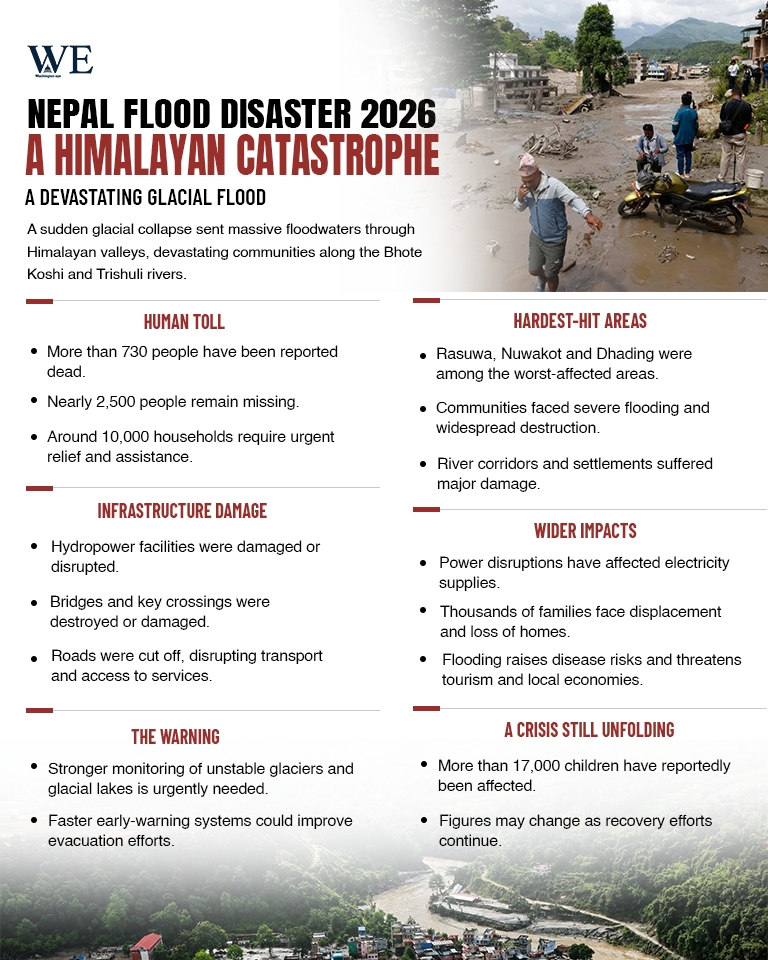
For Nepal, the August 26 flood is therefore both a humanitarian catastrophe and a warning about the future. A disaster beginning high among the glaciers travelled rapidly through rivers, villages and power stations, ultimately affecting housing, electricity, education, tourism, international trade and thousands of families. With more than 4,200 people still missing, however, Nepal has not yet reached the reconstruction phase. For thousands of families, the search for loved ones continues.