
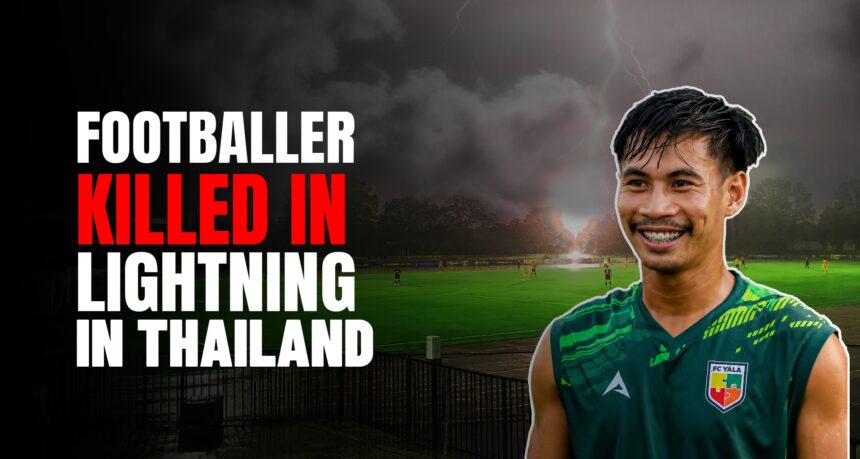
A football match in southern Thailand turned into tragedy when 24-year-old footballer Safwan Awae was struck by lightning on the pitch, leaving him dead and 12 other players injured. The extraordinary incident has shocked the regional football community and renewed questions over whether outdoor sporting events should continue when thunderstorms and lightning are nearby.
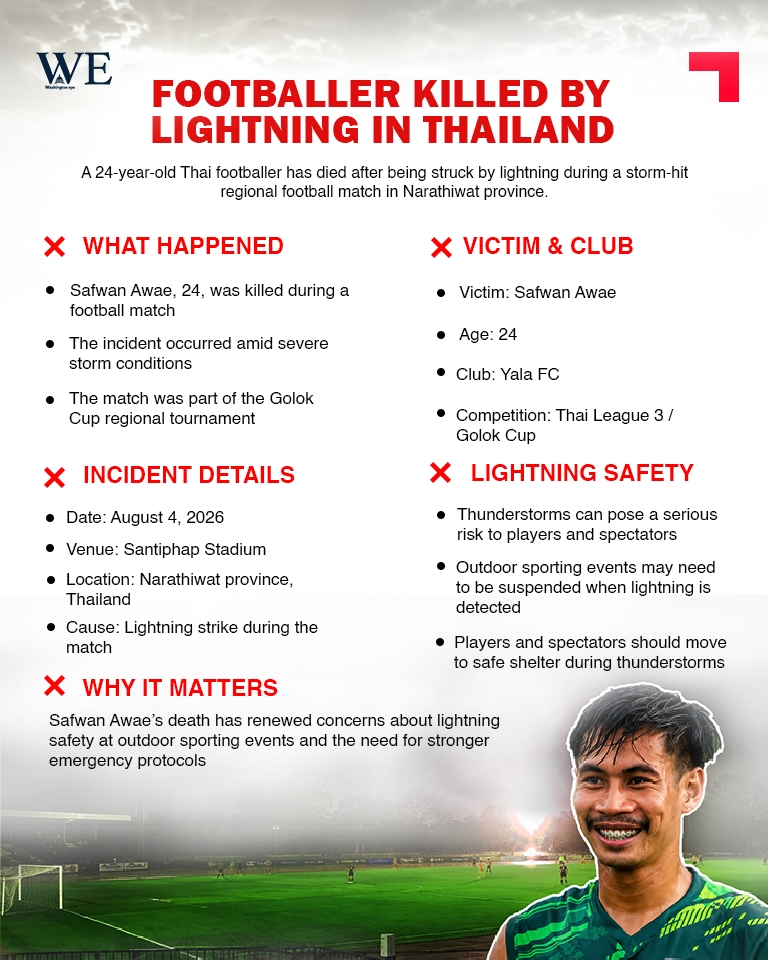
The incident occurred on August 4, 2026, at Santiphap Stadium in Narathiwat province, southern Thailand, during a Golok Cup regional tournament match. Safwan was playing as his team competed in heavy rain when a powerful lightning bolt suddenly struck the waterlogged pitch.
Video footage circulating online showed players continuing the match during a severe monsoon downpour. Moments later, a brilliant flash hit the field, followed by smoke as players fell or ran for safety. Safwan suffered the most serious injuries.

Lightning Strikes in the Middle of Match
Safwan was reportedly inside the penalty area when the lightning struck. Players and spectators immediately rushed towards him and attempted to provide assistance while emergency services were called. He was transported to hospital in critical condition, but doctors were unable to save him. Narathiwat police chief Thun Sirikhunt subsequently confirmed his death.

The same lightning strike injured 12 other players, who suffered burns of varying severity. Among those hurt was 22-year-old Malaysian footballer Alif Ezzahan Zulkifli, who was treated at a hospital in the Sungai Golok district. The match was abandoned immediately following the incident.
The tragedy was particularly devastating because Safwan’s football career appeared to be entering an important new phase. Only days before his death, he had signed with FC Yala, a club competing in the Thai League 3 Southern Region. Reports said he had signed on July 30, just five days before the fatal incident. FC Yala subsequently issued a tribute to its new player, offering condolences to his family and mourning a footballer who had barely had the opportunity to begin the next stage of his career.
Why Was the Match Being Played in a Thunderstorm?
The circumstances surrounding Safwan’s death have brought renewed attention to lightning safety in outdoor sport. Southern Thailand experiences particularly wet conditions during parts of the year, and thunderstorms can develop quickly. The August incident occurred amid heavy monsoon rain, but play had continued before the lightning strike. Rain itself does not necessarily require a football match to be stopped. Lightning, however, represents a much more serious danger.
A football field can be particularly exposed during thunderstorms because players are standing in a large open area. Lightning does not necessarily have to strike someone directly to cause serious injury. Electrical current can spread through the ground after a nearby strike and affect multiple people simultaneously. The fact that Safwan was killed while 12 other people were injured demonstrates how a single strike can produce casualties across a relatively wide area.
The tragedy has consequently renewed discussion about the “30-minute rule” commonly recommended in lightning-safety guidance for outdoor sports. Under this approach, activity should remain suspended until at least 30 minutes after the last thunder is heard or lightning is observed. The problem is that procedures and enforcement can differ considerably between competitions, particularly at regional and amateur levels.
A Promising Career Cut Short
Safwan was described as a forward and winger and had taken a significant step towards semi-professional football shortly before his death. His signing with FC Yala would have allowed him to compete in the Thai League 3 Southern Region, making the timing of his death especially painful for his family, teammates and supporters.
Tributes spread across social media after news of his death emerged. FC Yala expressed its condolences, while the wider Thai football community mourned the loss of the young player. The incident also attracted international attention because footage captured the moment the lightning struck the pitch. However, Safwan’s death is not the first time lightning has killed footballers. Fatal strikes have occurred during matches and training sessions in several countries, particularly where storms develop rapidly and players remain exposed.
Monsoon Weather Adds to the Risk
Southeast Asia experiences frequent thunderstorms, particularly during monsoon periods. Thailand’s rainy conditions can produce intense rainfall, strong winds and electrical storms with relatively little warning. Climate and weather patterns therefore make effective monitoring especially important for outdoor competitions. Modern technology can provide organizers with weather forecasts, radar information and lightning-detection alerts.
Yet technology alone cannot prevent deaths unless officials are prepared to suspend or abandon matches when conditions become dangerous. Safwan’s death has therefore shifted attention from whether the lightning strike itself could have been predicted to whether the risk could have been reduced by removing players from the field earlier.
Sport Should Never Outweigh Weather Safety
The tragedy raises an uncomfortable but necessary question: should the match have continued in such conditions? Thunderstorms are inherently unpredictable. No referee can determine precisely where the next lightning bolt will strike. That uncertainty is exactly why safety protocols generally recommend taking action before a strike occurs rather than waiting until conditions become visibly catastrophic.
Players may be reluctant to leave the field, particularly during important competitions, but responsibility ultimately lies with organizers and match officials to prioritize safety. Regional and amateur competitions can present additional challenges because they may lack sophisticated weather-monitoring systems available to elite professional leagues. But basic precautions, including monitoring forecasts, suspending play when thunder is heard and moving players and spectators into substantial enclosed buildings, can substantially reduce exposure.
Safwan Awae’s death therefore represents more than an extraordinary freak accident. It is a warning for football authorities and organizers of all outdoor sports. A promising 24-year-old player had signed for a new club only days earlier. Instead of beginning the next chapter of his career, his name has become associated with one of football’s most preventable environmental dangers. The lesson from Narathiwat is simple: when lightning threatens, no match is important enough to keep playing.