
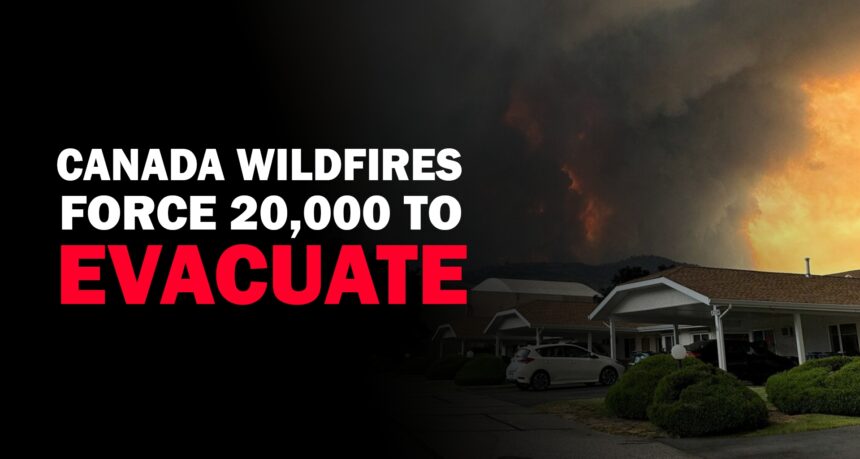
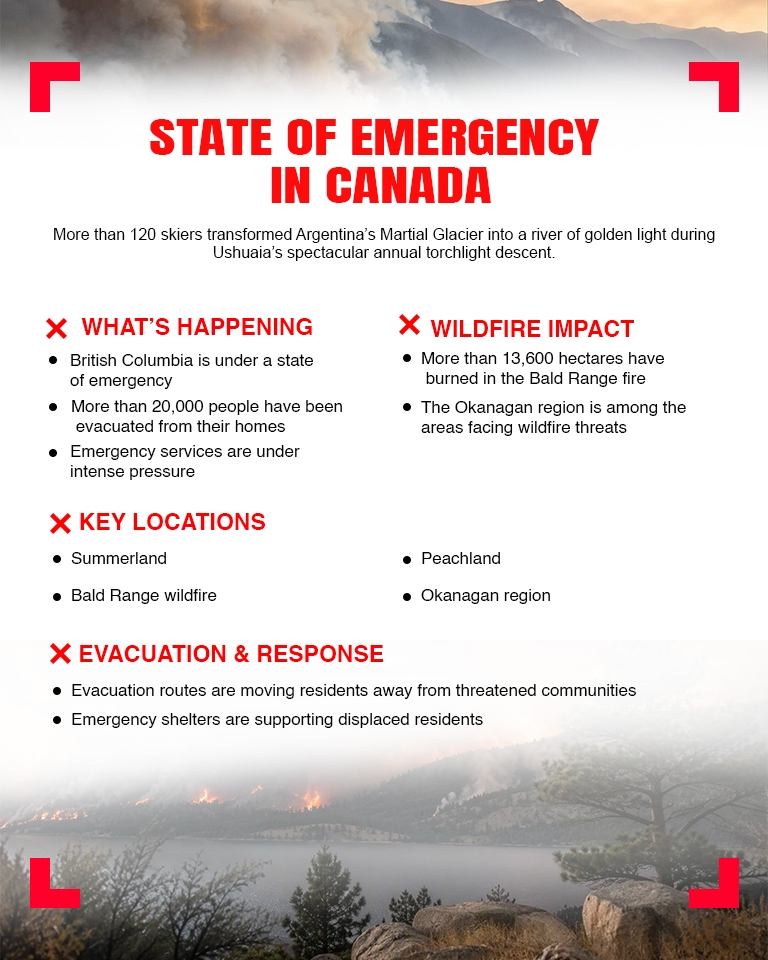
Canada’s western province of British Columbia remains under a state of provincial emergency after fast-moving wildfires swept through the southern interior, destroying properties, threatening communities and forcing more than 20,000 people from their homes in the largest evacuation event of the province’s 2026 wildfire season.
The emergency was declared on August 8 as the rapidly expanding Bald Range wildfire threatened communities around Summerland, Peachland and the Okanagan region. The blaze grew with extraordinary speed, fuelled by dry vegetation and dangerous fire conditions, leaving authorities scrambling to evacuate residents and protect homes, farms and critical infrastructure.
The crisis is part of a wider Canadian wildfire season that has seen hundreds of active fires across the country. Federal officials warned in August that elevated fire danger could persist through the remainder of the summer and into September in some regions.

Why British Columbia Declared an Emergency
The most immediate threat came from the Bald Range fire in southern British Columbia. By August 8, the uncontrolled blaze had expanded to approximately 9,500 hectares, or 23,500 acres, with evacuation orders affecting Summerland, Peachland and surrounding districts west of Okanagan Lake.

British Columbia Premier David Eby described the situation as extremely dangerous. One fire official compared the blaze’s explosive behaviour to “a bomb going off,” according to Eby. Flames were reported reaching around 100 feet into trees and extending much higher above them.
Even more alarming was the fire’s ability to influence atmospheric conditions around itself. Extremely intense wildfires can generate powerful convection and fire-driven weather, complicating firefighting operations and potentially helping fires spread further. Homes and other properties were lost, while some residents became trapped as conditions changed rapidly and required rescue. Agricultural areas were also affected.
The provincial emergency declaration gives British Columbia additional powers to coordinate its response. These can include controlling travel in affected areas, protecting essential supplies, supporting evacuations and preventing price gouging during the disaster. Importantly, this is a British Columbia provincial state of emergency, not a declaration of a federal national emergency covering all of Canada.

Thousands Evacuated as Firefighters Battle the Flames
More than 20,000 people across British Columbia had been forced to evacuate their homes by the time the provincial emergency was announced. Summerland, with roughly 12,000 residents, and Peachland, with around 6,500, were among the communities facing serious danger. Firefighters on the ground have been supported by aircraft dropping water and fire retardant as crews attempt to protect populated areas.
The scale of the evacuations has created challenges beyond fighting the flames. Authorities must provide temporary accommodation, transportation and emergency assistance while also managing road closures and ensuring that residents do not return to unsafe areas.
The Okanagan is particularly important economically. It is the centre of British Columbia’s wine industry and a major Canadian tourism and agricultural region. Damage to farms, vineyards, homes and tourism businesses could therefore continue to have financial consequences long after individual fires are controlled.
Canada’s Wider Wildfire Challenge
British Columbia’s emergency comes amid a broader national debate over Canada’s ability to respond to increasingly destructive wildfire seasons. Canada’s federal government said in August that overall 2026 wildfire activity remained below the recent five-year average at that point, but warned that significant fire danger would continue across parts of the country through late summer.
Hundreds of fires have nevertheless burned simultaneously during parts of the season, placing pressure on provincial firefighting resources. Canada’s vast geography makes the challenge particularly difficult. Wildfires can occur in remote northern forests hundreds of kilometres from major cities while simultaneously threatening densely populated communities elsewhere.
Fire seasons are also influenced by temperature, rainfall, wind, vegetation and drought. Long periods of hot, dry weather can leave forests highly combustible, while strong winds can transform relatively small fires into rapidly expanding emergencies. Climate change is an increasingly important part of the discussion because warmer conditions can increase the likelihood of severe fire weather and contribute to longer periods in which forests are vulnerable to burning.
Economic and Environmental Impact
The immediate financial cost of the 2026 British Columbia emergency is still being calculated. However, large wildfires can produce enormous economic losses through destroyed homes, infrastructure damage, disrupted businesses, emergency operations and insurance claims. The environmental consequences can be equally substantial. Fires destroy vegetation and wildlife habitat, release large amounts of carbon and generate smoke that can travel hundreds or even thousands of kilometres.
Wildfire smoke contains fine particulate matter that can affect air quality far beyond the actual fire zone, creating health concerns particularly for people with respiratory or cardiovascular conditions. There is also a difficult ecological distinction. Fire is a natural and necessary part of many Canadian forest ecosystems, helping regenerate vegetation. The problem arises when fires become exceptionally intense, threaten populated areas or occur under conditions that make them extremely difficult to control.
Is Canada Prepared for a New Era of Fire?
The emergency has again raised a larger question: does Canada have sufficient resources for increasingly complex wildfire seasons? Canada does not rely on a single national firefighting service. Provinces and territories hold primary responsibility for wildfire management, with federal assistance and international resources available when local capacity becomes overwhelmed.
Critics have argued that increasingly severe fire seasons require stronger national coordination and greater long-term investment in prevention, firefighting personnel, aircraft and emergency infrastructure. Prevention is equally important. Better forest management, prescribed burns, fire-resistant construction and vegetation management around communities can reduce vulnerability before a fire begins.
At the same time, governments face the difficult reality that it is impossible, and ecologically undesirable, to extinguish every wildfire across Canada’s enormous forests. The British Columbia emergency therefore represents more than one disastrous fire. It highlights the growing challenge of deciding how communities can coexist with wildfire in a warming climate. For thousands of displaced British Columbians, however, that long-term debate is secondary to the immediate task: returning home safely and discovering what remains after the flames.