
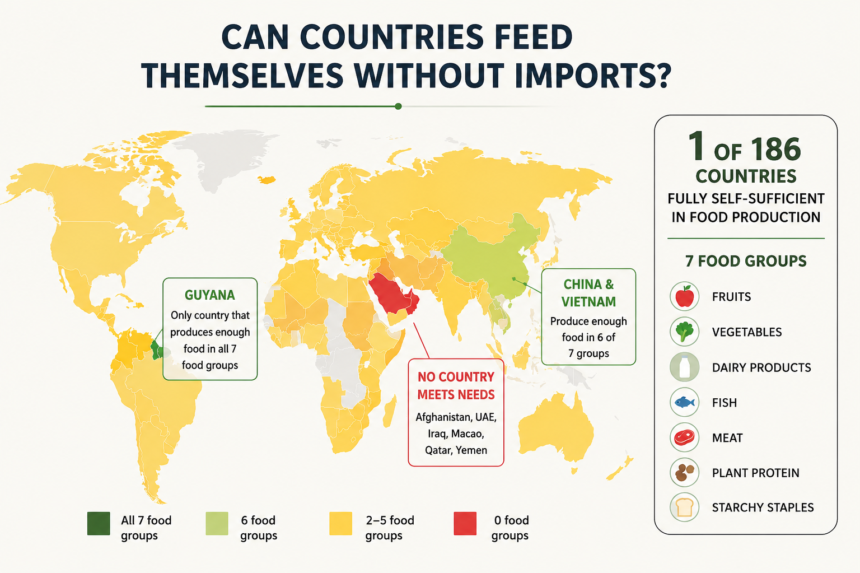
A global assessment of national food production has found that only one country, Guyana, produces enough food across all major nutritional categories to feed its population without depending on imports. The finding highlights how deeply the world’s food system relies on international trade and raises concerns about countries’ vulnerability to wars, extreme weather, export restrictions and disruptions to global supply chains.
The study, published in the journal Nature Food in 2025, examined agricultural production in 186 countries. Researchers compared the quantity of food produced domestically with the nutritional requirements of each country’s population. Seven major food groups were assessed: fruits, vegetables, dairy products, fish, meat, plant-based protein foods and starchy staples such as rice, wheat and potatoes.
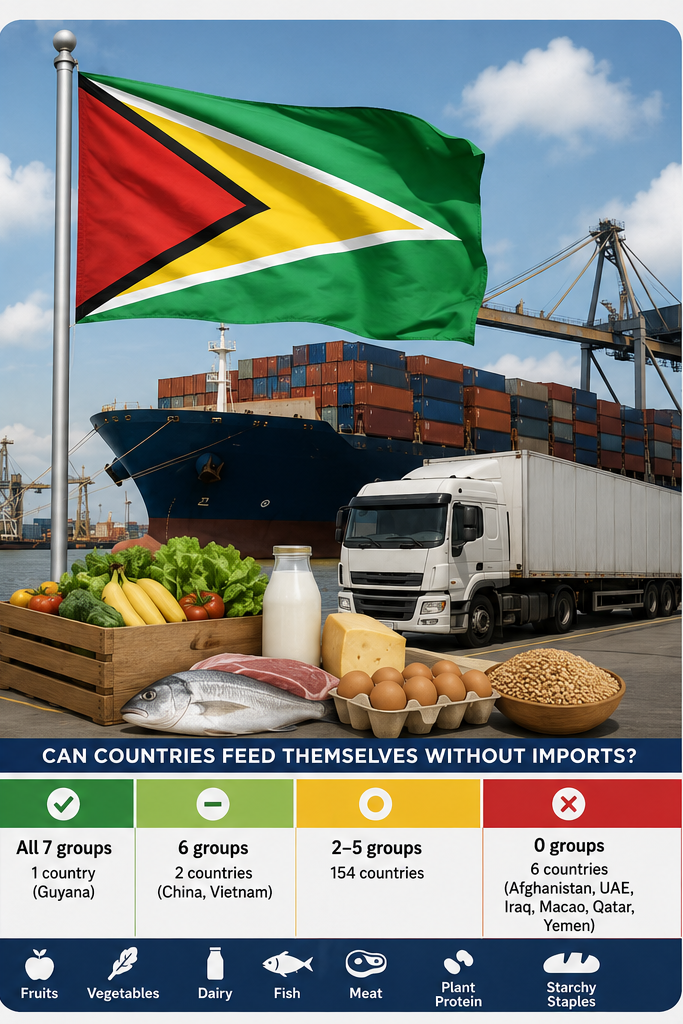
Guyana, a small South American country with a population of less than one million, was the only nation producing sufficient quantities in all seven categories. Its agricultural sector produces rice, sugar, fruits, vegetables, livestock and seafood, while its relatively small population means that domestic production can cover a wider range of nutritional needs.
China and Vietnam came closest to complete food self-sufficiency, producing enough food in six of the seven groups. However, even these major agricultural producers remain dependent on international markets for at least one important category. Overall, 154 of the 186 countries studied were capable of meeting their population’s needs in only two to five food groups.
At the other end of the scale, six countries and territories, Afghanistan, the United Arab Emirates, Iraq, Macao, Qatar and Yemen, were unable to produce enough food in any of the seven categories examined. Several of these countries have extremely dry climates, limited freshwater resources, restricted agricultural land or continuing political instability. They consequently depend heavily on imported food to meet the needs of their populations.
The results do not necessarily mean that people in Guyana enjoy better diets than those living elsewhere, or that all other countries are facing immediate food shortages. The study measures production capacity rather than affordability, distribution, food waste or equal access. A country may produce a large quantity of food while some communities still experience hunger because they cannot afford it or because supplies do not reach them.
Similarly, depending on imports is not automatically a weakness. International trade allows countries to obtain food that cannot be produced efficiently in their own climates. Northern European countries, for example, can import tropical fruit, while water-scarce states can purchase cereals from regions where rainfall and farmland are more abundant. Trade also gives consumers greater variety and allows agricultural producers to specialise in crops suited to local conditions.
However, researchers and food-security specialists warn that excessive dependence on a small number of suppliers can become dangerous during a crisis. The COVID-19 pandemic, Russia’s invasion of Ukraine, interruptions to Black Sea grain exports and climate-related crop failures have demonstrated how quickly transport problems or export restrictions can increase food prices. The research was widely reported as evidence that almost every country could face nutritional shortages if international trade were seriously disrupted.
Large and wealthy countries are not automatically self-sufficient. Population size, dietary demand and limited production of certain foods can force even agricultural powers to import substantial quantities. Smaller countries may also lack enough land to grow cereals, raise livestock and produce fruit and vegetables simultaneously. Climate, soil quality, water availability, farming technology, infrastructure and government investment all influence national production.
In my opinion, the findings should not be interpreted as an argument for ending food trade. Complete self-sufficiency may be unrealistic, costly and environmentally damaging for many countries. Attempting to grow water-intensive crops in deserts or clearing forests to expand farmland could create new environmental problems.
Instead, governments should treat diversified domestic production as a form of national resilience. Countries can strengthen food security by supporting local farmers, improving irrigation, reducing post-harvest losses, maintaining emergency grain reserves and importing essential products from several different partners rather than relying on a single supplier.
Guyana’s achievement demonstrates the value of combining agricultural diversity with manageable domestic demand. Nevertheless, its position is unusual and cannot simply be copied by countries with different climates, populations and natural resources.
The broader message is that modern food security depends on balance. Domestic agriculture provides resilience, while international trade supplies variety and fills unavoidable production gaps. With geopolitical tensions and climate shocks placing increasing pressure on food systems, countries must ensure that imports remain a useful connection to the world, not a single point of failure.
![Infographic about the Supreme Court's 6-3 decision rejecting Trump's bid to end birthright citizenship, with courthouse backdrop and Trump silhouette on the left and a baby wrapped in an American flag on the right.] ,](https://thewashingtoneye.com/wp-content/uploads/2026/07/ChatGPT-Image-Jul-20-2026-12_27_09-AM-150x150.png "birthright citizenship us - washington eye")