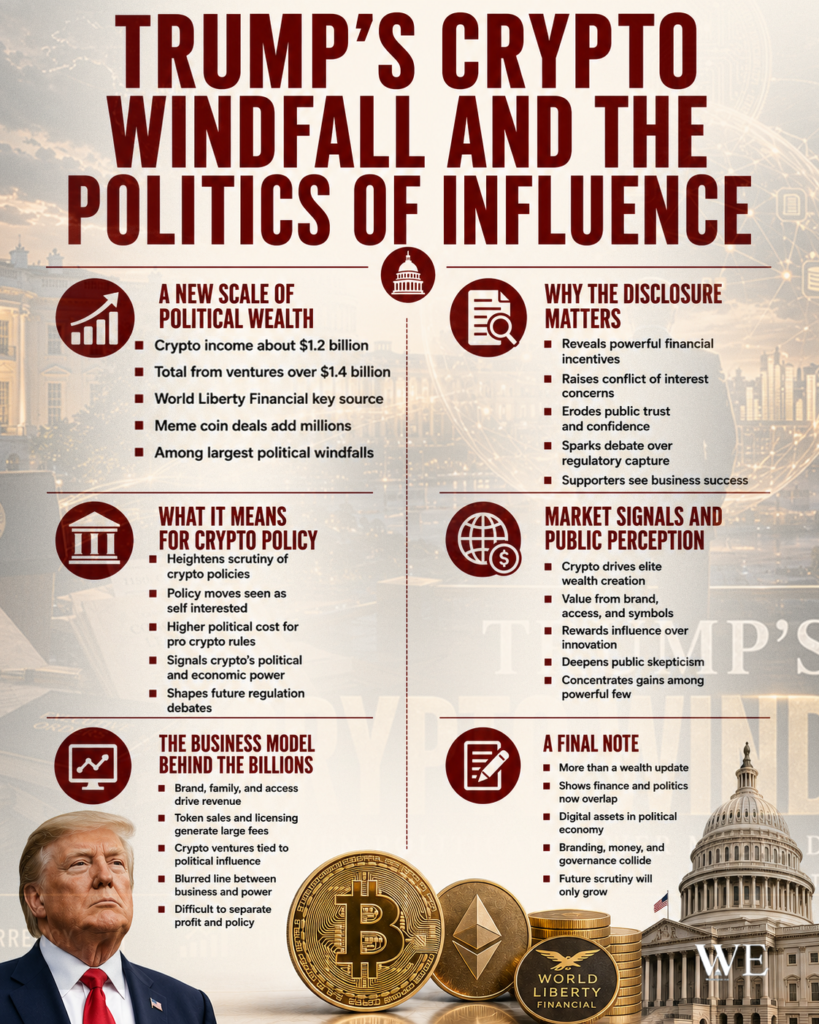
A new financial disclosure suggests that Donald Trump took in about $1.2 billion from cryptocurrency businesses last year, a figure that is striking not only for its size but also for what it signals about the growing overlap between political power and digital asset wealth. The report points to a business model in which the president’s brand, family ties, and policy environment appear to be deeply intertwined with the crypto sector.
A New Scale of Political Wealth
The filings indicate that crypto has become one of the most lucrative parts of Trump’s financial portfolio, with income flowing from ventures such as World Liberty Financial and meme coin related arrangements. Reuters reported that the total from crypto ventures exceeded $1.4 billion, while other reporting described the crypto portion as roughly $1.2 billion, underscoring the broad agreement that the amount is exceptionally large even if the exact breakdown varies by outlet. That level of income matters because it places Trump in a category where personal business success is no longer separate from policy debates about the industry itself.
Why the Disclosure Matters
The main significance of the filing is not just the money, but the incentives it reveals. When a sitting president or former president benefits so heavily from a sector that is also shaped by federal regulation, public trust can become harder to maintain, even absent any proven wrongdoing. For critics, the disclosure strengthens concerns about conflicts of interest and regulatory capture; for supporters, it may be presented as evidence that the crypto economy has become a mainstream and profitable part of American business.
What it Means for Crypto Policy
This disclosure is likely to intensify scrutiny of how the administration approaches digital assets. If an industry contributes so substantially to the president’s income, even routine policy moves can be read through the lens of self interest, which raises the political cost of pro crypto regulation. At the same time, the filing may reassure some investors that crypto remains politically powerful and commercially credible, especially when tied to high profile endorsements and brand recognition.
Market Signals and Public Perception
The earnings also show how quickly crypto has moved from a speculative niche to a vehicle for elite wealth creation. The scale of the reported income suggests that value is being generated less through ordinary adoption than through reputation, licensing, token sales, and political symbolism. That pattern could fuel public skepticism about whether the industry rewards innovation or simply concentrates gains around influential figures.
A Final Note
Taken together, the disclosure is more than a personal wealth update. It is a window into how digital assets are becoming embedded in political economy, where finance, branding, and governance increasingly overlap.