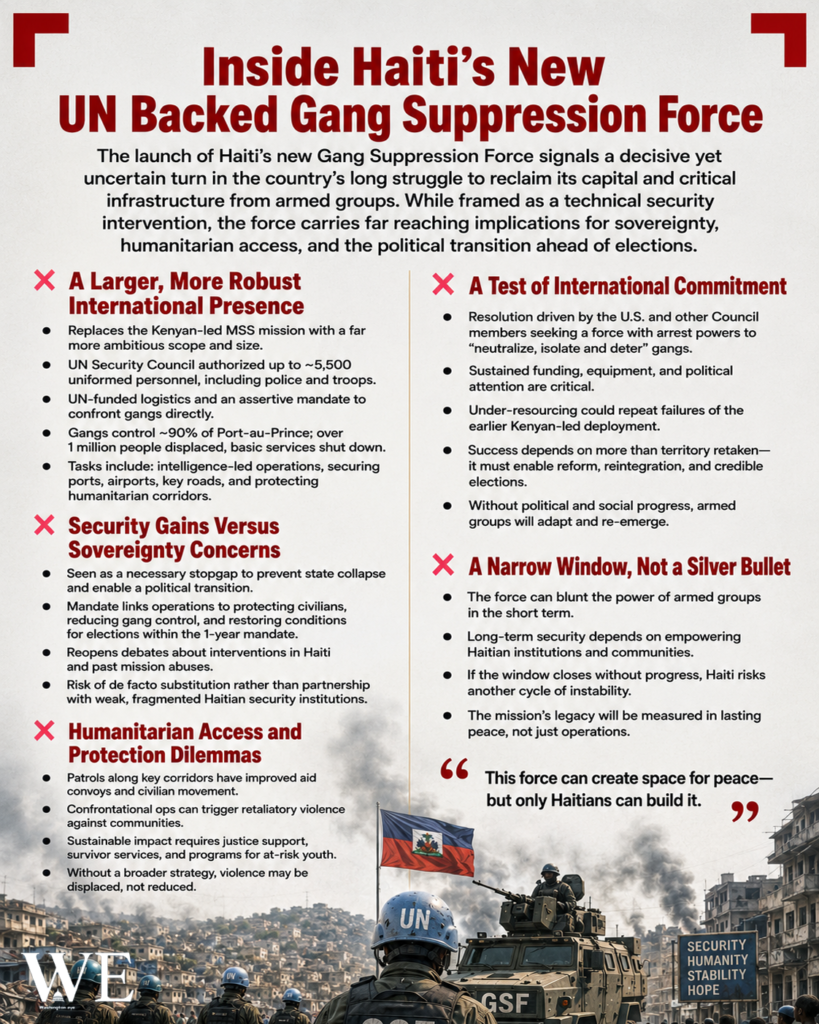
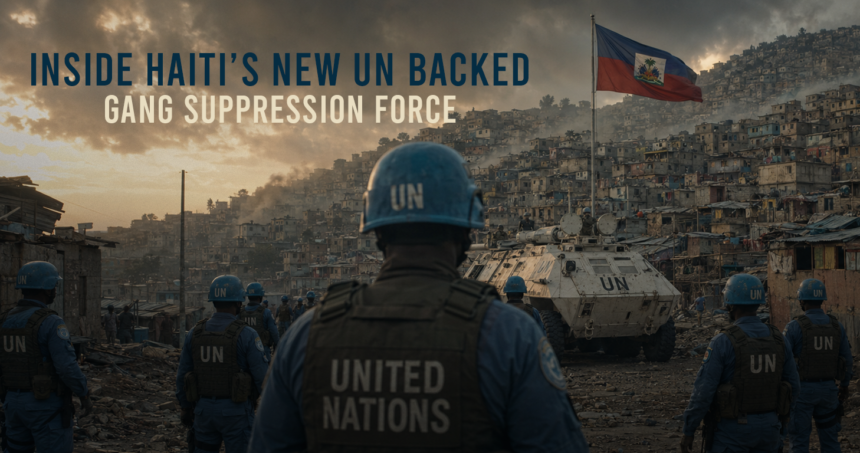
The launch of Haiti’s new Gang Suppression Force signals a decisive yet uncertain turn in the country’s long struggle to reclaim its capital and critical infrastructure from armed groups. While framed as a technical security intervention, the force carries far reaching implications for sovereignty, humanitarian access, and the political transition ahead of elections.
A Larger, More Robust International Presence
The Gang Suppression Force replaces and absorbs the earlier Kenyan led Multinational Security Support mission, but with a far more ambitious scope and size. The UN Security Council authorized up to about 5,500 uniformed personnel, including police and troops, backed by UN funded logistics and a more assertive mandate to confront gangs directly rather than merely supporting Haitian police from the sidelines.
This expansion responds to a context in which gangs are estimated to control roughly 90 percent of Port au Prince, with violence displacing more than one million people and shutting down basic services. The force is tasked with intelligence led operations to neutralize gangs, secure ports, airports, and key roads, and protect humanitarian corridors that are currently exposed to extortion, kidnapping, and blockade.
Security Gains Versus Sovereignty Concerns
Supporters inside and outside Haiti see the force as a necessary stopgap to prevent state collapse and create space for a political transition. The mandate explicitly links operations to the protection of civilians, the reduction of territorial control by gangs in the capital and Artibonite, and the restoration of conditions for credible elections within the one year initial mandate.
Yet the deployment reopens long standing debates about international interventions in Haiti. Past missions were criticized for abuses and for entrenching dependence on foreign security actors instead of building accountable local institutions. Although the new force is supposed to operate jointly with the Haitian National Police and armed forces, the risk of de facto substitution rather than partnership remains, especially given the weakness and fragmentation of Haitian security institutions.
Humanitarian Access and Protection Dilemmas
Humanitarian agencies view the Gang Suppression Force as both an enabling and a complicating factor. On one hand, patrols based near crucial road corridors have begun to push gangs away from some supply routes, allowing aid convoys and displaced civilians to move with reduced risk. On the other hand, more confrontational operations can provoke retaliatory violence against communities suspected of supporting the state or international actors.
Protection analysis from humanitarian clusters emphasizes that security operations will only be sustainable if paired with support for specialized justice units, survivor centered responses to sexual violence, and social programs targeting at risk youth who are vulnerable to gang recruitment. Without this broader strategy, tactical gains in certain neighborhoods may simply displace violence rather than reduce it.
A Test of International Commitment
Politically, the new force is also a test of whether external backers will sustain engagement beyond the first year of operations. The resolution establishing the Gang Suppression Force was driven in part by the United States and other Council members who argued that a more capable contingent with arrest powers was needed to “neutralize, isolate and deter” gangs. Analysts note that if funding, equipment, and political attention wane, the mission could face the same under resourcing that limited the earlier Kenyan led deployment.
For Haiti’s transitional authorities, success will be measured not only in territory retaken but in whether the force helps create conditions for institutional reform, reintegration of former fighters, and credible elections that Haitians view as legitimate. If these political and social dimensions lag behind the security push, the country risks another cycle in which foreign troops depart while armed groups adapt and re emerge.
In that sense, the Gang Suppression Force is less a solution than a narrow window of opportunity: it can blunt the power of armed groups, but long term security will depend on whether Haitian institutions and communities are empowered to fill the vacuum it creates.