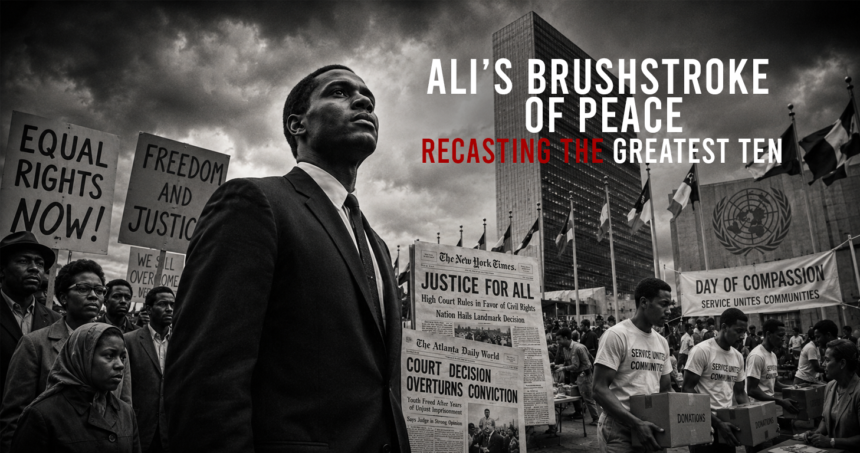
A watercolor of the United Nations headquarters, painted decades ago by Muhammad Ali and quietly hanging in New York, has become an unexpected focal point of global reflection ten years after his death. In the UN framing of this anniversary, Ali is remembered less as a heavyweight champion and more as an informal theorist of peace who linked personal service to collective security.
A Painting as Political Argument
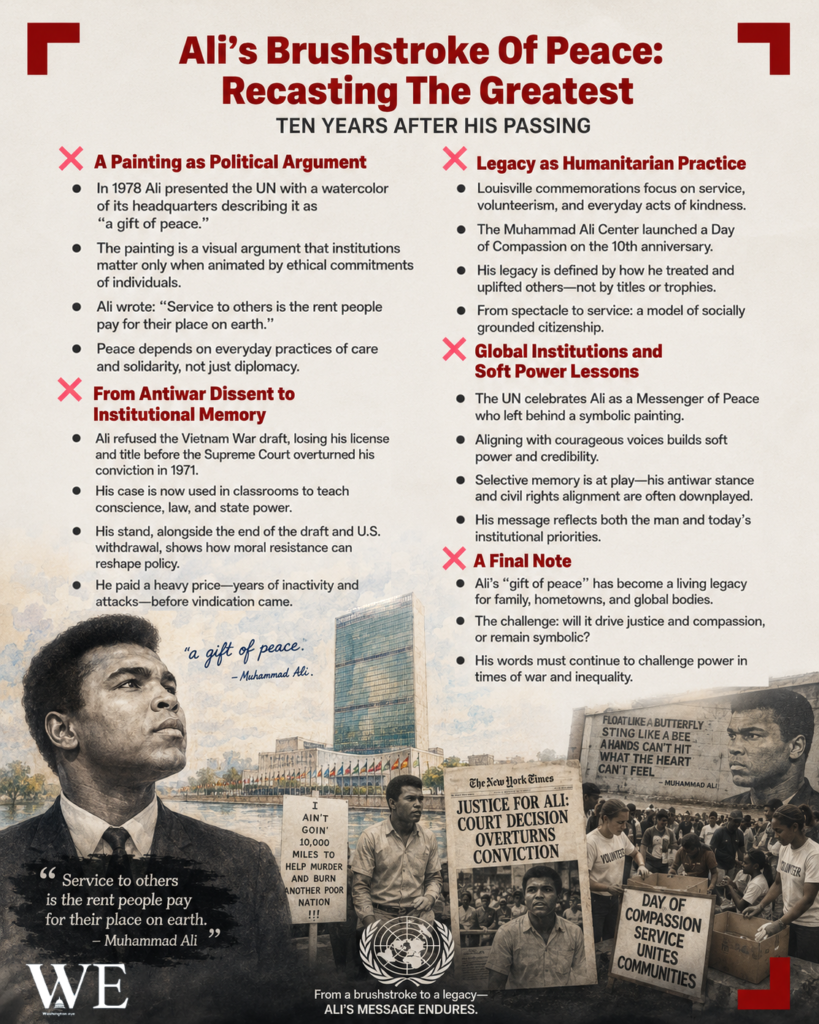
In 1978 Ali presented the UN with a watercolor of its headquarters describing it as “a gift of peace,” a phrase the organization has revived in its commemorative coverage this month. The work now functions as a visual argument that international institutions matter only when animated by the ethical commitments of individuals, not by architecture or procedure alone.
The UN highlights a line from the accompanying letter, in which Ali wrote that service to others is the rent people pay for their place on earth, a formulation that merges spiritual duty with civic responsibility. Read within today’s context of prolonged conflicts and widening inequality, the message suggests that peace cannot be outsourced to diplomats but depends on everyday practices of care and solidarity.
From Antiwar Dissent to Institutional Memory
Ali’s emergence as a symbol of peace is inseparable from his refusal to be drafted into the Vietnam War, a stance that cost him his boxing license and world title before the US Supreme Court overturned his conviction in 1971. Current educational initiatives developed by the Muhammad Ali Center and the University of New Mexico use this legal battle as a case study on the relationship between conscience, law, and state power, inviting students to examine how individual resistance can reshape public opinion and eventually policy.
By situating Ali’s case alongside the end of the draft and US withdrawal from Vietnam, these programs implicitly argue that moral objections articulated from below can alter the strategic calculus of great powers. Yet they also underline the asymmetry of costs, since Ali absorbed years of enforced inactivity and reputational attacks before judicial vindication arrived.
Legacy as Humanitarian Practice
Commemorations in his hometown of Louisville this week have centered less on Ali’s victories in the ring and more on initiatives encouraging volunteerism and everyday acts of kindness. The Muhammad Ali Center launched a Day of Compassion to mark the tenth anniversary of his death, urging residents to translate admiration for the boxer into concrete service in local communities.
Family members and center officials frame this turn to humanitarian practice as the core of his legacy, stressing that his greatness lay in how he treated and uplifted those around him rather than in his titles. This shift from spectacle to service indicates a broader recalibration of what counts as political impact, recasting Ali as a model of socially grounded citizenship rather than only a charismatic dissenter.
Global Institutions and Soft Power Lessons
For the UN, celebrating Ali as a Messenger of Peace who left behind a symbolic painting offers a way to humanize an often criticized institution while linking its brand to courage and moral clarity. The narrative underscores that multilateral organizations gain soft power when they align themselves with figures who challenge, rather than simply echo, prevailing state policies.
At the same time, the selective memory involved is politically instructive. Focusing on Ali’s universalist language of service and compassion can obscure the sharper edges of his antiwar critique and his alignment with Black freedom struggles, elements that remain more contentious in contemporary debates on security and protest. The way his message is curated today thus reveals as much about current institutional priorities as it does about the man himself.
A Final Note
Ten years on, the “gift of peace” that Ali offered the UN has evolved into a flexible repertoire of meanings, deployed by family, hometown institutions, and global bodies alike. Whether this legacy deepens commitments to justice as well as compassion will determine if his words function as mere commemoration or as a continuing challenge to how power is exercised in times of war and inequality.